Christian hypocrisy regarding Aisha?
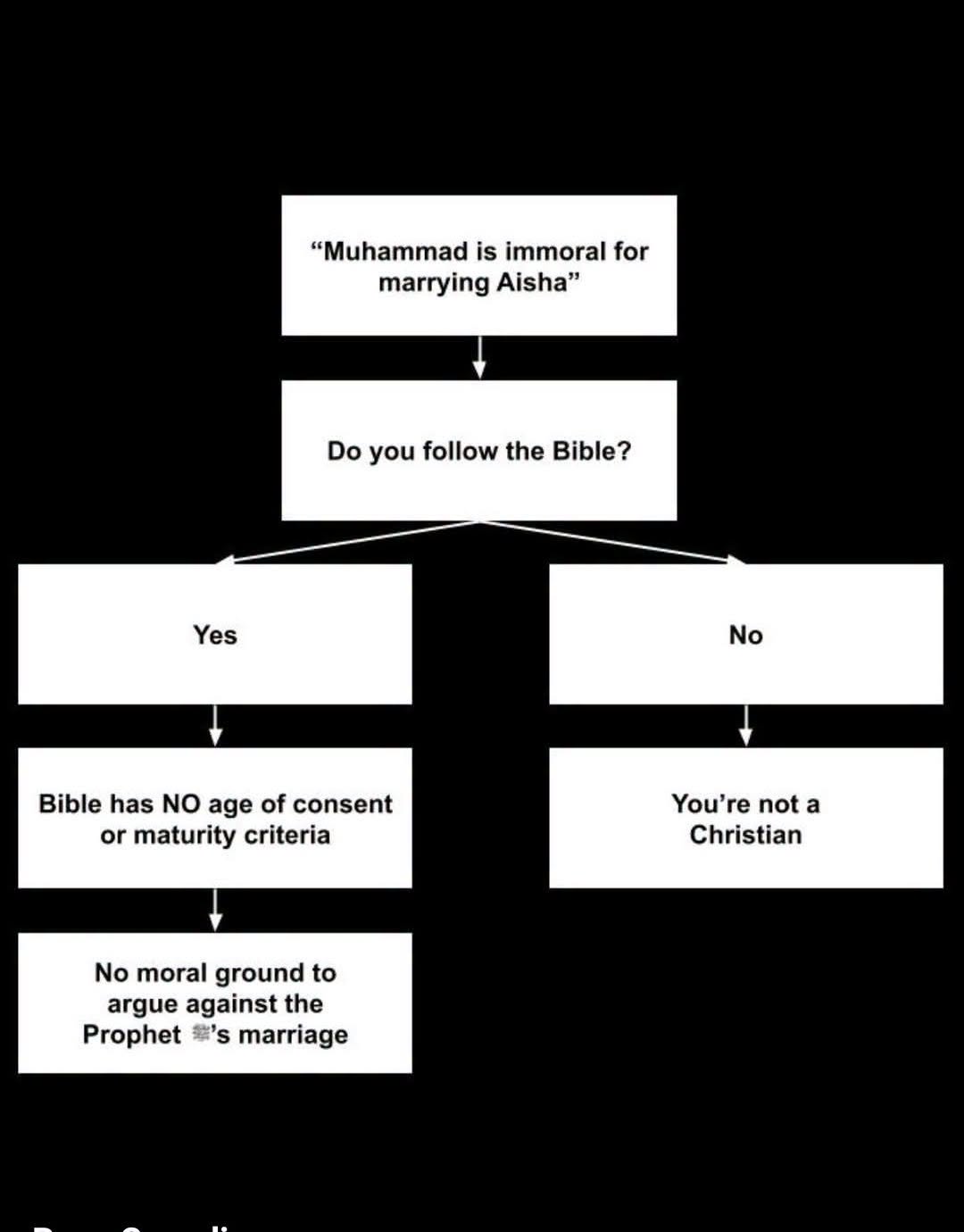
This flowchart commits several logical fallacies…
1. False Dilemma
It presents only two options:
- You follow the Bible, therefore you can’t criticize Muhammad.
- You don’t follow the Bible, therefore you’re not a Christian.
Those are not the only possibilities. A Christian can follow the Bible and not reach your conclusion, particularly if they don’t hold to Sola Scriptura. For example, they can include natural moral reasoning and historical evidence to evaluate any historical figure.
2. Non Sequitur
Even if the Bible never explicitly states an “age of consent,” it does not follow that every marriage at every age is therefore morally acceptable. That’s like saying: “The Bible never gives a speed limit, therefore reckless driving cannot be immoral.”
3. Argument from Silence
The argument assumes: “Because Scripture doesn’t explicitly prohibit X, Scripture approves X.” but silence is not approval The Bible never mentions heroin, identity theft, or child labor either, yet Christians can still conclude these are wrong by applying biblical principles.
4. Category Error
The Bible is not primarily writing a modern civil law code with every possible regulation. Christian morality applies Christian principles to situations the Bible never explicitly names.
5. False Equivalence
The comparison ignores a major theological difference – Christians do not believe every action recorded in Scripture is morally exemplary. The Bible records David’s adultery, Solomon’s polygamy, Jephthah’s vow, and many other sinful actions without approving them.
By contrast, many Muslims regard Muhammad as the perfect moral example for all generations (Qur’an 33:21). Therefore, questions about Muhammad’s actions carry a different theological significance than merely asking whether something appears in biblical history.
6. The Historical Question Isn’t Addressed
The chart never actually answers the criticism: Was consummating a marriage with Aisha when she was very young morally right?