Tell them about “the cells”…

Today’s post is one of those posts which I’m writing purely for my own benefit. Who said this has to be selfless?! I’m hoping that, in the process of writing this, that the information will stay in my brain, or at the very least, make it easier for me to find when I forget it… 🙂
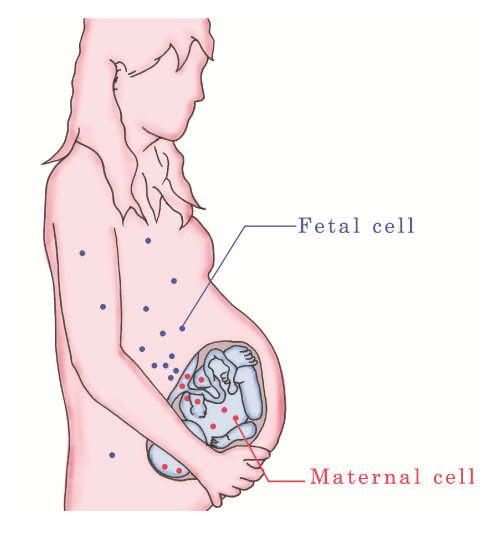
FMcIf any of you have heard Fr. Donald Callaway give a talk, you will have almost certainly heard him mention at some point something called Fetal Microchimerism, the biological process whereby cells from a fetus pass through the placenta into the mother’s own body (and vice versa).

The amazing thing about this process is that these cells have been shown to persist not only beyond pregnancy, but have even been found to remain in the mother’s body for decades afterwards. As far as I can tell, the scientific community is uncertain as to the consequence of the presence of these cells, with some suggesting that this is a source of potential disease, while others suggest that the child’s cells actually help to defend the mother.

When speaking about Fetal Microchimerism, Fr. Callaway reflects upon the intimate nature of the connection between mother and child. Even after a child has grown up, or even in the tragic cases of miscarriage or abortion, through Fetal Microchimerism, part of the child lives on in the mother.

Of course, where Fr. Callaway really goes to town is in the application of this biology to the area of theology. If this process is found in normal human pregnancies, then it is more than possible that this took place during the Blessed Mother’s pregnancy with Jesus. This would mean that some of the Saviour’s cells passed to His mother and remained there. The Lord’s human nature lived on in Mary’s body, even as He lay in the grave and even after He rose again and ascended into Heaven.

Not only that, if it is true that the child’s cells come to protect the mother from disease, then this has implications for Mary’s Assumption/Dormition, as well as providing a beautiful foreshadowing of the Eucharist, whereby Jesus gives us His Body, in the words of St. Ignatius of Antioch, as the “medicine of immortality”.


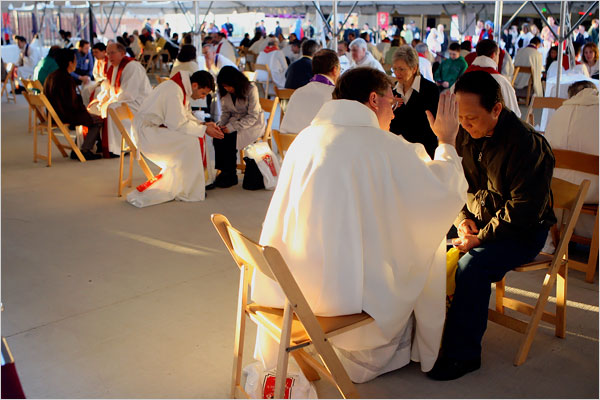
Quick Apology: Why confess to a priest?

Objection

Today’s “Quick Apology” concerns a very common objection heard by Catholics from Protestants…

“Why do Catholics confess their sins to a priest? He’s just a man. Why not confess your sins to God directly?”

Response

Obviously, a question like this truly deserves thorough theological treatment. However, since these are quick apologies, these are the points I typically try to make:

1.  Nowhere in the Bible is confession to God through a priest explicitly forbidden. In fact, Scripture explicitly encouraged to confess to other humans (James 5:16).

2. In the Old Covenant, God set up a priesthood for the forgiveness of sins (Leviticus 5).

3. Following this pattern, in the New Covenant Jesus grants His apostles the particular grace and authority to forgive sin:

“He breathed on them and said, ‘Receive the Holy Spirit. Whoever’s sins you forgive they are forgiven, whoever’s sins you retain, they  are retained'” – John 20:20-23

Why grant this power unless it is to be used? Through exercising this gift, Church leaders are entrusted with a “ministry of reconciliation” (2 Corinthians 5:18) and to act “in persona Christi” (2 Corinthians 2:10).

However, in addition to these points, when answering the above objection, I try to include a little testimony about the healing I’ve received through the Sacrament Confession. I’ve often found this more effective and lead to more productive conversations than simply giving above the arguments.

confession

The Historicity of Jesus: A Spirited Debate

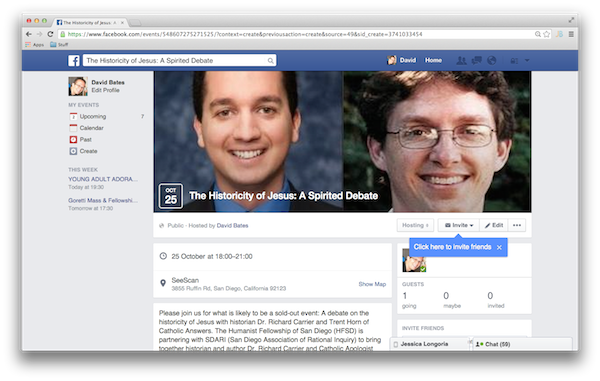
A while back, I posted about Catholic apologist Trent Horn’s debate with Dan Barker on the subject of atheism, as well as his debate with Cecili Chadwick concerning abortion. Well, later this month Trent is going to be debating Dr. Richard Carrier on the historicity of Jesus. You can register for tickets here. Since I couldn’t find one, I also created a Facebook event:

Screen Shot 2014-10-02 at 12.37.48 PM

This debate should be particularly interesting since Dr. Carrier is a prominent Jesus Mythicist and, to the best of my knowledge, the only historian with a PhD in Ancient History who casts serious doubt of Jesus’ existence. He’s published a couple of books on the subject where he explains why he thinks the scholarly consensus is wrong and what historical methods should be used instead.

If you’ve been to the other debates which Trent has done, you’ll know that this is sure to be a charitable and engaging debate. See you there 🙂

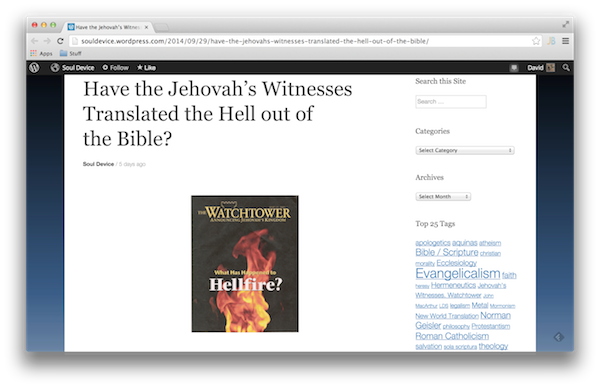
Sitting down with a Jehovah’s Witness

So, as many of you know, a couple of weeks ago I had Jehovah’s Witnesses (JW) scheduled to visit my home. I had already received two rounds of visits from them but had not yet managed to get them across my threshold. However, on their previous visit they had promised that next time they would have time to come in and have a proper chat.

I had received my first visit about a month earlier when two female JWs had called. During our discussion on the doorstep, I had spoken a little bit about my reversion to Catholicism and about how the question of the canon had played an important part in my return, being rather unimpressed with the various Protestant explanations as to the Bible’s Table Of Contents. Since JWs are distinctly set apart from Protestants, I asked the ladies on my doorstep how they would justify the contents of the Biblical canon. They had no explanation, but said that they would find out and get back to me.

Several weeks later, two gentlemen rang my doorbell, saying that they had heard from their associates that I was interested in knowing about the “hidden” books of the Bible. I explained that my question was not about the deuterocanon/apocrypha per se, but rather about the Biblical canon as a whole. How did they know the right books were in the Bible? How did they know that there were no wrong ones included and no books missed out? Unfortunately, they said that they didn’t have time to talk with me there and then, but they booked an appointment for the following week.

In today’s blog post I’d like to explain what happened on this next visit and the rather interesting turn of events towards the end…

Tea_Feature

Read more

1 172 173 174 175 176 322