Come Holy Spirit!
 Happy Pentecost! How about a short reflection from Raniero Cantalamessa, one of my all-time favourite people, who also happens to be the Preacher to the Papal Household?
"We are travellers…not yet in our native land" – St. Augustine
Happy Pentecost! How about a short reflection from Raniero Cantalamessa, one of my all-time favourite people, who also happens to be the Preacher to the Papal Household?
A while ago, during a discussion in the comment section of this blog, I made the assertion that the historic Church of Christianity was the Catholic Church. A non-Catholic disputed this claim, asserting that the Catholic Church only came into existence with the reign of the Emperor Constantine.
In response to this claim, I shared with her my post entitled Before 300: Pre-Constantinian Christianity, where I provide evidence for twenty-one doctrines which were believed by Christians prior to AD 300 and the rise of Constantine. The original purpose of that post was not only to show that the Catholic Church was in existence long before Constantine arrived on scene, but also to provide non-Catholics with a simple way to compare their own beliefs to that of the early Christians.
After reading that article, my internet friend appeared to concede that the Catholic Church did actually exist from the earliest of times. Wonderful! However, despite denying its existence only moments before, she now claimed that the Catholic Church had persecuted the “true” Christians in the early centuries! I’ve heard similar claims in the past made by other Protestants as well as Muslims, in an effort to explain why the belief system that we find in the Early Church is incompatible with their own.
Today I would like to examine the assertion that the Catholic Church suppressed “true” Christianity in the early centuries and I will attempt to dismantle it using an argument which may be referred to as “The dog who never barked”…
Over at Seton Magazone, John Clark posted an article entitled “7 Confessions of a Catholic Blogger”. They’re all spot on…

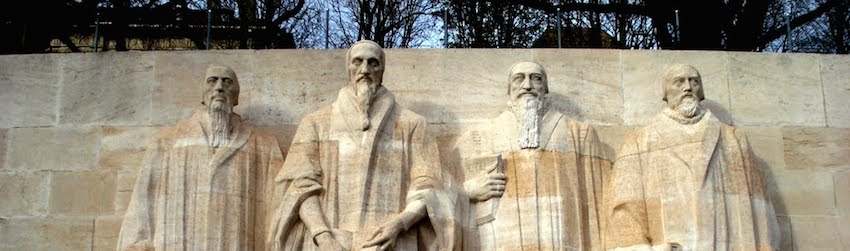
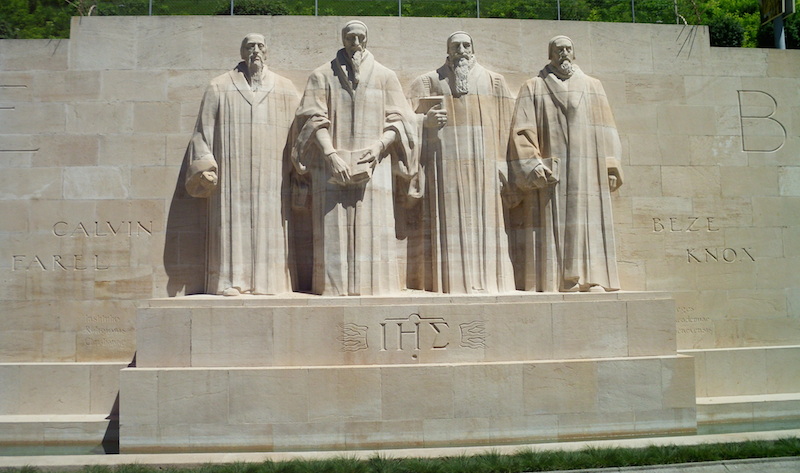
When Catholics critique the contradictory beliefs held in different parts of the Protestant world, we are often told that “Protestants agree on all the essentials”. A statement like this, of course, this begs two questions:
1. Which doctrines should be considered “essential” and which “non-essential”?
2. Who gets to make that categorization?
The second question is particularly important. Who gets the final say as to what is “essential” and what is “non-essential”? After all, what happens when two Protestants disagree on what is “essential”?
To pick an example from the dawn of the Reformation, Luther and Zwingli came into conflict concerning their respective understandings of the Eucharist, so much so that this ruptured their relationship. Could we still say that these two fathers of the Reformation agreed on “essentials”?
Read more
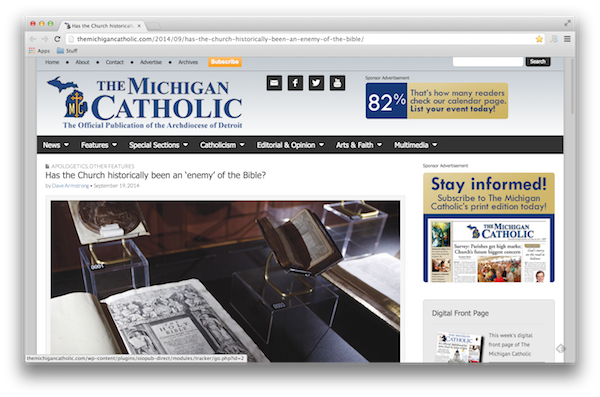
A while back I did a post where I gave a “Quick Apology” concerning the charges that the Catholic Church chained Bibles. I came across this article from Dave Armstrong this week where he gives a fuller response:
A little while ago, I was discussing with a Protestant the issue of baptism in the Early Church. The exchange was quite typical in that he rejected the beliefs of the Early Church, choosing instead to trump the witness of history with his own personal interpretation of the Scriptures.
In response to this, I did something unusual, departing from my usual strategy. Rather than trying to demonstrate to him that the Early Church was correct, I asked him, in his opinion, why did the Early Church get it all so wrong? After all, the question of whether baptism washes away sin isn’t some trivial doctrine, but one which relates to the question of our very salvation!
 I’ve written before about why you should encourage your son to become an altar boy, but today I wanted to share a great video I found describing how he can live out this ministry to the best of his ability: