I was in an apologetics discussion group and someone posted the following:
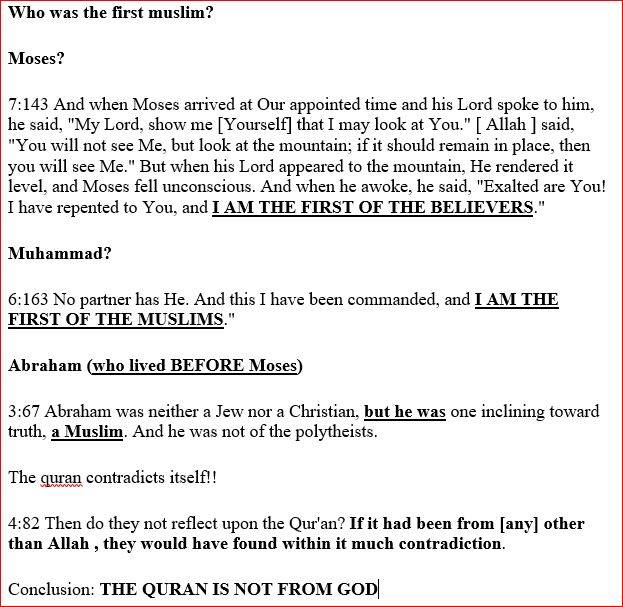
I told the members of the group that I didn’t like this line of argumentation. Several people responded by saying that since the Qur’an claims that there are no contradictions within its pages, the passages cited above were clear evidence that the book is not of divine origin.
In reply, I explained that they were interpreting the Qur’an in a way which forced a contradiction and then declared it to contain contradictions. I pointed out that they would never accept a Muslim exegeting the Bible in this way.
Even without digging into the context of these passages from the Qur’an, it seemed immediately obvious to me that the statements could very easily be harmonised by simply recognising that “first of” can mean “foremost among”. This would mean that, according to the Qur’an, Moses declared himself to be foremost among the believers of his time and Muhammad made the same claim for himself in his own generation. Interpreting the passages in this way eliminates the contradiction.
There are many apparent contradictions in the Bible, but careful exegesis can show this not to be the case. If you wouldn’t accept bad methodology when interpreting the Bible, you shouldn’t force it on the Qur’an….
I don’t think it’s news that the Catholic Church is in a mess at the moment. This prompts many non-Catholics to ask: why are you still Catholic. Listen to Joe Heschmeyer and Chloe Langr from The Catholic Podcast give their answer by clicking on the image below:
If you have read any material related to Islamic apologetics, you’ll no doubt be familiar with the names Ahmed Deedat and his one-time pupil, Zakir Naik. I came across a video on YouTube of Deedat tutoring Naik. He was supposedly teaching him how to refute Christianity, using training materials apparently known as “The Combat Kit”.
This teaching session is extremely enlightening and I would like to walk through the video and break down the advice Sheikh Deedat gives to his pupil in this video. I thought this would be a worthwhile exercise because I think it demonstrates some of the fundamental misunderstandings of Christianity held by even well-known Muslim apologists, as well as showing flaws in their methodology.
Jihadic Judo?
Deedat’s English is rather stilted and, although his voice is calm, what he says at the start of the video isn’t exactly pleasant.
“[The Christian] is trained…he smells a rat…the shit…he wants to change the subject...”
Ahmed Deedat
Deedat tells Naik that, when disputing with Christians, he should get the Christian to hand over his Bible and use it to show him that Christianity is false.
“[Tell the Christian] ’Give it here’…. don’t be shy… their women…they don’t care a damn. This is the book, want to push it down your throat. They want to steal your Imam.”
Ahmed Deedat
Immoral Prophets?
Deedat then alludes to Genesis 19:30-38 and tells Naik to use it to shame the Christian. Deedat says this because in that passage, Lot’s daughters get their father drunk and sleep with him in order to get pregnant. Naik seems to think that this scandalous event is some kind of refutation of the Old Testament. However, it’s not for two reasons:
1. He’s comparing it against an Islamic standard The doctrine of “Isma” in Islam says that all Prophets are sinless. Now, if you hold that belief, it’s understandable why you might be scandalized by this passage, as well as many others in the Old Testament. However, neither Jews nor Christians hold to this doctrine! Although the prophets were indeed used by God, they were also flawed human beings, so their sin shouldn’t really surprise us. Why would he expect Christians to judge Old Testament prophets and patriarchs by a standard exclusive to Islam?
2. He’s performing a basic error in Biblical interpretation Simply because the Bible records something, does not mean that it condones it! This is basic exegesis. Some texts are prescriptive while others are simply descriptive! Some passages tell us about the good things that we as readers should do, but other passages tell us about the good and bad actions of Biblical characters.
For example, just because King David committed adultery and murder, doesn’t mean that God endorsed his actions or wants Christians to do likewise! What’s funny is that Deedat repeatedly a question:
“Ask the Christian: what is the moral, what is the lesson?”
Ahmed Deedat
Clearly the answer is: don’t get drunk and don’t commit incest! Deedat asks whether the Christian would read such a passage to his mother or daughter. This is a strange question, implying that a text has to be PG-13 in order for it to be the Word of God.
Next in the video, we then see another man enter the room, calling out “Salaam alaikum!”. Rather than giving the customary response (“Wa-Alaikum-Salaam”), Deedat sends him away with “I’m busy now!” and then moves on to the next Bible passage which scandalises him…
Son rapes his mother?
Deedat then gets Naik to turn to Genesis 35:22 and to write in large letters above it “Son rapes his mother”. If you look in the text, you’ll see the following:
While Israel dwelt in that land Reuben went and lay with Bilhah his father’s concubine; and Israel heard of it.
Genesis 35:22
Naturally, Deedat makes the same mistakes as noted in the previous section, concerning the sinlessness of Biblical characters, as well as the difference between prescription and description.
Of course, there are three other problems with describing Genesis 35:22 as “Son rapes his mother”. Firstly, the text does indeed say that fornication takes place, but there’s nothing to suggest that it was a violent act of rape. Secondly, as the text says, Bilhah was Israel’s concubine, not wife. Finally, Reuben’s mother was Leah, not Bilhah. Deedat attempts to justify his assertion by saying that “Concubine and wife mean the same thing”.
What exactly is Deedat’s main problem with this passage? After all, didn’t Muhammad’s adopted son divorce his beautiful wife Zaynab so that Muhammad could marry her? What is the real problem concerning Reuben in Genesis 35:22? Deedat goes on and explains.
“[People told Jacob] he screwed your wife and [Jacob] didn’t lose his temper, he didn’t spank him, he didn’t scold him and God Almighty didn’t give him AIDS, Syphilis or Gonorrhoea, nothing. That’s all. The man didn’t react. Nothing. There is not one word… It starts and end… The subject changes”
Ahmed Deedat
Once again, Deedat demonstrates his ignorance of what is happening here, as well as his Biblical knowledge concerning the consequences of Reuben’s sin.
In this passage, Reuben is asserting his dominance. He is attempting to ensure his continued authority over his other siblings. Did Reuben suffer consequences for his sin? He did indeed, but we can’t simply look to the next verse to discover them. We must look later in the narrative, namely at the end of his father’s life. Reuben’s actions result in his being deprived of the blessing and the inheritance from Jacob/Israel that he would have naturally received as the first-born son:
[On his deathbed, Jacob said]: “Reuben, you are my first-born, my might, and the first fruits of my strength, pre-eminent in pride and pre-eminent in power. Unstable as water, you shall not have pre-eminence because you went up to your father’s bed; then you defiled it—you went up to my couch!”
Genesis 49:3
Reuben’s birthright instead passed to his younger brother, Joseph:
The sons of Reuben the first-born of Israel (for he was the first-born; but because he polluted his father’s couch, his birthright was given to the sons of Joseph the son of Israel, so that he is not enrolled in the genealogy according to the birthright; though Judah became strong among his brothers and a prince was from him, yet the birthright belonged to Joseph)…
1 Chronicles 5:1-2
Once again referring Naik to his “Combat Kit” study materials, Deedat moves onto a supposed Biblical contradiction…
Wife or Concubine?
In an attempt to demonstrate a contradiction, Deedat first refers to is Genesis 25 where the text speaks about Abraham’s new wife, Keturah:
Abraham took another wife, whose name was Keturah.
The sons of Keturah, Abraham’s concubine: she bore Zimran, Jokshan, Medan, Midan, Ishbak, and Shuah. The sons of Jokshan: Sheba and Dedan.
1 Chronicles 1:32
Only a few minutes ago, Deedat was saying that “wife” and “concubine” mean the same thing, yet when there is the opportunity for a polemic against Christians, they are suddenly have very different menings! Deedat mockingly asks why God would be confusing people by saying two contradictory statements. He continues repeating this for some time. He ends by saying that, if the Christian replies that “wife” and “concubine” are basically the same thing, then Deedat’s earlier claim that Reuben “raped his mother” is thereby validated.
If Christians treated the Qur’an in this way they would be rightly chided. Does Deedat know whether there are Christian responses to this supposed contradiction? There are indeed. Firstly, there is the possibility that each passage is simply referring to a different point in time, meaning that Keturah began as Abraham’s concubine and eventually became his wife, much in the same way that a woman today might transition from being a man’s mistress to being his second wife. Secondly, even in Genesis it appears that the term “wife” had a degree of flexibility. For example, in Genesis 16:3, Hagar is referred to as Abraham’s wife, but a few chapters later in Genesis 25:6 it is implied that she was his concubine. It is entirely possible that at this stage of Hebrew culture, the term “wife” was somewhat elastic and was used imprecisely to sometimes refer to concubines. Either way, once again Deedat is applying an Islamic standard of literalism which might be problematic for Islam, but not for Judaism and Christianity.
Dangerous Liaisons?
Deedat moves to his next example found in Genesis 38, the illicit liaison between Judah and his daughter-in-law, Tamar. It’s at this point that the video stops, but it doesn’t really matter because it’s very likely that he’s going to make exactly the same mistakes as above.
When I lived in London and interacted with Muslims at Speaker’s Corner, I often found that they were very well prepared, no doubt receiving the same kind of training we see here from Deedat. However, as we’ve seen in this video, this training comes along with fundamental methodological flaws, as well as basic misunderstandings concerning what Christians believe and why…
Yet another person on Facebook recently told me that:
“It’s not for me or any other man or woman to place their beliefs upon a woman who should have the right to choose whether we agree or not. We will all stand before our maker if the story plays out as told.”
In response to these comments, I asked my friend whether or not he would say the same thing if he knew a mother planning on having her toddler drowned. If not, why not? As I’ve come to expect, I received no answer.
Instead I was told that my question was “wholly immaterial and inappropriate to this discussion”. I asked why this was this the case? Why was it inappropriate? Why was it immaterial? Once again, I received no answer.
I think it’s pretty clear that my friend would intervene in the situation with the toddler. The question is, why? After all, by interfering, he’d be “plac[ing] [his] beliefs upon the woman”, something which he’s apparently not meant to do. So, why interfere in one situation and not the other? What is the distinguishing factor? Why does one child demand her protection but another not merit it?
The implication here is that, unless I am directly impacted by a particular issue, I cannot comment upon its morality. That’s about as nonsensical as saying that unless you’re a plantation owner, you don’t get to comment on slavery. I have neither been the victim of sexual assault nor committed sexual assault. Despite this, I do not doubt for a moment that sexual assault is wrong and should be prevented.
The main reason I wanted to briefly blog about this conversation is because there is a deeper problem with what my friend said. He was saying that, because I am a man, I’m not even allowed to express my opinion on the morality of abortion. How is this anything other than textbook sexism? What was the basis for his dismissal of my argument? Was it the argument itself? Did he find a logical fallacy or a false premise? No, it was dismissed based on the gender of the person offering the argument. That’s a variant of the Ad Hominem Fallacy and remarkably sexist to boot!
I enjoy a lot of Frank Turek’s apologetics and listen to his weekly podcast, but he really does have a few blind spots. I recently came across this video which shows that the canon of Scripture is one such blind spot…
What he says here concerning the discernment of the canon isn’t entirely false, but he offers a very insufficient description of what took place. It was the Catholic Church who determined the canon in the early centuries of the Church. In fact, it’s a bit embarrassing that it’s the questioner who is the first person to bring up these councils!
His statement about the Protestant Bible lining up with the Jewish Old Testament is too simplistic, so much so that it’s misleading. The Protestant Old Testament matches the canon of the Jews today… but not of all the Jews in the First Century! After all, there were a number of different Jewish sects in the First Century, such as the Sadducees, Pharisees and Essenes. Each of these groups had a different canon of Scripture…
Now, the Protestant canon matches the canon settled by the rabbis in the Second Century, following the establishment of the Church and the destruction of Jerusalem by the Romans. However, this begs the question: why should Christians accept the opinion of this particular Jewish group? After all, these are the successors to those who rejected that Jesus was the Messiah! If they didn’t recognize the Word incarnate, why would they necessarily correctly recognise the written Word of God? Not only that, wouldn’t they have motivation to exclude books from the canon which very clearly prophesy the suffering of Jesus?
The really egregious error in this video is Frank’s assertion that Roman Catholics added books to the Bible at the Council of Trent. That claim is patently false and honestly I’d expect more from an apologist of Frank’s calibre. Catholics did not add books to the Bible at the Reformation, the Protestants removed them. This is just one of the worst arguments used against the Deuterocanon. Incidentally, Luther even tried to remove books from the New Testament, such as the Epistle of James because he couldn’t reconcile it with his novel theology of Sola Fide…
The Catholic Bible aligns itself to the Septuagint, the Greek translation of the Old Testament which is the translation most often quoted by the New Testament authors themselves. The Catholic Canon was declared by the early councils of the Church, as well as later ones such as The Council of Florence (AD 1431). You don’t have to wait for the Council of Trent (AD 1545). For further proof of this, just ask a Coptic or Eastern Orthodox Christian if they have the Deuterocanonical books in their Bible. These Churches separated from the Catholic Church long before the Reformation, yet still have these Deuterocanonical books…conclusive proof that what Frank said here is incorrect.