Polycarp – Something I didn’t initially notice…
I was looking at my post from a couple of days ago and noticed something about the icon of Polycarp that I didn’t initially notice…
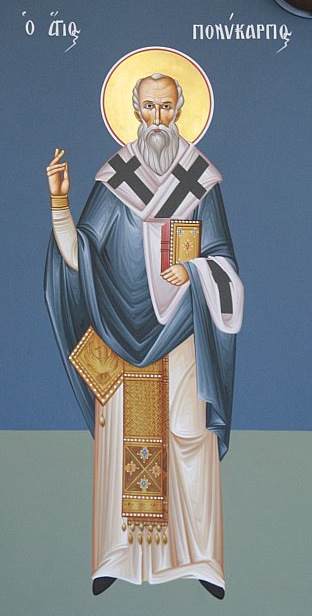
If you look carefully, you will see on the left the emblem of a bird, peaking out from underneath Polycarp’s robes. I believe this bird is the Phoenix. If you don’t know the mythology surrounding the Phoenix, it is described in the letter of St. Clement of Rome to the Corinthians (96 AD):
“Let us consider that wonderful sign [of the resurrection] which takes place in Eastern lands, that is, in Arabia and the countries round about. There is a certain bird which is called a phoenix. This is the only one of its kind, and lives five hundred years.
And when the time of its dissolution draws near that it must die, it builds itself a nest of frankincense, and myrrh, and other spices, into which, when the time is fulfilled, it enters and dies. But as the flesh decays a certain kind of worm is produced, which, being nourished by the juices of the dead bird, brings forth feathers.
Then, when it has acquired strength, it takes up that nest in which are the bones of its parent, and bearing these it passes from the land of Arabia into Egypt, to the city called Heliopolis. And, in open day, flying in the sight of all men, it places them on the altar of the sun, and having done this, hastens back to its former abode.
The priests then inspect the registers of the dates, and find that it has returned exactly as the five hundredth year was completed” – Epistle of Clement of Rome to the Corinthians, Chapter 25
Clement uses the Phoenix as an image of the resurrection. It’s therefore an appropriate symbol for all martyrs, but how much more so Polycarp?!
“When [Polycarp] had pronounced this ‘Amen’ and so finished his prayer, the men attending to the fire lit it. As the flame blazed forth in great fury…[it shaped] itself in the form of an arch, like the sail of a ship when filled with the wind, surrounding the martyr, his body in the centre of it, not as burning flesh, but as bread that is baking or as gold and silver refined in a furnace! In fact, we even caught a sweet aroma such as the scent of incense or of some other precious spice” – Martyrdom of Polycarp, Chapter 15
What a load of codology! Is it any wonder people say Christianity & paganism borrowed from each other.
Phoenix (mythology)
From Wikipedia, the free encyclopedia
This article is about the mythological bird. For other uses, see Phoenix (disambiguation)…
Restless Pilgrim: I cut the rest of this since it’s just a dump from Wikipedia.
If you want to read the article, please see http://en.wikipedia.org/wiki/Phoenix_(mythology)
Friend, a brief survey of the literature from the early centuries shows two things:
1. Christianity distinctly marked itself out from Paganism both in faith and in practice. In fact, this was one of the reasons for the more common popular, rather than imperial persecutions in the early years of Christianity.
2. Christians would readily draw upon pagan culture in order to communicate the Good News of Christ. This was done by St. Paul and has been done by Christians throughout history until this present day in an effort to engage with current society.
In this case, Clement uses the example of the Phoenix to explain the Resurrection and this icon’s artist uses the symbolism of the Phoenix to describe Polycarp’s martyrdom while gently pointing towards his future resurrection.
I think you ignore this written by St Paul:
From 1 Cor 9 NCB (BibleGateway):
19 Although I am free and belong to no man, I have made myself a slave to all so as to win over as many as possible.
20 To the Jews, I became like a Jew in order to win the Jews. To those under the Law, I became like one under the Law—although I myself am not under the Law—in order to win over those under the Law.
21 To those outside the Law, I became like one outside the Law—although I am not outside the Law of God but am subject to the Law of Christ—in order to win over those outside the Law.
22 To the weak, I have become weak in order to win over the weak. I have become all things to all, so that by every possible means I might save some.
23 I do all this for the sake of the gospel so that I might share it with you.
Meeting people where they are.
From Acts 17, when St Paul was speaking to the Athenians:
22 Paul’s Speech at the Areopagus.[f]Then Paul stood before them in the Areopagus and said: “Men of Athens, I have seen how religious you are. 23 For as I walked around, looking carefully at your shrines, I noticed among them an altar with the inscription, ‘To an Unknown God.’ What, therefore, you worship as unknown, I now proclaim to you.
24 “The God who made the world and everything in it, the Lord of heaven and earth, does not dwell in shrines made by human hands. 25 Nor is he served by human hands as though he were in need of anything. Rather, it is he who gives to everyone life and breath and all other things. 26 From one ancestor,[g] he created all peoples to occupy the entire earth, and he decreed their appointed times and the boundaries of where they would live.
27 “He did all this so that people might seek God in the hope that by groping for him they might find him, even though indeed he is not far from any one of us. 28 For ‘In him we live and move and have our being.’[h] As even your own poets have said, ‘We are all his offspring.’
He Leonardo, welcome to Restless Pilgrim!
(a) How exactly are these passages related to this post?
(b) In what way do you think I ignore them?
This was no drawing upon this was restating something he knew nothing about as a fact. He told a lie upon the altar. Plain and simple. Now what’s the name of that other fellow who said John the Revelator and Ezekiel and Isaiah said the millennium will be 1,000 years in the City of Jerusalem before Jesus returns. Another piece of confusion.
To tell a lie implies deceit. Do you think St. Polycarp, hero of the Early Church and martyr of Christ was purposefully trying to mislead?
I’m not really sure what you’re referring to here.
Out of interest, is there anybody from the early centuries of Christianity of whom you are a fan?