Symbolism: What is the significance of "IHS"?
 As I mentioned a while ago, I’ve started teaching myself New Testament Greek. This endeavor has already started bearing some rather fruity tidbits. In the first few lessons I learnt the Greek alphabet and, even with this basic information, certain things which had previously mystified me, started to make sense. Today I would like to share with you one of my first “aaahhhh…” moments 🙂
For those Catholics reading this, it’s time for a pop quiz! Often in churches, you will see the letters “IHS” (it’s even used on the Reformation Wall in Geneva). You see these letters on books, altars, baptismal fonts, communion hosts etc, but what does it mean?
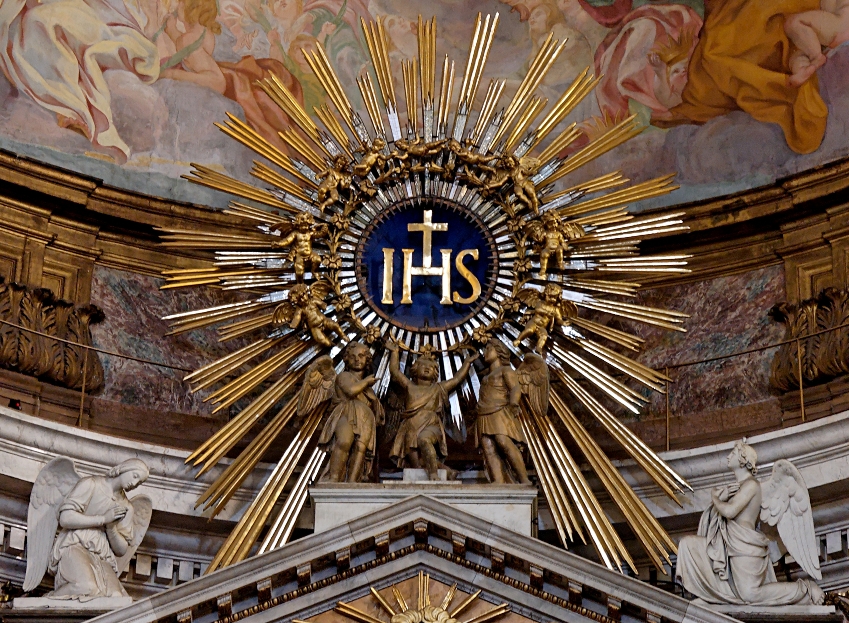
If you don’t know what this means, then don’t worry, you’re in very good company! Only a few people I’ve spoken to about this have known the answer. Catholic churches are so densely packed with symbols that it’s all too easy to become numb to them. Familiarity can lead us to stop asking questions, yet our places of worship have so much to teach us about our own faith!
Okay smarty-pants, what does it mean?
The “IHS” is a “Christogram”. This is a type of monogram which is an abbreviation of Jesus’ name.
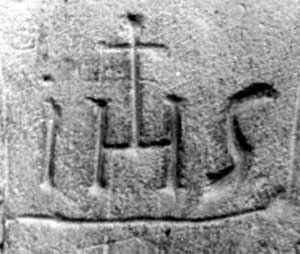
“Wait a minute!” I hear you say! “‘IHS’ looks nothing like the word ‘Jesus’!”. And, of course, you’re quite right…until you translate “Jesus” into Greek…
Greek has its own alphabet and in it “Jesus” is spelled “ιησυς” and when capitalized it becomes “ΙΗΣΟΥΣ”. If we take just the first three letters of this word then we have “ΙΗΣ”. These are the Greek letters “iota”, “eta” and “sigma”. When these letters are converted (“transliterated”) into our alphabet it becomes “IHS” (sometimes “IHC”, “JHS” or “JHC”).
There are some other suggestions as to what “IHS” stands for, although these are rather unlikely. Two Latin phrases have been suggested: “Iesus Hominum Salvator” (“Jesus, Saviour of men”) and “In Hoc Signo” (“In this sign…[you shall conquer]”). I even came across two English phrases – “I Have Suffered” and the rather nice “In His Service”. Unfortunately, these are all “backronyms” – phrases constructed to fit an already existing acronym.
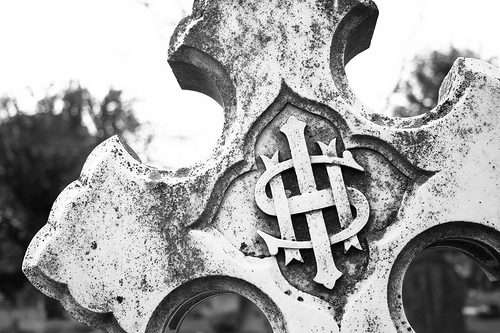
So, there you have it. “IHS” is a shorthand for “Jesus”. It was used in the Early Church from at least 7th Century and popularized by St. Bernardino of Sienna in the 15th Century, adopted as the seal of the Jesuits in the 16th Century and can now be found in Christian art and architecture throughout the world.
And all this time I thought you were named after the ‘Doncaster Association of Visitors to Immigration Detainees’……. now you’re telling me that’s just a “backronym”??!!
For centuries before Christ, IHS stood for Isis, Horus & Seb. If you think that is a lie, then explain the more than dozens of ancient pagan relics with IHS all over them? According to your breakdown, you sure have to take alot of steps before you can get Jesus out of IHS so what would have been the point? Unless of course you were trying to come up with a christian cover for your pagan idolatry? 😉 Just sharing a thought.
Sorry I didn’t realize there was a new blog til *after* I posted! Such is life!
My breakdown doesn’t really require a lot of steps except for those who have no knowledge of Greek.
If I profess ΙΗΣΟΥΣ is my Lord and I leave ΙΗΣ inscriptions everywhere what do you think ΙΗΣ likely stands for? The God I profess or three pagan gods that I fail to mention at any other time?
It’s because most people have no knowledge of Greek that I wrote my post on “ICXC”. Text such as this needs breaking down for those unfamiliar with Greek and don’t understand how divine names are abbreviated. Out of interest, do you also believe that “ICXC” has pagan roots?
Do you have some images of these ancient pagan relics? I’m a little confused as to how that’s possible since the Egyptians didn’t use our alphabet. Surely there’d at least have to be some conversion of characters?
Actually, while we’re on the subject of pagan roots, do you approve the wearing of wedding rings?
I first came across the kind of theory you suggest when I read one of Jack Chick’s frankly laughable tracts. Why does Chick say that it’s Isis, Horus and Seb? Why not the more powerful gods such as Ra or Osiris? The only reason I can think of is that it then wouldn’t fit nicely into his conspiracy theory.
You’ve only got to look at the other theories Chick propagates to see how reliable his material is. He asserts that the Catholic Church invented Islam and that the Catholic Church keeps all the names of Protestants on a super computer! If you place any weight on his comics I’d suggest you read this: http://www.catholic.com/documents/the-nightmare-world-of-jack-t-chick.
Finally, Isis, Horus and Seb weren’t gods, they were Goa’uld 😉
(A little “Stargate” joke there)
I haven’t seen a chick tract in years, didn’t even know he had one on IHS. Also, I didn’t mean YOU specifically when I said “your” pagan idolatry, I was referring to whoever first started putting IHS in the church.
I give up on the ancient symbols. I have been looking at so many lately they are starting to blur together. [being honest] The IHS symbols I saw were old catholic ones, but they were shown along with isis/horus/baby [and other misc sun gods] sun disk symbols, showing the likeness. There is just so much pagan symbolism in the RCC it boggles my mind and I can hardly believe they deny it. It’s one thing to have your reasons for holding to your beliefs, but be honest!
Wedding rings? What are you talking about?!! LOL
Anyway, I’m not hating on Catholics as over half my family are such. I was born into it, sprinkled as a baby, had a nun for a teacher in kindergarten and 1st grade…however, I do now passionately reject the pope’s so called authority and the majority of the RCC doctrine. I don’t hate people!
Where did you find out about this supposed Egyptian link to IHS? Do you know of any reputable historians who would endorse this theory?
Have you seen any images of the pagan relics you mention? In what language where they in? At the very least, the lettering would have to go through some form of conversion in order to get it into the English IHS, and probably a more complicated conversion than from the Greek ΙΗΣ(ΟΥΣ).
You didn’t answer my question about “ICXC”. Do you believe that also has pagan roots?
I asked about wedding rings because they are very clearly a pagan tradition, albeit one which Christians of every stripe have embraced. I wondered whether or not you thought that was okay.
> “There is just so much pagan symbolism in the RCC it boggles my mind”
The onus here is on you to show the causal link, to show that Catholicism imported these symbols from Paganism.
Let’s consider the fish symbol. This is one of the earliest Christian symbols. Could you find it used as a symbol in pagan religion? Almost certainly! Since paganism is deeply grounded in the created order you’ll find almost virtually every living creature depicted somewhere. However, to then make the assumption that Christianity “borrowed” the fish symbol is a mistake. The Christians had their own reasons for using that symbol that had absolutely nothing to do with Paganism.
What about another symbol? How about the cross? It’s the sign of our salvation and new life! Did you know that the Jehovah witnesses say that is a pagan import?! Would you agree? I’m sure if I went looking I could find a cross or “tau” somewhere in a pagan religion…
For more on this: http://www.catholic.com/tracts/is-catholicism-pagan
> “I do now passionately reject the pope’s so called authority and the majority of the RCC doctrine”
I’m assuming you are Protestant of some sort. I have some posts coming out next month on Sola Scriptura which you may be interested to read, but in advance of that, would you mind answering the following questions?
1. How do you know that the Bible is the Word of God and the Book of Mormon is not?
2. Do we have all the right books and none of the wrong books in the Bible? How do you know?
3. When was the contents of the Christian Bible officially settled? By whom? Can we trust them?
4. If I believe the Epistle of James to not be inspired can I throw it out of the Bible? Why not?
5. If two faithful Bible-believing pastors, both of whom know the original Biblical languages disagree on a particular passage’s interpretation, how is this deadlock resolved?
(It was my attempt to answer these questions in a logical and consistent manner that ultimately brought me back to Catholicism)
Leave Babylon don’t go back
Hey Bliss, from what sources are you getting your information?
How can we know which Religions SACRED WRITINGS are TRUE & OF The ONE GOD, as opposed to all the others out there? The Bible, The “Received Text”, is UNIQUE from ANY & ALL OTHER COLLECTIONS OF “SACRED WRITINGS”! WHY? It ALONE has The amazing amounts of VERY SPECIFIC, DETAILED, TIME BOUND, PREDICTIVE PROPHECIES, Which have ALSO been CONFIRMED BY WORLD HISTORY!!! THE Dan.9:24-27 Prophecy, for example! Written more than 500 B.C., Covered a period of 490 years, the prophecy was to BEGIN by a SECIFIC DECREE FROM THE KING OF THE KINDOM RULING OVER THEM. Once the prophecy BEGAN, the 1st 7 Weeks, or 49 years by the day/year PROPHECY PRINCIPLE, Mandated that CERTAIN Things MUST be Completed with in THAT TIME PERIOD, IF THE PROPHECY WERE TRULY FROM GOD! Thus this portion of prophecy was time bound. Read it! It is ALSO VERY SPECIFIC AS TO WHAT, MUST BE DONE WITHIN THAT PERIOD OF TIME!!! The rest of the prophecy is ALSO Time bound and VERY SPECIFIC! It prophesies the VERY YEAR CHRIST WAS TO “APPEAR” IN HIS PUBLIC MINISTRY! ALSO THE YEAR HE WOULD BE “CUT OFF” or KILLED AND WHY, AND WHAT THE RESULT OF THAT WOULD BE! IT ALSO PROPHESIES THE DESTRUCTION OF JERUSALEM SHORTLY THEREAFTER AND HOW TERRIBLE THAT WOULD BE! HISTORY HAS CONFIRMED ALL OF THOSE EVENTS DOWN TO THE SMALLES DETAIL! This was only 1 such prophecy! The Daniel 7: prophecy BEGAN as soon as Medo-Persia Conquered Babylon and that prophecy is still being fulfilled to this day and will continue EVEN UNTO THE 2ND COMING OF JESUS CHRIS!!! IT TOO IS VERY, VERY SPECIFIC AND DETAILED! IT ALSO TIES INTO THE 2 “BEAST” OF Revelation chapter 13! The UNITED STATES GOVERNMENT IS THE 2ND BEAST!!! THE ROMAN CATHOLIC CHURCH IS THE 1ST BEAST!!!
The Early Church was the Catholic Church. If you wish to dispute this, I’d refer you to the Early Church Fathers and ask you to name the first Christian after 2nd Century to whom you could point as sharing the same form of Christianity as your own.
Tell me,What means of EVIDENCE does your religion have? Is it Predictive Prophecy? IF SO, ARE THEY VERY GENERAL PROPHECIES THAT COULD FIT MANY SITUATIONS, EVENTS OR PEOPLE? I know they are NOT, Specific, and Detailed, and Time Bound and Can be VERIFIED by WORLD HISTORY!!!
I’ve already provided evidence, showing that the Early Church was the Catholic Church. It was the Catholic Church who discerned, assembled and preserved the Sacred Scriptures.
If you think otherwise, I’ll renew my request for you to name the first Christian after 2nd Century to whom you could point as sharing the same form of Christianity as your own. If you deny that the Catholic Church gave us the Bible, please provide some dates and names of those Christians involved in the discernment of the canon.
How do you know for sure that English was not the 1st language?? Also men lie all the time make up history, write books etc. And the Holy Bible the KJV to be precise came by the will of God not man and only God can teach you His word and reveal what is hidden in His word. I don’t believe anything I read unless God backs it up in His word and He does this all the time because every question can be answered through His word and His word is Jesus the living breathing testimony from the Father!
Because we have inscriptions predating the development of the English language.
Okay, but which book do you think is telling a lie?
Well, everything that happens is, in some sense, the will of God. However, the “efficient cause” for the KJV is demonstrated in the name – King James.
Why then does the Bible talk about teachers?
Do you know when and how the Bible was constructed into a single book?
Also, out of interest, look at what’s carved beneath the statues of the memorial to the Protestant Reformers:
https://restlesspilgrim.net/blog/wp-content/uploads/2011/04/ihs.jpg
Look familiar?
Pilgrim, find out about Santos Bonacci and maybe you can realize why IHS has rays of blazing light and fire around it on your images.
Some help for you on youtube:
“The Ancient Theology Astrology”
“As Above So Below”
I’m not really sure what I’m to learn from someone who believes that “The Bible is not a book written by God” and who believes that we’ve all been radically misinterpreting the Bible for 2,000 years…
I’m sure he’ll have his own interpretation of the sun rays, but it begs the question: why should I trust his interpretation? Doesn’t it make much more sense to listen to the Catholic Church’s, within which that symbol was born?
Well, i ask you the same. Should i trust the Catholic Church’s?! Don´t know…
About “The Bible is not a book written by God”, it misses “but a book written about/of God” to be more clear. Isn´t that right? Didn´t were Moses, Joshua, Samuel, etc, etc, etc, who seemingly wrote it?
The greeks didn´t inherited the knowledge of ancestors cultures? Should i investigate forward for answers, or go right way back to the source and try to understand the genesis and get some misunderstanding and bias interpretation through the times? You tell me…
> “Well, i ask you the same. Should i trust the Catholic Church’s?! Don´t know…”
Whose interpretation is likely to be correct? The Church from whom the symbol came, who used it in art and architecture for hundreds of years…or some random guy in 2013? This guy is going to have to provide something pretty impressive to convince me…
> “About “The Bible is not a book written by God”, it misses “but a book written about/of God” to be more clear. Isn´t that right? Didn´t were Moses, Joshua, Samuel, etc, etc, etc, who seemingly wrote it?”
The Bible didn’t drop down from Heaven, sure. The authors of the different books of the Bible are true authors. They were active participants in the writing of the Sacred Scriptures, but Santos Bonacci appears to deny any aspect of divine agency in the process. This stands in direct contradiction to the earliest Christian witness, which for 2,000 years that the Scriptures are “God-breathed” (2 Timothy 3:16)
> “The greeks didn´t inherited the knowledge of ancestors cultures? Should i investigate forward for answers, or go right way back to the source and try to understand the genesis and get some misunderstanding and bias interpretation through the times? You tell me…”
I don’t really understand what you’re getting at here. To understand something, you go back to the earliest sources, sure. In the case of Christianity our primary sources of information are the Hebrew and Greek Scriptures, as well as the writings of the Early Church Fathers.
Well, i don´t see any contradiction in denying any aspect of divine. If i want to make anything divine, or not, any time anywhere i´ll just make it and state it as i please like Constantino did in Rome. The Ancient Greece was a pagan one before being christian! So it seems valid to say, not just me saying randomly, that christianism could had taken and distorted at please to fulfill a well known, great and rich empire, that´s what it is in my point of view, through a personification of the Sun and Stars worshiped by Egiptians like Heaven in the sky, through Jesus. Similarities seems to be there…
http://www.sabbathcovenant.com/IHS.htm
> “Well, i don´t see any contradiction in denying any aspect of divine”
For 2,000 years the Church has held the New Testament to be inspired and the Jews held this opinion of their own Scriptures for even longer. Mr. Bonacci appears to deny this. There’s the contradiction.
> “If i want to make anything divine, or not, any time anywhere i´ll just make it and state it”
That sounds an awful lot like relativism to me. Christianity denies that and asserts that there is such a thing as objective truth.
> “…as i please like Constantino did in Rome.”
You’re referring to Emperor Constantine? What exactly are you saying he did in Rome?
My guess is that you’re actually referring to the Council of Nicaea and asserting that he made up the divinity of Christ. If that’s the case, that’s easily debunked.
> “The Ancient Greece was a pagan one before being christian! So it seems valid to say, not just me saying randomly, that christianism could had taken and distorted at please to fulfill a well known, great and rich empire, that´s what it is in my point of view, through a personification of the Sun and Stars worshiped by Egiptians like Heaven in the sky, through Jesus.”
I’m guessing English isn’t your first language, so I’m having some difficulty working out what you’re getting at here, but you appear to be assert some kind of Syncretism, mixing up Pagan Greek and Egyptian culture with Christianity. Given the link you’ve posted, I believe this is the case. If so, it is also easily debunked:
http://catholicdefense.blogspot.com/2011/11/jesus-and-mithras-debunked.html
http://www.catholic.com/tracts/is-catholicism-pagan
http://www.catholic.com/magazine/articles/paganism-prophecies-and-propaganda
Yes, english is not my first language. And i wonder if you saw Santos Bonacci’s videos…
I will rest my case cause by the sites you posted, it seems to me that there is to much coincidences easily debunked. Just saying…
> “And i wonder if you saw Santos Bonacci’s videos…”
I watched some of them. They was full of silly statements like “Everything that we’ve been taught by our institutions is absolute false. Everything. The whole lot.”.
Again, why should I trust this guy rather than the successors to the Apostles in understanding Christianity? Ignatius, Polycarp, Justin…and all the other Church Fathers were much closer to the time of Christ and even gave their lives for Him. Wouldn’t it make more sense to hear how they understood the faith? Why should I trust Mr. Bonacci?
> “I will rest my case cause by the sites you posted, it seems to me that there is to much coincidences easily debunked. Just saying…”
A judge only judges after hearing both sides. If you read the links I posted and still hold to your current opinion, I’ll be very much surprised.
The argument that Catholicism is warmed-over paganism has been shown to be false again and again. A lot of the arguments you hear are borrowed from Ralph Woodrow’s “Babylon Mystery Religion”…which he later retracted after realizing that basing his data and logic off Alexander Hislop’s book “The Two Babylons” was not exactly a good idea.
Ugly websites, however, much like the one you posted, keep these bad arguments very much alive…
Maybe the Reformers were the pagans. 😉
1. The Roman Catholic Church was not the first church – that is the biggest hoax foisted on mankind.
2. The apostolic church was the first church led and taught by Jesus himself and His Spirit.
3. This church keeps all the commandments of God including the second and the fourth
4. This church was persecuted by pagan Rome.
5. They were fed to the Lions, crucified etc, fulfilling the prophecies of Daniel 7, 8 &11.
6. The emperor Constantine nominally converted to Christianity with his “In Hoc Signo Vinces” dream.
7. Pagan practises including Sunday worship became entrenched in APOSTATE Christianity.
8. Paul warned of this falling away (2Thess 2:3,4) of ‘Christianity’ (Acts 20:26-30)
9. John spoke of this in 4 verses – 1John 2:18, 22, 4:3 and 2John 1:7 – the AntiChrist was & is in town!
11. With Constantine’s abdication of the city of Rome, the Bishop of Rome ascended the throne & ceased the sceptre.
12. The rest is history – Pagan Rome had metamorphosised into Papal Rome.
13. Papal Rome like its mother, Pagan Rome, continued the persecution of Bible believing Christians.
14. Despite this, the true Bible believing Christian church continued on in obscurity, in the wilderness.
15. The persecution continued for > 1000 years until Papal Rome received its deadly wound in 1798.
16. France took the Pope prisoner and he died in exile. You realise we are not being persecuted now!
17. The prophecy predicts this deadly wound would be healed (Rev 13) & persecution will be revived.
18. The first movements toward this was by Mussolini in the Lateran Pact of 1929.
19. Ever wondered about the myriad of apologies by Pope John Paul II and Pope Francis to those the church ‘killed’ ….and you say this is the first church? Even blind Freddy can see that the wall is painted white even though you say and insist its black.
20. The story is not over bro Pilgrim. The sins of Papal Rome will be laid bare for all to see.
21. She has sexually abused and buggerized our children and brutalised true Bible believing Christians and you say she is the first church?
22. The prophecies of Daniel and Revelation point unmistakably to Rome as the harlot of Revelation 17 who will suffer her just dues in the conflagration that is to come in the second coming of Jesus (2Thess 2:8) The Jesuits have done a great job in sucking in the Protestant world in drawing attention away from Papal Rome in its Preterist and futurist interpretations of prophecy but the prophecy cannot be broken.
Most of these 22 points are uncontroversial (2, 3, 4, 5, 8, …), but you do claim a distinction between the Church founded by Christ and the Catholic Church. When do you think the Catholic Church was founded and by whom?
You seem to point to things going wrong with that usual bogeyman, Constantine. However, one finds Catholic belief and practice long before Constantine was even born, including Sunday worship. How do you explain that?
The canon of Scripture isn’t settled for hundreds of years after Pentecost and it is done so by men who believe many doctrines which I imagine you’d regard as heresy. Is that a problem for your position?
Can you name anybody who lived between 2nd-10th Century who was a “real” Christian, who held to the same faith to which you hold? Is it problematic if you can’t?
Hi Gina
With you on this one
Check out “The Two Babylons” on the website: http://www.returnofelias.org
May God bless you
Elias
What on earth makes you think “The Two Babylons” is good scholarship?! Seriously, I’d like to hear the answer to this one.
Anti-Catholics used to quote Ralph Woodrow’s “Babylon Mystery Religion” which was based off “The Two Babylons”, but stopped when Woodrow later recanted after finally recognizing the poor data and logic found in Hislop’s book.
Egyptian rulers were Greek from the rule of Alexander, a Greek.
What significance do you find in this?
One has to remember that
Christianity was made the world religion through an agreement between Constantine and the pope.
So due to this agreement we now see that Christianity would never be here except for crooked rulers and crooked religions.
There is only one God. Read the second commandment to understand what God said about himself.
Then read Book of Hosea 13.4 and see how God tells you who the savior is.
These two items destroy Jesus and Christianity.
You gotta just live with it.
Gramps
Hey Gramps, welcome to Restless Pilgrim!
Your claim does not follow. Even if one doesn’t think that Constantine was sincere, he supported Christianity because it was already taking over the Empire (Rodney Stark has done lots of work on the growth rate of the Church in those early centuries). I’m guessing you’re Jewish? The logic you’re using would be like saying that Judaism is false because it was supported by Cyrus the Great!
Not only that, after Constantine, Christianity did not always have supportive Emperors. It had several Arians and even Julian who attempted to restore Paganism!
Cheers,
David
Can you send me links with credible sources for the info you have provided here please and also pictures OF IHS symbols which predate Christianity – it would be much appreciated…thanks
The Jesuit lied about everything so they why believe it’s means Jesus in Greek seeing they probably created. The Greek teacher also I’m just curious that’s it’s to much of a coincidence
Leaving the unsubstantiated ad hominem aside, the Christogram predates the Jesuits by centuries. Its first usage of IHS is in the 7th Century and the Jesuits weren’t founded until the 16th Century.
Why would you make up IHS to mean that when you’d have to translate them from English. Most people in Pagan history didn’t do anything in English. Stop Getting your info from Jack Chick tracts.
Thank you!
I agree. Isis – Horus – Seb
Do you have any evidence to back up that claim? If so, please present it.
Hey bro
Check out this website on the two Babylons – http://www.returnofelias.org
God bless you
It’s the same nonsense with the same ahistorical, unsubstantiated claims.
Old Chinese saying – “a picture speaks 10 thousand words”.
The real Jesus would use that sort of symbolism promoted by the papacy as Christian? Come now Mr or Mrs Pilgrim, tell us another story. Wilful blindness covers a whole lot of things but the end will not change. Remember a rose by any other name will smell just as sweet so it is with paganism and its symbols and symbolism – you can christianise them but they are pagan.
Hey Robert, welcome to Restless Pilgri.
What exactly is “that sort of symbolism”? Please explain.
What is it about a Christogram that is so un-Christian?
You first have to prove that this is a Pagan symbol!
You have lots of different, conflicting explanations to choose from above. To which one do you subscribe and what evidence can you present to support it?
Spot on Gina
Check out http://www.retunofelias.org and “The Two Babylons” – Paganism enters the church on that site.
Like I told Gina, it’s the ahistorical nonsense, widely rebutted and to which no real historian would ever ascent.
Must be all coincidence, those photographs right?
Check it out folks at http://www.returnofelias.org – great website even though Pilgrim rubbishes it.
I am sure Papal Rome has some sort of explanation for each of the symbols depicted in those photos which will satisfy the poor Roman Catholic people especially as the Pope is considered infallible. That is absolutely incredible that a mere man can be considered infallible – maybe he is not just a mere man, he must be God, right?
Do you believe the Pope is God?
Do you believe the Catholic priest can forgive you your sins?
Do you believe that saying so many ‘Hail Marys’ and ‘Our Fathers’ is penance enough for your sins?
If you do, then you are a great Roman Catholic and nothing else.
Hey Rob, you didn’t address a single question I asked:
1. What exactly is “that sort of symbolism”? Please explain.
2. What is it about a Christogram that is so un-Christian?
3. To which of the (conflicting) explanations of Pagan origin do you subscribe and what evidence can you present to support it?
What exactly is a coincidence? You shared a link to website homepage and nothing specific. I searched for “IHS” and found nothing.
No, there’s isn’t a Catholic alive who believes that. Is that what you think the Catholic Church teaches?!
Christ forgives the sins through the priest. This is because he gave authority to men in John 20:21-23:
Again Jesus said, “Peace be with you! As the Father has sent me, I am sending you.” And with that he breathed on them and said, “Receive the Holy Spirit. 23 If you forgive anyone’s sins, their sins are forgiven; if you do not forgive them, they are not forgiven.”
If Jesus isn’t giving the authority to men to forgive sins, what is He doing?
Sins are already forgiven in Confession prior to the performing of penance.
Peculiarly the exact acronym representing Egypt’s pre-Christian, triune god. Yes, Catholicism is full of all sorts of religious symbols, many with pagan origins. Tjis is interesting.
Hey Aaron, welcome to Restless Pilgrim.
Except it’s not. Firstly, Egypt didn’t have a “triune god” – there was not a single essence shared by three divine persons. There was, however, a triad of gods commonly associated, but it was Aset (Isis), Heru (Horus), and Asar (Isis), which rather ruins the conspiracy theory.
Secondly, it’s also hampered by the fact that it’s also an entirely different alphabet and Egyptian gods having multiple names.
Thirdly, and most crucially, it defies explanation – why on earth would in Latin-speaking Christianity of medieval Western Europe suddenly decide to popularize pre-Christian Egyptians gods yet continue proclaiming the name of Christ?!! It defies all sense.
Yes! Gina! Look at you back in 2011 dropping Truth bombs!!! Symbolism will be their downfall.
If by “Truth bombs” you mean unsubstantiated claims and ignoring my rebuttals and questions, sure…
Let me take a wild guess… you are a fundamentalist Protestant….
You are absolutely correct..
Hey Gramps, welcome to Restless Pilgrim!
I assume you’re referring to some of Gina’s comments about Horus etc. Since Gina has been unable or unwilling to share any evidence for her claims, can you?
You are spot on Sir, oh what a deception. And it has worked for centuries but his time is short and he is kicking up a right old stink! Let’s face it, the mask is off, you have been exposed.👹
Hey CJ, welcome to Restless Pilgrim!
Since Gina has been unable or unwilling to share any evidence for her claims, can you?
Yep.
According to Walter Veith also.
It is Babylonian sun worship etc.
I saw a very small little chapel building in the south Germany this, morning with the IHS on th archway and the all seeing eye on the pyramid just further along.
Their symbolism, but then Mary and Jesus also included, just to throw people off into believing it is all good.
Walter Veith?! Why should anyone care about what a South African zoologist thinks?
How well versed are you in your Greek studies? I am learning to read Greek, and am familiar enough with many biblical names and some other words. I’d like to be able to learn it better with another person, if you were interested. My name is Scott. Thanks. fshrmfrdj@gmail.com
Hey Scott,
I know enough Greek to be able to use a lexicon. I don’t really have time to devote to improving it though I’m afraid as life/work are rather crazy at the moment. I would, however, recommend http://learngreekfree.com/. I just did a few lessons and it was enough to help me achieve a basic understanding.
Thanks,
David.
I.HS restless pilgrim is not Jesus it is isis horab seth…..pagan trinity brother do more research on this just saying
Hey Timothy,
Can you give the name of any reputable historian who would affirm this? I’ve only ever seen such claims in Jack Chick tracts.
God bless,
David.
You do not need any reputable historian to affirm the origins of IHS behind the sun symbol – the Jesuit logo. The Jesuits themselves are at loss to explain what the sun symbol stands for. So its easy to coin an acronym for IHS.
The Holy Scriptures has the answer, look at the verses below:
[Eze 8:13]
He said also unto me, Turn thee yet again, and thou shalt see greater abominations that they do.
[Eze 8:14]
Then he brought me to the door of the gate of the LORD’S house which was toward the north; and, behold, there sat women weeping for Tammuz.
[Eze 8:15]
Then said he unto me, Hast thou seen this, O son of man? turn thee yet again, and thou shalt see greater abominations than these.
[Eze 8:16]
And he brought me into the inner court of the LORD’S house, and, behold, at the door of the temple of the LORD, between the porch and the altar, were about five and twenty men, with their backs toward the temple of the LORD, and their faces toward the east; and they worshipped the sun toward the east.
Notice the last verse 16 … that says -“…and they worshipped the sun toward the east”
The Eucharist is just a form of sun worship. So its not Jesus in the Eucharist, its’ simply the SUN GOD being worshiped.
Take a look at this picture of the monstrance a priest holds up for veneration below, and compare what is written in the Bible verses above.
https://encrypted-tbn1.gstatic.com/images?q=tbn:ANd9GcRFGdfWVLqXmOFwQch3R2oPyzkrpfmj5eSNWpIL4k8Xo9Tp1Cjd
https://encrypted-tbn2.gstatic.com/images?q=tbn:ANd9GcTlPeXclbfg7wqXht1IpP4pNp3e7DXbe3p2L0Esdbg0Pzz7VB08
These images clearly show sun worship as per the bible verses ezekiel 8:13-16.
Hi Nathaniel, welcome to Restless Pilgrim 🙂
> You do not need any reputable historian to affirm the origins of IHS behind the sun symbol – the Jesuit logo.
Out of interest, do you happen to know any reputable historians who support the theory you present here?
> The Jesuits themselves are at loss to explain what the sun symbol stands for. So its easy to coin an acronym for IHS.
The IHS has been in use since 7th Century, long before the foundation of the Jesuits in the 16th Century. The explanation which I give in this article also explains the variations we see in the text (JHS etc.) I’d hardly say that the Jesuits are “at a loss to explain what the sun symbol stands for”. There are several layers of symbolism available to us. For example, can you think of anyone who claimed to be “the light of the world”?
> The Eucharist is just a form of sun worship. So its not Jesus in the Eucharist, its’ simply the SUN GOD being worshiped
Sorry, you’re going to have to explain this one a little more. Are you saying that Catholics think they’re worshipping Jesus but accidentally worshipping the sun instead? How do you accidentally worship a deity? Or do you think that Catholics knowingly worship the sun. If so, why the charade?
Are you saying that St. Ignatius purposefully included a pagan symbol in his seal in order to trick people into worshipping the sun? To what end? If so, why did he bother preaching Christ? Why did he dedicate his life to Him? Why was he willing to suffering for Him? Why did he urge people to read the Scriptures? Why did he urge people to live according to Christian morality? It all seems a bit pointless if his purpose was simply to lead people to worship the sun…
> Take a look at this picture of the monstrance a priest holds up for veneration below, and compare what is written in the Bible verses above… These images clearly show sun worship as per the bible verses ezekiel 8:13-16.
I’m afraid you haven’t exegeted Ezekiel 8, you’ve conducted pure eisegesis, reading into the passage what you want to see there. Here is the logic you’ve presented:
1. An Old Testament passage speaks of people worshipping the sun
2. Catholics sometimes put the Eucharist in a monstrance which has rays coming out of it
3. Therefore Catholics worship the sun
Does (3) really follow from (1) and (2)? It seems a considerable stretch. Let’s test the above logic a little further…
(a) Does this mean that if Catholics use a monstrance without the rays then they’re not worshipping the sun?
(b) Given that the monstrance doesn’t make an appearance until the end of the Thirteenth Century, does that mean Christians suddenly started worshipping the sun in the Fourteenth Century?
I look forward to reading your answers to these questions.
It’s no accident Nathaniel they know exactly what they are doing. They are the biggest cult the world has ever known, and there con has worked for centuries,I’m surprised that they have got away with there deception so long. Jesus Christ is Lord and ourGOD worship him and him only, not man or anything man has made.
You’re actually highlighting a real problem. Which is more likely?
(a) The Apostles failed and Jesus failed to protect His Church from immediate total apostasy
(b) Your modern interpretation of Scripture is wrong
Hi Restless Pilgrim,
Firstly, God commands us to worship Him in spirit and in truth John 4:24 and not through symbolism. And off-course John 4:24 does not need exegesis nor eisegesis, ok? God is angry that the creation is worshiped other than the creator only – Romans 1:24-25.
Catholics are faithful and sincere. But one also can be sincerely wrong and destitute of the the truth. Majority of lay catholics are “cradle” catholics who simply believe what has been passed down to them and are discouraged to question the clergy. So they, unlike you, won’t delve into history about those pagan symbols that have been christianized to make it palatable. They just sheepishly obey being ignorant and destitute of the truth. So Satan is a master-deceiver making the unsuspecting to believe a lie against Romans 1:24-25.
As per the quoted scripture passage on Ezekiel 8:13-16 its just what it says. It’s not rocket science. I do not do either a exegesis nor a eisegesis – because that’s human wisdom. I simply follow the Apostle Paul in rightly dividing the Word of Truth 2 Tim 2:15 and obey God’s command following the divinely inspired method he commands me to read His book. Remember the Mystery of Iniquity began its work right from the very beginning of Genesis, and still continues today.
Jesus said:
1. “And Jesus answered him, saying, It is written, That man shall not live by bread alone, but by every word of God.” Luke 4:4, and NOT THE WORD OF A POPE
2. “But he answered and said, It is written, Man shall not live by bread alone, but by every word that proceedeth out of the mouth of God.” Matthew 4:4 and NOT THE WORD OF A POPE
3. “And it came to pass, as he spake these things, a certain woman of the company lifted up her voice, and said unto him, Blessed is the womb that bare thee, and the paps which thou hast sucked. But he said, Yea rather, blessed are they that hear the word of God, and keep it”. Luke 11:27,28 and NOT THE WORD OF A POPE
4. If ye love me, keep my commandments. John 14:15 and NOT THE POPE’S COMMANDMENTS
– Wilful blindness is bro Pilgrim’s lot
– Defending the indefensible is bro Pilgrim’s lot
– Scripture says: “Ephraim is joined to idols: let him alone” – Hosea 4:17
What Catholic claim do you think this response refutes? Nobody claims that man shall live by every word of a Pope :-/
> Firstly, God commands us to worship Him in spirit and in truth John 4:24 and not through symbolism
Wait, “spirit and truth” means “not through symbolism”? Where do you get that idea from the text?
Also, if God is so against symbolism, why did he command in the Old Testament liturgical worship absolutely laden with symbolism? Why in the New Testament did He institute Baptism and the Lord’s Supper, rituals both heavily laden with symbolism? Why is it that when we look into the worship of the early centuries of the Church we find ritual and symbolism?
> And off-course John 4:24 does not need exegesis nor eisegesis, ok?
Every passage needs exegesis. To read Scripture is to interpret Scripture.
> God is angry that the creation is worshiped other than the creator only – Romans 1:24-25.
That point isn’t really under dispute, is it?
> Catholics are faithful and sincere. But one also can be sincerely wrong and destitute of the the truth
Okay, so you don’t think that Catholics are purposefully worshipping the sun. So…you think they’re accidentally worshipping the sun? How does that work?
You also didn’t answer my questions about Ignatius. Do you think he knowingly introduced Paganism?
> Majority of lay catholics are “cradle” catholics who simply believe what has been passed down to them and are discouraged to question the clergy
Catholics are not special in this regard. The same could be said for Protestants.
> So they, unlike you, won’t delve into history about those pagan symbols that have been christianized to make it palatable
I don’t think anything here is a pagan symbol. Would you charge Solomon with Paganism since the Temple was covered in garden imagery? Would you charge Moses with Paganism since he forged a bronze serpent?
You appear to want to ban everything from Christianity that has any Pagan associations. However, do you do this consistently? For example, I’ve notice that, at every single Christian wedding I’ve attended, the bride has carried a bouquet down the aisle and the couple have exchanged rings. What’s that got to do with anything? Well, both the bridal bouquet and the use of wedding rings are imports from Paganism. If bouquets and rings can be “baptized” and put to the service of the Christian faith (holy matrimony), doesn’t that mean other things could too?
> They just sheepishly obey being ignorant and destitute of the truth. So Satan is a master-deceiver making the unsuspecting to believe a lie against Romans 1:24-25.
You’re applying this text to Catholics without any explanation. What creatures are Catholics meant to be worshipping? Why not apply it to Protestants? Why not to Mormons? In fact, why not exegete it in its original context and apply it to Pagans?
> As per the quoted scripture passage on Ezekiel 8:13-16 its just what it says. It’s not rocket science.
Are you seriously saying that, in the syllogism I presented above, (3) can be logically deduced from (1) and (2)?
> I do not do either a exegesis nor a eisegesis – because that’s human wisdom. I simply follow the Apostle Paul in rightly dividing the Word of Truth 2 Tim 2:15 and obey God’s command following the divinely inspired method he commands me to read His book. Remember the Mystery of Iniquity began its work right from the very beginning of Genesis, and still continues today.
You say you “rightly divide the Word of Truth” – that’s exegesis! To interpret the meaning of a passage or to apply it to life is to do exegesis.
However, it must be pointed out that this interpretation is both fallible and a completely novel interpretation when placed against the backdrop of Christian history. Don’t you find that troubling? Why is it that nobody else has had this interpretation in Christian history?
Finally, you didn’t answered my first question: do you happen to know any reputable historians who support the theory you’ve present here?
> Wait, “spirit and truth” means “not through symbolism”? Where do you get that idea from the text?
You are justifying yourself by referring to Old Testament scripture about symbolism. You don’t have a clue how to “rightly divide the word of Truth” (2 Tim 2:15). God revelation in the bible is “progressive revelation”. God’s dealing with the nation Israel (the jews – his covenant people) in times past dealings has always been faith+works. Which means apart from faith, the jew had to do a work to affirm his faith – hence a lot of symbolism in OT. There is a danger that symbolism being the focal point, the idol of the heart to keep man from the truth of the Holy Scriptures – that is why in the New Testament God says worship him in spirit and in truth. According these symbols are just “dumb idols” 1 cor 12:2, 2 cor 6:16.
Okay, so you don’t think that Catholics are purposefully worshipping the sun. So…you think they’re accidentally worshipping the sun? How does that work?
Ignorance. They don’t know they’re worshipping the Sun. Because its in-doctrinated in their minds otherwise.
What’s that got to do with anything? Well, both the bridal bouquet and the use of wedding rings are imports from Paganism
As long as they’re use is not the central focus of attention for veneration, worship of for any form of adoration.
> You say you “rightly divide the Word of Truth” – that’s exegesis! To interpret the meaning of a passage or to apply it to life is to do exegesis.
To “rightly divide the Word of Truth” is to take biblical truths and place them in their respective time frame. Remember I said above that God’s Revelation in the Holy Scriptures is “progressive” not “stagnant”.
> Are you saying that St. Ignatius purposefully included a pagan symbol in his seal in order to trick people into worshipping the sun?
I don’t know much about Ignatius.
>Finally, you didn’t answered my first question: do you happen to know any reputable historians who support the theory you’ve present here?
I don’t happen to know any historian, but have you heard of Mithraism? for more info, see this link http://www.cogwriter.com/christianity-mithraism.htm
> You are justifying yourself by referring to Old Testament scripture about symbolism
Are you the only one who is allowed to use Scripture to argue a point? Am I not allowed? Even Shakespeare and the New Testament granted the devil that privilege… 🙂
> You don’t have a clue how to “rightly divide the word of Truth” (2 Tim 2:15). God revelation in the bible is “progressive revelation”. God’s dealing with the nation Israel (the jews – his covenant people) in times past dealings has always been faith+works.
Are Christians not also a Covenant people? Mark 14:24. In fact, that’s what “New Testament” means – “New Covenant”.
> God’s dealing with the nation Israel in times past dealings has always been faith+works.
Interesting position for a Protestant. By what was Abraham saved? How does this fit into Paul’s argument from Romans 4?
> Which means apart from faith, the jew had to do a work to affirm his faith
…and you think that Christians can be saved with faith without works? That’s not what James 2:17 says.
> Which means apart from faith, the jew had to do a work to affirm his faith – hence a lot of symbolism in OT
I don’t really understand the jump you make here. Why does the fact that works are involved in salvation necessitate ordered, complex, liturgical worship in the Old Testament?
> There is a danger that symbolism being the focal point, the idol of the heart to keep man from the truth of the Holy Scriptures
Should the Scriptures be the focal point, or should it be God? I’d argue that the Bible has the potential to become just as much of an idol as anything else, and I say this as someone who loves Scripture.
> There is a danger that symbolism being the focal point, the idol of the heart to keep man from the truth of the Holy Scriptures – that is why in the New Testament God says worship him in spirit and in truth.
There’s another big logical jump here I don’t understand. Perhaps it’s what you understand from the passage in John’s Gospel. What do you understand by the phrase “worship in spirit and truth”?
> There is a danger that symbolism being the focal point, the idol of the heart to keep man from the truth of the Holy Scriptures… According these symbols are just “dumb idols” 1 cor 12:2, 2 cor 6:16
Again I take issue with the way you are using the Bible. Rather than exegeting the passage, you are looking at something you don’t like (symbols), unilaterally declaring it to be a “dumb idol” without any justification and then using the passage from Corinthians to justify your dislike.
What was the original context of the passage in Corinthians? Paul is speaking to Pagans who, quite literally, worshipped dumb idols prior to their conversion to Christianity. When interpreting Scripture we must always start with the literal sense and interpret it in context.
We can’t just take a condemnation of something in Scripture and then just randomly apply to things we don’t like as justification for the claim that it’s “unbiblical”.
> They don’t know they’re worshipping the Sun. Because its in-doctrinated in their minds otherwise
How exactly do you worship a deity by accent? Again and again in Scripture God tells His people that they must bring their hearts, minds and souls consciously to Him, otherwise their worship means nothing…yet you appear to be asserting that simply by having a sun-shaped piece of metal present in a particular devotion somehow manages to trick Catholics into worshiping a false God, without the slightest conscious thought or intention. That seems pretty bizarre to me.
A lot of yoga poses are basic stretches done by practitioners of every sport (tennis, weight-lifting etc). Many of these athletes have never done yoga, these are just basic stretches they’ve been doing ever since high school. However, since these yoga poses have their roots in the worship of Pagan gods, does that mean that a soccer player is unwittingly worshipping a Pagan god when he stretches his back or when a ballerina warms up prior to a performance? I think the obvious answer is “no”…
> What’s that got to do with anything? Well, both the bridal bouquet and the use of wedding rings are imports from Paganism
It’s important because of what I said: “If bouquets and rings can be ‘baptized’ and put to the service of the Christian faith (holy matrimony), doesn’t that mean other things could too?”. You appear to think that the presence of anything of pagan origins automatically means worship of another God, yet you appear to not mind the presence of Pagan symbols in the marriage ceremony. Isn’t that an inconsistent position? Isn’t that a double-standard?
> As long as they’re use is not the central focus of attention for veneration, worship of for any form of adoration
What counts as “central focus”? What is more central to the marriage ceremony than the exchanging of rings? What is more of a standard part of the party afterwards than tossing the bouquet?
>> Are you saying that St. Ignatius purposefully included a pagan symbol in his seal in order to trick people into worshipping the sun?
I don’t know much about Ignatius.
But you’ve just accused the Jesuits of having a Pagan symbol in their seal…yet you don’t know much about the designer of the logo?! You’ve just accused Catholics of worshipping the sun…yet you don’t know how this was introduced to the Faith?! These are serious, serious claims… What led you to make these claims if you know nothing about the origin of these things?
Other than your instinctive dislike of the Jesuit logo and the Eucharistic monstrance, you have yet to demonstrate that the sun and sunbeams are meant to point to anything other than Christ.
> I don’t happen to know any historian, but have you heard of Mithraism? for more info, see this link http://www.cogwriter.com/christianity-mithraism.htm
Mithraism is not the proof you need to prove your point. Also, consider one of the quotations on the website you referenced and ask yourself how many of these apply to your faith:
“…belief in the immortality of the soul, a future resurrection, judgment, heaven,…a communion rite consisting in Mithraism of bread and water, to which Cumont would add wine; a purificatory rite of ablution in water…”
Do you practice Mithraism?!
Also, you might like to check out Labarum.net, an excellent website by a non-Catholic which debunks the typical Mithra claims.
Outstanding unanswered questions:
(a) If symbolism is not part of Christianity, why in the New Testament did Jesus institute Baptism and the Lord’s Supper, rituals both heavily laden with symbolism?
(b) If symbolism is so terrible, why is it that when we look into the worship of the early centuries of the Church we find ritual and symbolism?
(c) Would you charge Solomon with Paganism since the Temple was covered in garden imagery?
(d) Are you seriously saying that, in the syllogism I presented above, (3) can be logically deduced from (1) and (2)?
(e) Don’t you find it troubling that your interpretation of these texts is completely novel when placed against the backdrop of Christian history? Why is it that nobody else has had this interpretation in Christian history?
Ignatius de Loyola’s original name was Íñigo López de Loyola, a Spanish soldier / priest who started one of the most if not the most despicable Roman Catholic orders know as the Jesuits aka the “Society of Jesus” – made legit by Pope Paul III in September 1540. There’s lots on the Jesuits on the internet. Have you read the Jesuit oath? Man oh man, read it and you’ll know how the Jesuits simply continued Papal Rome’s treatment of all dissenters and so called heretics.
Bro Pilgrim does not appear to be an ignorant chap and the Lord will judge him accordingly.
Speaking of being accountable for spreading lies, on what basis do you actually believe the “Jesuit Oath” is real?
> Are Christians not also a Covenant people? Mark 14:24. In fact, that’s what “New Testament” means – “New Covenant”.
Yes, by “faith” in Jesus Christ and in his blood for the remission of sins, Jews and gentiles alike are called/saved by believing the Gospel of Jesus Christ St.Paul preached in Romans 3:24-26. St. Paul was the last apostle to see Jesus when he was converted on the road to Damascus, to proclaim the Gospel of Grace in light of mystery truth- the glad tidings of good things Romans 10:15 – to all the nations, Jews and Gentiles.
>God’s dealing with the nation Israel in times past dealings has always been faith+works.
Interesting position for a Protestant. By what was Abraham saved? How does this fit into Paul’s argument from Romans 4?
Be aware I am not a Protestant because I personally did not protest against anyone.What matters most is what my eternal father in heaven calls me – a son of God and joint-heir with Christ. As i said above, St.Paul wrote his Gospel which he terms it as “my gospel” (Rom 2:16, Rom 16:25, 2 Tim 2:8) starting in Romans – a book of doctrine – whereby he uses Abraham as an example in Romans 4 to demonstrate how we today are to be justified by faith before God and be saved from sin by believing the Gospel of Christ in Romans 3:24-26. So you are of the seed of Abraham who believed by “faith” in God, and being fully persuaded Roman 4:21 that God would fulfill the promises made to him.
> Which means apart from faith, the jew had to do a work to affirm his faith …and you think that Christians can be saved with faith without works? That’s not what James 2:17 says.
Do you understand how the Jew had to function under the LAW vis-a-vis how we (Jews & Gentiles) are NOW to function under GRACE OF GOD in light of Mystery Truth which was a secret in times past but FIRST revealed by God/Jesus to St.Paul and later other Apostles got it by the Spirit – see Ephesians 3:1-7 and 1 Tim 1:16?
As for James 2:17, its a favourite verse used by persons who do not know how to rightly divide the word of truth 2 Tim 2:15 following St.Paul’s method. Who are the recipients of James? To Whom is James is addressed to? Remember the Bible is written to us but not all of it is for us. Some biblical truths God addresses the nation Israel, some to the Body of Christ – the Church, while some biblical truths transcend all time periods where in how God’s progressive revelation deals with mankind. So one must be careful in picking up doctrine from James and doctrinally apply it to the body of Christ without first understanding the context to whom it is addressed to. James is specifically addressed to the 12 tribes of dispersed of Israel James 1:1. Offcourse there are some biblical truths therein where we can glean from to apply to our lives. I don’t see how Paul and James can contradict one another. Paul says we are saved by faith using Abraham in Romans 4 as an example on how to believe the Gospel of CHrist in Romans 3:24-26 to be justified/saved by faith in Jesus and his shed blood. Good works surely follow that shows the fruit of your faith believing in the Gospel of Christ being fully persuaded (Rom 4:21) like Abraham. You don’t do good works to be saved. Good works come as a result of genuine saving faith in Christ, because eternal life is found in Christ – the author of salvation. So James does not contradict what Paul penned in Romans. Also note that James cobatins “specific” doctrine for the TRIBULATION period also know as Jacob’s Trouble (Jeremiah 30:7) and fulfillment of the prophesies in Daniel 9- that is in future.
>Should the Scriptures be the focal point, or should it be God? I’d argue that the Bible has the potential to become just as much of an idol as anything else, and I say this as someone who loves Scripture.
I briefly went through you talk on “reading the bible for all its’ worth” – I laud you on you efforts but it misses the mark. It does not fufill God’s eternal purpose for a Christian believer. Do you know wherein in the New Testament scripture does God states his eternal purpose for every saved Christian believer? Do you know where in scripture does God command you “how to read the Bible” – a command where today everybody ignores? Think carefully … if God is the author of the Holy Scriptures, do you think he simply tells you to read it anyhow you want? God is not the author of Confusion 1 Corinthians 14:33
Lord Willingly, I will try to reply to your Outstanding unanswered questions asap.
> Be aware I am not a Protestant because I personally did not protest against anyone.
True, but I imagine you’re not in communion with Rome and that you embrace the formal and material principles of the Reformation, Sola Scriptura and Sola Fide. I’m sure you’ll have a unique matrix of beliefs, but the term “Protestant” probably does a pretty good job at broadly describing your position.
> …whereby he uses Abraham as an example in Romans 4 to demonstrate how we today are to be justified by faith before God and be saved from sin by believing the Gospel of Christ…
I don’t feel like you’ve really answered my question. By what was Abraham saved? Faith alone?
> As for James 2:17, its a favourite verse used by persons who do not know how to rightly divide the word of truth 2 Tim 2:15 following St.Paul’s method
It’s the favourite verse used by people who don’t think we’re saved by faith alone, since James gives us the only passage in Scripture where that phrase is used…and he says that we’re not saved by faith alone.
Of course, there are many other passages to which one could point. For example, every single time judgement is mentioned in the New Testament the question of works is raised (“I was hungry…thirsty…naked…imprisoned….”). That seems pretty odd if we’re saved by faith alone. Why don’t we hear things like “You never truly believed”?
> So one must be careful in picking up doctrine from James and doctrinally apply it to the body of Christ without first understanding the context to whom it is addressed to
It sounds to me like you’re trying to do exegesis…
I think consideration of context would aid considerably in your application of the passages from Romans and Corinthians which you’ve mentioned previously.
> James is specifically addressed to the 12 tribes of dispersed of Israel
That’s not quite what he says. He calls them “the twelve tribes in the dispersion”. The next question is: what does he mean by this? If the Church is the new Israel, is he referring to all Christians? Since the Church was initially populated by Jews until Peter started bringing in Gentiles, is he referring to those who have fled from Jerusalem following the first Christian persecutions described in Acts?
By the time James is writing the New Covenant is already in effect. It seems logical, therefore, to conclude that James is writing to all members of the New Covenant.
It seems to me like you’re trying to say that, although James is part of the New Testament and was read in the Churches made of both Jews and Gentiles, its contents was only intended for those Jewish members? That doesn’t make sense to me.
> I don’t see how Paul and James can contradict one another
They don’t. They’re in perfect harmony as long as extra words aren’t added to Paul’s epistle – we are saved by faith, but not by faith alone. As St. Paul said, “For in Christ Jesus neither circumcision nor uncircumcision is of any avail, but faith working through love“ (Galatians 5:6). Faith working through love…not faith alone.
> Good works surely follow that shows the fruit of your faith believing in the Gospel of Christ being fully persuaded (Rom 4:21)
You’re saying that faith will necessarily produce works? Where does Scripture say that? If that’s the case, why does James need to write his epistle at all? Why does he need to tell his readers that works must complete their faith if faith automatically generates works?
> Also note that James cobatins “specific” doctrine for the TRIBULATION period also know as Jacob’s Trouble (Jeremiah 30:7) and fulfillment of the prophesies in Daniel 9- that is in future
James has judgment oracles, sure. What does this prove?
> I briefly went through you talk on “reading the bible for all its’ worth” – I laud you on you efforts but it misses the mark. It does not fufill God’s eternal purpose for a Christian believer. Do you know wherein in the New Testament scripture does God states his eternal purpose for every saved Christian believer?
Various passages from John, Ephesians, Peter and Revelation could be given, but in general I’d say that the our end is to be freed from sin and the effects of sin, to be restored to supernatural life, to enter into God’s family, participate in the life of the Trinity and worship the Lord forever.
> Do you know where in scripture does God command you “how to read the Bible” – a command where today everybody ignores? Think carefully …
I’m not really sure what you’re getting at here. Are you referring to private interpretation? Are you referring to the use of allegorical interpretation? Or simply the idea of hearing/reading and believing?
> if God is the author of the Holy Scriptures, do you think he simply tells you to read it anyhow you want? God is not the author of Confusion 1 Corinthians 14:33
No, but isn’t that the essence of Sola Scriptura, that each Christian gets to read and interpret Scripture as he sees fit? This is why most of the interpretations you’ve given thus far are at odds with the way Christians interpreted those texts for over a millennia. It’s also why there is massive doctrinal confusion in the Protestant world.
THE JESUIT OATH
“I now in the presence of the Almighty God, the blessed virgin Mary, the blessed Michael the Archangel, the blessed St. John the Baptist… and my ghostly father, the superior general of the Society of Jesus, founded by St. Ignatius Loyola, do by the womb of the Virgin . . . swear that His Holiness the Pope is Christ’s vice-regent, and is the true and only Head of the Catholic or Universal Church … I do now renounce and disown any allegiance is due to any heretical King, Prince, or State, named Protestant or Liberal, or obedience to any of their laws or magistrates, or officers. I do further declare the doctrine of the Church of England, and Scotland, and of Calvanists, Huguenots, and others of the name of Protestant or Liberal, to be damnable, and themselves to be damned, who will not forsake the same- Ido further promise and declare that, notwithstanding I am dispensed with, to assume my religion heretical for the propagation of Mother Church’s interest, to keep secret and private all her agents, counsels, from time to time, as they interest me, and not divulge directly or indirectly by word, writing, or circumstances whatever. I do furthermore promise and
declare that I will, when opportunity presents, make and wage relentless war secretly or openly, against all heretics, Protestants, and Liberals, as I am directed to; extirpate them from the face of the earth; and that I will spare neither age, sex, or condition, and that I will hang, burn, waste, boil, flay, strangle and bury alive those infamous heretics; rip up the stomachs and wombs of the women, and crush their infants’ heads against the walls in order to annihilate their inexecrable race. That when the same cannot be done openly, I will secretly use the poisonous cup, the strangulating cords, the steels of the poinard, or the leaden bullets, regardless of the honour, rank, dignity, or authority of the persons, whatever may be their condition in life,
either public or private, as I at any time may be directed to by any agent of the Pope, or the superior of the Holy Father of the Society of Jesus. In confirmation of which I hereby dedicate my life, my soul, and my corporeal powers; and with this dagger, which 1 now receive, I will subscribe my name written in my
blood in testimony thereof; and should I prove false, or weaken in my determination may my brethren and fellow-soldiers of the militia of the Pope, cut off my hands and my feet, and my throat from ear to ear, rip my belly open, and sulphur burn therein, and all the punishments that can be inflicted on me on earth, and my soul be tortured by demons in an eternal hell for ever.
In testimony thereof I take this most holy and blessed sacrament of the Eucharist, and witness the same further with my name written with the point of this dagger, dipped in my own blood, and sealed in the face of the holy covenant”
(Copied from the “Divine Calendar’, Vol. 11., edited by Augusta Cook, and published by Dank and Sons, 1916.) Printed by Protestant Publications, 110 Glebe Point Road, Glebe, and obtainable at the Protestant Truth Society (Mr. A. L. Sainsbury, Secretary), 15a Barlow Street, Sydney.
The Jesuit Oath is a clumsy fabrication of the forger Robert Ware, exposed by Thomas Edward Bridgett in “Blunders and Forgeries”.
> Be aware I am not a Protestant because I personally did not protest against anyone. True, but I imagine you’re not in communion with Rome …
Does it mean that I have to be in communion with Rome to be justified in the eyes of God?? I see it foolishness If one subscribes to such an idea! God in the Bible commands me to follow Paul my apostle for today – that settles it. He did not tell me I have to be in communion with Rome – so I am not deceived. ok?
> …whereby he uses Abraham as an example in Romans 4 to demonstrate how we today are to be justified by faith before God and be saved from sin by believing the Gospel of Christ… I don’t feel like you’ve really answered my question. By what was Abraham saved? Faith alone?
First of all the gospel that saves you today is Romans 3:24-26. God talks to a lost sinner in the first four chapters of Romans which contains doctrine of justification – which is deliverance from the penalty of sin. A lost sinner is justified in the eyes of God when that sinner truly believes in Jesus after having faith in his blood for the remission of sins Romans 3:24-26. The issue today is that God is dealing with sin. So a lost sinner to be reconciled to God should be first justified of the sin problem by simply truly believing what God’s gospel Romans 3:23-24 concerning his Son Jesus Christ Rom 1:3 states a lost sinner must do today to be justified before GOD – simply obey what the scriptures teach!! Then in Romans Chapter 5-8 God begins to talk to his newly saved child and contains the doctrines of Grace the saved is commanded to walk therein and get established in the faith. That’s why St.Paul tell us that he is not ashamed of Gospel of Christ for it is the power of God to salvation to everyone that believes (Rom 1:16). Romans Chapter 9-11 contains doctrine that St.Paul specifically addresses national Israel bringing to the fore God’s dealings with them in Times Past (Old Testament covenants), Present dispensation of Grace (Ephesians 3:2) in light of Mystery Truth in the body of Christ – the Church and in future when God will begin dealing again with national Israel (final revelation) during the tribulation period. You should by now be well versed in the layout of Romans – a pattern that emerges very clear. Romans (Paul’s masterpiece) is core doctrine for the Church the Body of Christ for today laid out in a perfect doctrinal order, so to speak. But why you don’t see it, or do you?? Biblical salvation has two components to it (i) Justification (ii) sanctification. Justification is what a lost sinner needs to come by faith alone in Christ. Did you catch what Romans 1:17 means? Did you understand the mechanics of salvation for today which Ephesians 2:8-9 states? What was Paul and Silas answer to the Philippian Jailer – Act 16:31? And what does Romans 4:5 the chapter about Abraham, state? If Abraham got justified initially by works but then he could not glory before God – Rom 4:2 is clear on this. Rom 4:24-25 sums it all up. For today, the Bible states that only “Believe” in Jesus, after having faith in His blood for the forgiveness of sins (Rom 3:24-26) is the only requirement God expects from a lost sinner to comply to be justified before him. Justification means remission of sin and absolution from guilt and punishment; or an act of free grace by which God pardons the sinner and accepts him as righteous, on account of the atonement of Christ. Again recall Romans 1:17. Hope you understand the distinctive difference between how LAW and GRACE operates. For now in the present time we are living in, the Bible is clear that “Believe” in the Bible is only considered not to be works of the flesh, otherwise you will be part of the Mathew 7:21 crowd.
The issue of “faith alone” is always non-argument brought up by Roman Catholics. Justification takes place by “faith in Jesus alone” since salvation is in a person and not in a church. Paul settles the argument in the first four chapters of Romans – so I believe Paul because he is my apostle I’m commanded in scripture to follow, So that settles it. When Catholics like yourself talk about “how was Abraham saved? faith alone?” – the Words “in Christ” is removed from faith alone. To be justified/saved, It Should be “by faith in Christ alone”. As said earlier in Romans 4 Paul used Abraham as an example to us explaining how Abraham was justified (justification) in the eyes of God by simply believing in God and what he had promised being fully persuaded. You appear to be confusing Abraham’s sanctification with his justification. In operation for today, Sanctification follows after being Justified, the later which must take place first – otherwise a lost sinner is still lost whose soul will eventually perish in the lake of fire upon death (Heb 9:27). Righteousness by faith in God alone was imputed to Abraham when he believed God. He then did a work moved by his faith because he believed God fully persuaded, by offering Isaac as sacrifice when God tested him, because he staggered not at the promise of God and was not weak in the faith.
> James is specifically addressed to the 12 tribes of dispersed of Israel. That’s not quite what he says. He calls them “the twelve tribes in the dispersion”. The next question is: what does he mean by this? If the Church is the new Israel, is he referring to all Christians? Since the Church was initially populated by Jews until Peter started bringing in Gentiles, is he referring to those who have fled from Jerusalem following the first Christian persecutions described in Acts?
No, the Church is not the new Israel. The Church is the Body of Christ on the earth, presently, Israel is the Bride of Christ (Rev 21:9) in future, when the Bridegroom will come for his bride and all the redeemed of the earth will participate in the marriage supper of the Lamb. To know what James was referring to, see Acts 8:1. James addresses the “Jewish proselytes” holed up in Jerusalem saved under Peter’s Gospel on Pentecost. In Romans, Paul is also addressing the same crowd where in Romans Paul presents his gospel of salvation by grace through faith which he got by direct revelation from God/Jesus in light of Mystery truth (Ephesians 1:1-7).
> Do you know wherein in the New Testament scripture does God states his eternal purpose for every saved Christian believer?. Various passages from John, Ephesians, Peter and Revelation could be given, but in general I’d say that the our end is to be freed from sin and the effects of sin, to be restored to supernatural life, to enter into God’s family, participate in the life of the Trinity and worship the Lord forever.
Looks like you have not understood and accepted the perfect atonement of Christ. You are carnal and still struggling with sin. Christ sacrificial death freed us from the curse of the law, sin, death and hell. Do you know that a carnal mind walking in the flesh is enmity against God? Did you know doctrine in Romans 6 commands every truly saved child of God to walk sin-free in his members? Did you know a saved person is called to mortify deeds in his members? Did Paul emerge victorious over sin and do you know how? Christ completely freed us from sin, and if you are still struggling with sin, then go back to the drawing board. That’s not what It means in knowing God’s eternal purpose for every truly saved child. The Answer is simple: God wants us to be “conformed to the Image of His Son (Rom 8:29) plain and simple is his eternal purpose. How? this is another subject by itself.
> Do you know where in scripture does God command you “how to read the Bible” – a command where today everybody ignores? Think carefully …
I’m not really sure what you’re getting at here. Are you referring to private interpretation? Are you referring to the use of allegorical interpretation? Or simply the idea of hearing/reading and believing?
I am not referring to any form private interpretation or allegorical. I am referring to an explicit command God calls every truly saved child of God to obey. Its not optional. Its mandatory. Ignoring it will not empower the saved to fulfill God Eternal Purpose (Rom 8:29) and have the resurrected life of Christ living through them. Satan does not want you to know it. That’s why there is a lot of massive doctrinal confusion (as you term it), and I do believe we have to bundle Catholicism into the mix apart from Protestantism, the later is the offspring of a corrupt root. There is a portion in scripture (New Testament) where God commands us “How to Read his book” that is, his tell us to read the books of the bible in a specific doctrinal order, so to speak to his progressive revelation can be easily discerned. Majority of Protestantism rejects it including Catholicism. That’s why there are divisions despite Paul’s call for one mind and no divisions in the Body of Christ – Corinthians is an example. So please simply and honestly answer me whether you are aware where in the New Testament God commands to read the books of the bible in a specific doctrinal order? Just answer with a simple YES or NO if you are aware or not. God is not the author of confusion, He doesn’t simply say ‘ “hey buddy – I speak through my word. Just Read it!” That would make him the author of confusion, right?
> Does it mean that I have to be in communion with Rome to be justified in the eyes of God??
Did I say that? No. I simply mentioned lack of communion with Rome as being a characteristic which helps categorize you as “Protestant”.
> He did not tell me I have to be in communion with Rome – so I am not deceived. ok?
Of course, this betrays a Sola Scriptura mindset which I think has serious logical, historical and Scriptural problems
> Did you catch what Romans 1:17 means?
Yup, that we’re saved by faith. I have absolutely no problem with what Paul says here.
> Did you understand the mechanics of salvation for today which Ephesians 2:8-9 states?
Yes, that everything comes from God’s grace through faith. It does not come from ourselves. This is the teaching of the Catholic Church. It was the Catholic Church which condemned Pelagianism and and Semi-Pelagianism which taught the idea that we could earn God’s favour by ourselves, apart from His grace. So, again, I have no problem with what Paul says here. I do, however, take issue with the way you’re interpreting Paul’s words.
> What was Paul and Silas answer to the Philippian Jailer – Act 16:31?
They tell him to believe. Amen!
However, this brief exchange of dialogue is not the sum total of what Scripture has to say about salvation. Even that passage doesn’t give the full formula expressed elsewhere in Acts. For example, there is no mention of repentance. Do Paul and Silas think that you have to repent and believe the Gospel? Of course, but they’re cutting to the quick in this exchange and expressing the core element of conversion – faith. You shouldn’t take this one sentence and think that it is the only thing that Paul, Peter or Jesus taught about salvation.
> For today, the Bible states that only “Believe” in Jesus, after having faith in His blood for the forgiveness of sins (Rom 3:24-26) is the only requirement God expects from a lost sinner to comply to be justified before him
That’s the only thing? Really? That is not the testimony of Scripture. To pick but one example, why is it that, when speaking about judgement in the New Testament, the question of works are raised? If faith is the only thing which matters, why mention works at all?
> Justification takes place by “faith in Jesus alone” since salvation is in a person and not in a church
On the day of Pentecost people were saved by faith in Jesus…but this salvation was communicated to them through Peter. You are trying to separate the Head from the Body.
> As said earlier in Romans 4 Paul used Abraham as an example to us explaining how Abraham was justified (justification) in the eyes of God by simply believing in God and what he had promised being fully persuaded…Righteousness by faith in God alone was imputed to Abraham when he believed God.
That was a looooooong two paragraphs. At least in these final two sentences, the question I asked (“How as Abraham saved”) is finally answered.
Okay, so if you believe that Abraham was saved “by faith in God alone”. I’d now like you to reconcile that with what you said earlier: “God’s dealing with the nation Israel in times past dealings has always been faith+works.”.
Outstanding questions:
(a) If symbolism is not part of Christianity, why in the New Testament did Jesus institute Baptism and the Lord’s Supper, rituals both heavily laden with symbolism?
(b) If symbolism is so terrible, why is it that when we look into the worship of the early centuries of the Church we find ritual and symbolism?
(c) Would you charge Solomon with Paganism since the Temple was covered in garden imagery?
(d) Are you seriously saying that, in the syllogism I presented above, (3) can be logically deduced from (1) and (2)?
(e) Don’t you find it troubling that your interpretation of these texts is completely novel when placed against the backdrop of Christian history? Why is it that nobody else has had this interpretation in Christian history?
(f) Every single time judgement is mentioned in the New Testament the question of works is raised (“I was hungry…thirsty…naked…imprisoned….”). That seems pretty odd if we’re saved by faith alone. Why don’t we hear things like “You never truly believed”?
(g) Where does Scripture say that faith will necessarily produce works? If that’s the case, why does James need to write his epistle at all? Why does he need to tell his readers that works must complete their faith if faith automatically generates works?
> So please simply and honestly answer me whether you are aware where in the New Testament God commands to read the books of the bible in a specific doctrinal order?
No, please enlighten me.
> No, the Church is not the new Israel
That’s not what Galatians says: For neither circumcision counts for anything, nor uncircumcision, but a new creation. Peace and mercy be upon all who walk by this rule, upon the Israel of God. – Galatians 5:15-16
In the Old Testament God formed a covenant with His people, Israel. In Christ, this covenant was expanded to include every tongue, tribe and nation. We have become “grafted in” to use Paul’s language in Romans. Abraham is now our father…by faith.
> The Church is the Body of Christ on the earth, presently, Israel is the Bride of Christ (Rev 21:9) in future, when the Bridegroom will come for his bride and all the redeemed of the earth will participate in the marriage supper of the Lamb
Why do you restrict the biological Israel to being the “Bride of Christ”? If Jesus is the groom, then surely the bride must be the Church, the one with whom He enters into covenant?
> To know what James was referring to, see Acts 8:1
This was one of the options I presented (“…is he referring to those who have fled from Jerusalem following the first Christian persecutions described in Acts”).
> James addresses the “Jewish proselytes” holed up in Jerusalem saved under Peter’s Gospel on Pentecost
Wait, if they’re in Jerusalem, how are they “in the disphora” (James 1:1)?
> In Romans, Paul is also addressing the same crowd where in Romans Paul presents his gospel of salvation by grace through faith which he got by direct revelation from God/Jesus in light of Mystery truth (Ephesians 1:1-7).
The same crowd? Although it possible some of his readers would have been at Pentecost, Paul is addressing the Roman Church…
>> Various passages from John, Ephesians, Peter and Revelation could be given, but in general I’d say that the our end is to be freed from sin and the effects of sin, to be restored to supernatural life, to enter into God’s family, participate in the life of the Trinity and worship the Lord forever.
> Looks like you have not understood and accepted the perfect atonement of Christ
Because being “freed from sin and the effects of sin…restored to supernatural life…enter into God’s family” sounds so terrible?
> You are carnal and still struggling with sin
You don’t struggle with sin?! Even Paul did…(Romans 7:15)
> Christ sacrificial death freed us from the curse of the law, sin, death and hell
Yeah…and I said “freed from sin”, allowing us to “participate in the life of the Trinity and worship the Lord forever”.
> The Answer is simple: God wants us to be “conformed to the Image of His Son (Rom 8:29) plain and simple is his eternal purpose. .
Yeah…and I said “restored to supernatural life” and “enter into God’s family”, this is a restoration of what was lost in Adam and restored in Christ.
Just because I didn’t choose one particular verse that you had in mind or expressed it in particular language, doesn’t mean that I don’t understand salvation. If I wanted, I could critique your response for omitting participation in the divine life and our ultimate end being the worship of God. However, I’m not going to do that because I know you either expressed it in different language or that it’s implied in your answer.
you did not understand my original question. I said – “What is God’s eternal purpose for every truly saved believer” not the un-saved. Obviously a saved believer is already saved from sin and its effects.
>You don’t struggle with sin?! Even Paul did…(Romans 7:15)
No I don’t. In so called Christianity it is widely taught that Paul struggled with sin (Romans 7). They teach that in order justify themselves to continue living in sin in their flesh. They further teach that we have no control but will still continue to live in sin until we get glorified bodies. This is simply false teaching of the devil. They justify themselves using Paul as an example. Okay, so Paul admits he struggled with sin – no problem with that. The question is whether he continued struggling with sin till he was martyred or did he achieve victory over sin during his life time? why did he write Romans 6 about living sin free in your members? Why did he mention of a condemnation for a saved believer who continues walking in the flesh in Romans 8:1? what is the extent of that condemnation?
>Yeah…and I said “restored to supernatural life” and “enter into God’s family”, this is a restoration of what was lost in Adam and restored in Christ.
Reconciliation is the more appropriate biblical term. God’s eternal purpose Romans 8:29 for every saved believer occurs subsequently after reconciliation.
>Just because I didn’t choose one particular verse that you had in mind or expressed it in particular language, doesn’t mean that I don’t understand salvation
How do you know you are a spiritual believer? Simply the words that come out of your mouth should match verbatim what the (S)pirit wrote in scripture because the (S)pirit itself bears witness with our (s)pirit, that we are the children of God. Other than what i have said, non-scriptural expression comes from men’s wisdom. What is the popular definition of GRACE you will hear being preached today?
(I always make a point of responding to anything with a question mark at the end of it. I’m looking forward to seeing your answers to (a) -> (g) when you get to them)
>>You don’t struggle with sin?! Even Paul did…(Romans 7:15)
> No I don’t
Wow. So you’d say you’re now sinless?
> In so called Christianity it is widely taught that Paul struggled with sin (Romans 7).
Yup, that’s because that’s what the Bible says. For example, James and John in their epistles speak as though sin is something which must be addressed in the life of the believer.
> They teach that in order justify themselves to continue living in sin in their flesh
No, they teach it because it has been the common experience of Christians since Pentecost.
> They further teach that we have no control but will still continue to live in sin until we get glorified bodies
I don’t know of any mainline Christian denomination that teaches that. We are given the grace to endure our trials (1 Corinthians 10:13).
> Okay, so Paul admits he struggled with sin – no problem with that. The question is whether he continued struggling with sin till he was martyred or did he achieve victory over sin during his life time?
Since you believe in Sola Scriptura, please give me chapter and verse where Paul says that he no longer struggled with sin. If Paul doesn’t say it in the Bible, you shouldn’t believe it…
> why did he write Romans 6 about living sin free in your members? Why did he mention of a condemnation for a saved believer who continues walking in the flesh in Romans 8:1? what is the extent of that condemnation?
Have you ever heard a pastor (heck, even another Christian) exhort a fellow believer to holiness or rebuke someone for sinning?
> you did not understand my original question. I said – “What is God’s eternal purpose for every truly saved believer” not the un-saved. Obviously a saved believer is already saved from sin and its effects
Despite what you say, you still have an inclination to sin. Concupiscence does not disappear the day you become a Christian. As Paul describes in his epistle, there is still that fallen desire to choose lesser goods.
Not only do I think you still have an inclination to sin, I don’t think I’m out of line in suggesting that you still do sin. Even the righteous man falls (Proverbs 24:16) and even great Saints slip up (Galatians 2:11).
So, we still have an inclination to sin and we do still fall. That’s not going to change until we get to Heaven and are confirmed in the good. And what must first happen before you get to Heaven? You must die…an effect of sin.
Out of interest, do you know how GotQuestions.org (a Protestant, rather anti-Catholic website) answered your question? They give part of the the answer I gave (and which was absent from your response): “Man’s chief end and highest purpose in life is to glorify God and enjoy Him forever (Romans 11:36; 1 Corinthians 6:20; 1 Corinthians 10:31; Psalm 86:9)”.
>Yeah…and I said “restored to supernatural life” and “enter into God’s family”, this is a restoration of what was lost in Adam and restored in Christ.
Reconciliation is the more appropriate biblical term. God’s eternal purpose Romans 8:29 for every saved believer occurs subsequently after reconciliation.
Reconciliation is another word for it, but it’s no better or worse. The phraseology you use expresses some ideas which mine do not and vice verse.
You word “reconciliation” expresses the notion that we have been rebels against God who are now reconciled, but it misses some of the dimensions mentioned by the two phrases that I used. The first is that the supernatural life lost by sin is restored and the second is that we are invited into covenant, kinship with God.
There are books in the Bible other than Romans and other apostles other than Paul, you know. It doesn’t have to come out of Romans in order to be true.
> How do you know you are a spiritual believer?
1 Corinthians 4:3
> Simply the words that come out of your mouth should match verbatim what the (S)pirit wrote in scripture because the (S)pirit itself bears witness with our (s)pirit, that we are the children of God.
Verbatim? So I assume you have no sermon at your church? Just reading of Scripture?
Other than what i have said, non-scriptural expression comes from men’s wisdom
Really? Do you believe in the Trinity?
>Since you believe in Sola Scriptura, please give me chapter and verse where Paul says that he no longer struggled with sin. If Paul doesn’t say it in the Bible, you shouldn’t believe it…
Why do you think Christianity at large ignores Romans 7:25? Why is Paul thankful in Romans 7:25? DIdn’t he achieve victory over sin by learning how to live sin free in his members? Yes the believer will struggle with sin but the he needs to take steps to stop willful sinning. Paul writes in Romans 6 that knowing that were buried with Christ into his death how can we continue any longer to live in sin? So continuing in sin till we get to heaven is a bunch of crap that’s being taught by carnal men. God calls us now in the present life to holiness. In Romans 12 Paul tells us we are to present our bodies as a living sacrifice, our body is the temple of the Holy Ghost. Again what is the extent of the condemnation Paul mentions in Romans 8:1 or is there isn’t any condemnation?
>Have you ever heard a pastor (heck, even another Christian) exhort a fellow believer to holiness or rebuke someone for sinning?
Yes every one needs a rebuke to bring them to remembrance of what God requires of them, that includes the Pope – the so called “Universal Pastor”
>So, we still have an inclination to sin and we do still fall. That’s not going to change until we get to Heaven and are confirmed in the good. And what must first happen before you get to Heaven? You must die…an effect of sin.
That’s is false teaching. God forbid. How shall we, that are dead to sin, live any longer therein? Romans 6:2 and also Romans 6:11. Once truly saved your body is dead to sin by the body of Christ – Paul uses the ordinance of marriage between a man and woman in Romans 7.
> Why do you think Christianity at large ignores Romans 7:25?
I don’t think it does. It might ignore your personal, fallible interpretation of that passage, but I think all the major branches of Christianity recognize the truth of this verse, the reality that believers continue to struggle with sin even after conversion.
> Why is Paul thankful in Romans 7:25?
He’s thankful because God sent a rescue mission, sending the Son to redeem us.
> DIdn’t he achieve victory over sin by learning how to live sin free in his members?
Battles can be won. It doesn’t mean the war is over.
> Yes the believer will struggle with sin but the he needs to take steps to stop willful sinning
This sounds in conflict with what you said earlier. You said you don’t struggle with sin. That aside, I’m in complete agreement with the above statement.
> Paul writes in Romans 6 that knowing that were buried with Christ into his death how can we continue any longer to live in sin?
By all means, being washed clean in Baptism should mark the beginning of a life of virtue. However, it doesn’t guarantee it. It seems like you’re taking Paul’s words as a guarantee when they’re not meant in that way.
> So continuing in sin till we get to heaven is a bunch of crap that’s being taught by carnal men
Do you consider vulgar language sinful? :-/
We shouldn’t sin, but we do! As I said earlier, many passages in Scripture speak about the sinner’s struggle with sin. Just consider the Lord’s Prayer for a moment. “Forgive us our _____”?
> God calls us now in the present life to holiness. In Romans 12 Paul tells us we are to present our bodies as a living sacrifice, our body is the temple of the Holy Ghost
No argument from me there.
> Again what is the extent of the condemnation Paul mentions in Romans 8:1 or is there isn’t any condemnation?
I think you’re focussing on the wrong part of that verse. There’s no condemnation for those who are in Christ Jesus. He is the vine, we are the branches. Our salvation, our freedom, our strength, our grace, our redemption come through Him, with Him and in Him.
> >Have you ever heard a pastor (heck, even another Christian) exhort a fellow believer to holiness or rebuke someone for sinning?
> Yes every one needs a rebuke to bring them to remembrance of what God requires of them, that includes the Pope – the so called “Universal Pastor”
You’ll be pleased to know that the Popes go to confession weekly. Please try and stay on topic – you keep wandering into other topics.
>>So, we still have an inclination to sin and we do still fall. That’s not going to change until we get to Heaven and are confirmed in the good. And what must first happen before you get to Heaven? You must die…an effect of sin.
> That’s is false teaching. God forbid. How shall we, that are dead to sin, live any longer therein? Romans 6:2 and also Romans 6:11. Once truly saved your body is dead to sin by the body of Christ – Paul uses the ordinance of marriage between a man and woman in Romans 7.
That’s not false teaching – it’s the reality that Scripture puts in the plainest of words. Not only that, reality teaches us this. Are you saying that you have not committed a sin since becoming a Christian?
The ongoing list of outstanding questions:
(a) If symbolism is not part of Christianity, why in the New Testament did Jesus institute Baptism and the Lord’s Supper, rituals both heavily laden with symbolism?
(b) If symbolism is so terrible, why is it that when we look into the worship of the early centuries of the Church we find ritual and symbolism?
(c) Would you charge Solomon with Paganism since the Temple was covered in garden imagery?
(d) Are you seriously saying that, in the syllogism I presented above, (3) can be logically deduced from (1) and (2)?
(e) Don’t you find it troubling that your interpretation of these texts is completely novel when placed against the backdrop of Christian history? Why is it that nobody else has had this interpretation in Christian history?
(f) Every single time judgement is mentioned in the New Testament the question of works is raised (“I was hungry…thirsty…naked…imprisoned….”). That seems pretty odd if we’re saved by faith alone. Why don’t we hear things like “You never truly believed”?
(g) Where does Scripture say that faith will necessarily produce works? If that’s the case, why does James need to write his epistle at all? Why does he need to tell his readers that works must complete their faith if faith automatically generates works?
(h) Why do you restrict the biological Israel to being the “Bride of Christ”? If Jesus is the groom, then surely the bride must be the Church, the one with whom He enters into covenant?
(i) If James is speaking to “Jewish proselytes holed up in Jerusalem” how can they be “in the diasphora” (James 1:1)? Why do you think Paul is writing to the same group?
(j) Have you ever committed a sin since becoming a Christian? Are you sinless?
(k) Where in Scripture does it say that Paul ceased struggling with sin?
(l) Why do James and John in their epistles speak as though sin is something which must be addressed in the life of the believer?
(m) Do you believe in the Trinity?
Again what is the extent of the condemnation Paul mentions in Romans 8:1 or is there isn’t any condemnation?
Though he admits to struggling with sin, In Romans 7:25, Paul is thankful because he emerged victorious over sin by learning how to bring his members under subjection before sin could take root. Sin first starts manifesting itself in the life of a believer as a thought in the mind. A believer needs to bring the sin thought into subjection or captivity. There are a number of factors that come into play such as being constrained by the love of Christ, that I may know him and the power of his resurrection, and more important giving consent to the doctrine of Mystery of Godliness – that Paul taught. But off course, its another subject and you simply won’t understand.
>> Again what is the extent of the condemnation Paul mentions in Romans 8:1 or is there isn’t any condemnation?
I think you’re focusing on the wrong part of that verse. There’s no condemnation for those who are in Christ Jesus. He is the vine, we are the branches. Our salvation, our freedom, our strength, our grace, our redemption come through Him, with Him and in Him.
No I am not focusing on the wrong part of the verse. I’d highly appreciate if you will verbatim quote the verse, below
> Though he admits to struggling with sin, In Romans 7:25, Paul is thankful because he emerged victorious over sin by learning how to bring his members under subjection before sin could take root.
That’s not what the text says. You’re reading that into the text.
This entire discussion can be brought to a head very quickly if you just answer the questions I’ve previously asked:
* Have you committed any kind of sin since becoming a Christian?
* Are you sinless?
* Can you name other sinless Christians in history?
* Was Peter’s hypocrisy in Galatians sinful?
Not only that, you still have to deal with the vast amounts of Scriptural passages which exhort Christians to reject sin and live lives of holiness. Why make those exhortations? Clearly, simply becoming a Christian (no matter how heartfelt) doesn’t mean that sin necessarily automatically vanishes from our lives.
> No I am not focusing on the wrong part of the verse. I’d highly appreciate if you will verbatim quote the verse, below
I don’t see what that achieves, but since I have a policy of always responding to every request or question, here it is…
There is therefore now no condemnation for those who are in Christ Jesus. For the law of the Spirit of life in Christ Jesus has set me free from the law of sin and death. For God has done what the law, weakened by the flesh, could not do: sending his own Son in the likeness of sinful flesh and for sin, he condemned sin in the flesh, in order that the just requirement of the law might be fulfilled in us, who walk not according to the flesh but according to the Spirit. For those who live according to the flesh set their minds on the things of the flesh, but those who live according to the Spirit set their minds on the things of the Spirit. To set the mind on the flesh is death, but to set the mind on the Spirit is life and peace. For the mind that is set on the flesh is hostile to God; it does not submit to God’s law, indeed it cannot; and those who are in the flesh cannot please God. – romans 8:1-8
Answers to your “some” outstanding questions .. mine in bold.
(a) If symbolism is not part of Christianity, why in the New Testament did Jesus institute Baptism and the Lord’s Supper, rituals both heavily laden with symbolism?
Jesus did not institute any form of symbolism or rituals. Baptism and the Lord’s supper are ordinances. BTW, since Paul was the last appointed apostle, the last mention of baptism in his epistles occurs in Ephesians 4:5, and guess what?? that Baptism refers to Holy Spirit baptism and not water baptism
(b) If symbolism is so terrible, why is it that when we look into the worship of the early centuries of the Church we find ritual and symbolism?
Symbolism is terrible if the source is satanic. Satan also manifests himself through symbolism. Would you appreciate the following symbols:
http://www.whale.to/c/nikki_3.jpg
Or The all-seeing eye is the classic symbol of Freemasonry – http://s2.hubimg.com/u/6631401_f248.jpg and found also on the US One dollar bill – http://image.shutterstock.com/display_pic_with_logo/69271/69271,1221496599,2/stock-photo-pyramid-on-one-dollar-bill-macro-17493613.jpg
(c) Would you charge Solomon with Paganism since the Temple was covered in garden imagery?
I have to investigate
(e) Don’t you find it troubling that your interpretation of these texts is completely novel when placed against the backdrop of Christian history? Why is it that nobody else has had this interpretation in Christian history?
No its not troubling to me because I believe God as it was told me. They were not established in the faith Acts 16:5 once delivered the saints Jude 1:3
(g) Where does Scripture say that faith will necessarily produce works? If that’s the case, why does James need to write his epistle at all? Why does he need to tell his readers that works must complete their faith if faith automatically generates works?
James is writing to exhort them to show fruit as a result after being saved under Peter’s preaching on Pentecost. Its quite common nowadays to find people touting to believe (even devils do) in Jesus but there isn’t evident of a changed Christ-like life and submission to his authority. Syncretism could be another possibilty for James exhoeting his readers as such practice was common them. The book of colosians Paul is concerned about such practices because Christ has lost his pre-eminence in the Colossian church . They’re carnal and subject themselves to worldly lusts. You shall know them by their fruits Mat 7:16.
> Jesus did not institute any form of symbolism or rituals. Baptism and the Lord’s supper are ordinances.
What do you see as the different between an ordinance and a ritual? Here’s google’s definition of ritual: “a religious or solemn ceremony consisting of a series of actions performed according to a prescribed order.”. Sounds like Baptism and Eucharist to me…
Are you saying that there’s no symbolism in Baptism or the Lord’s Supper? Scripture says otherwise (Romans 6:4, 1 Corinthians 11:24-25, …)
> BTW, since Paul was the last appointed apostle, the last mention of baptism in his epistles occurs in Ephesians 4:5, and guess what?? that Baptism refers to Holy Spirit baptism and not water baptism
What do you mean by “apostle” here? There are more apostles in the New Testament than Paul and the Twelve. The word simply means “one who is sent”. Among those identified as “apostle” in the New Testament are:
1. Barnabas (Acts 14:14)
2. Silas (1 Thessalonians 1:1)
3. Timothy (1 Thessalonians 1:1)
4. Epaphroditus (Philippians 2:25)
5. Apollos (1 Corinthians 4:9)
How do you know Paul is the “last” apostle? He describes himself as “the least” (1 Corinthians 15:9) of the apostles, but that’s not the same thing as “the last”. I’m not asserting that Paul wasn’t the last (depending upon your sense of the word), but I would like to hear your justification for the assertion.
I don’t understand the logical construct you’re trying to make here. You say “since Paul was the last appointed apostle…”, but there’s no corollary to your statement. What is the consequence of (your assertion) that Paul is the last appointed apostle? Are you trying to say that Paul was the last person to speak authoritatively on the matter of baptism?
Am I correct in assuming that you’re asserting that Ephesians is the last epistle Paul wrote which mentions baptism? Colossians is another candidate for that.
> …in Ephesians 4:5, and guess what?? that Baptism refers to Holy Spirit baptism and not water baptism
What makes you think that Ephesians 4:5 doesn’t refer to water baptism? I see nothing in the text to suggest that.
>> b) If symbolism is so terrible, why is it that when we look into the worship of the early centuries of the Church we find ritual and symbolism?
Symbolism is terrible if the source is satanic. Satan also manifests himself through symbolism…
Allow me to spell out the logical proposition that you are making here:
1. Satanic symbolism is bad
2. Therefore symbolism is bad
Is that logic well-constructed? By the same formulation one would have to condemn everything! Just because extramarital sex is bad, it doesn’t make sex bad. Just because false religion exists, doesn’t make all religions false. Just as there can be symbols which represent something evil, there are also other symbols which represent something good. As the adage goes: abuse does not deny legitimate use.
Finally, you haven’t really answered my question: why do we find the first centuries of Christian worship containing ritual and symbolism if these things are so terrible?
http://i.ytimg.com/vi/JRXD-2Pyn1A/hqdefault.jpg
http://1.bp.blogspot.com/-GY3yIyjaXeI/VLnZOSDnOaI/AAAAAAAAcRU/CnFkK1a59sA/s1600/z13.jpg
http://cristolaverdad.com/wp-content/uploads/2015/03/Pope_Satanic_hand_sign.jpg
http://2.bp.blogspot.com/-nIC934tvyTY/TduhPYcsjCI/AAAAAAAAFkE/g0mIPm5qrQs/s1600/benoit-xvi.jpg
http://www.infiniteunknown.net/wp-content/uploads/2013/02/pope-benedict-XVI-handsign-351×450.jpg
https://catholic4lifeblog.files.wordpress.com/2015/01/bergoglio-and-tagle-give-the-horns-wally-santana-ap1.jpg
There are lots more, but this should suffice – please don’t tell us they’re signaling “I Love You” in sign language….btw, Helen Keller was a Theosophist anyway. Maybe they’re like “Dubya” and they’re Texas Longhorn fans? Somehow, when you look at the thousands of celebs, politicians, religious leaders, entertainers all flashing the horns, a “conspiracy theory” becomes far easier to believe. Also, why have all the last what, five popes advocated a new world order? Benedict saying the U.N. needs real “teeth” to enforce the redistribution of food? The U.N. is so infested with Theosophy it’s ridiculous! Why would the “shepherd” of all Christians trust such a totally antichrist organization with redistribution of the world’s food? You can explain it all away, but it all adds up to an overwhelming conclusion that the RCC is the Harlot of Babylon in Rev. 17 – I find it much easier to believe that, since they wear purple & scarlet, deal with the “kings of the earth”, persecuted and killed many many people over centuries because they didn’t conform to their dogmas, and sit on 7 hills – yeah, yeah, I know Vatican hill wasn’t one of the 7 hills, but that’s pretty lame – everyone knows ROME is the city of 7 hills! Is the ecumenical movement bringing all the “separated brethren” back into the fold of the One True Church, or is it building the apostate World Church, like the World Council of Churches has been doing for many years, with the U.N.? Then there are the obelisks, all-seeing eyes, calling the day Jesus was resurrected by the name of a goddess, allowing and even encouraging all the fertility symbolism: rabbits, eggs, etc. They don’t have to have exactly the same religion as Babylon, or exactly the same practices – ALL the Greek, Roman, Egyptian mysteries, as well as the Indian gods can ultimately be said to have originated in Babylon, the “Mother of all Harlots & Abominations of the Earth”. Splitting hairs and saying “why Isis, why Horus, why not Osiris?” is just a diversionary tactic and doesn’t work – it’s ALL Mystery Babylon and antichrist in the end! Then Mary having the very same titles of the goddess that God hated – Queen of Heaven…how about May Queen? What’s the origin of THAT one? “Father”? “Holy Father”? It goes on & on & on….I know, theologians & apologists have come up with explanations for just about all of them individually, but taken all together? I’m sorry, much easier to believe Catholicism’s infected with the Babylonian Mysteries, and bringing them into the modern world for the prophetic events to be fulfilled. The Whore will ride the beast, until the beast turns on her and burns her with fire – just look at all the “kings of the earth” giving obeisance to the popes!
http://upload.wikimedia.org/wikipedia/commons/1/1c/JPII_on_bier.jpg
Oh yeah, there’s “Slick Willy”, “Dubya” and “New World Order” old man Bush…
Is it an inverted cross because of Peter being crucified upside down, or is it secretly satanic?
http://www.traditioninaction.org/RevolutionPhotos/Images/084_InvertedCross03.jpg
Gee, it must be because of Peter – and maybe it’s because Thomas went to India that SAINT J.P. 2 allowed the Shiva priestess to make the mark of her god on his forehead – yeah, that’s it! Oh, wait…Jimmy Akin refuted that, it’s really a Catholic Indian woman blessing the Pope! But oh, wait – why would the Pope allow a woman to trace a symbol on his head – a commenter in the video says this:
This video is refuted by one posted on 4/24/14 running 11:45 minutes and also found here on YouTube, entitled “John Paul II & the Mark of Shiva”. The newer one shows that Jimmy Akin doesn’t know what aarti really is (clips show Hindus performing aarti and it’s nothing like what he thinks it is!), other clips showing the undeniable Hindu origins of receiving the forehead mark, another video clip of John Paul II receiving the mark, footage of other personages (including a Novus Ordo “Cardinal” receiving it not from a Catholic, but from a Hindu at one of their temples, a pre-Vatican II decree absolutely forbidding Catholics from wearing any marking that could even be confused for a pagan one, and quotes from eminent theologians, including St. Thomas Aquinas, teaching that heresy is conveyed externally not only by written or spoken words, but by actions (like kissing a Koran). Jimmy Akin is so soundly thrashed by this video, that he’ll need to regroup or, better yet, simply concede there’s a real problem here.
Gee, I don’t know….it sure seems like there are an awful lot of weird Catholic practices that need to be explained. And I haven’t even begun to scratch the surface!
Your comment was rather rambling and in no way related to my article, but here are a few thoughts…
You realize that most of those pictures were photoshopped, right? The only one which doesn’t look like it’s been altered is the one of Pope Francis in the Philippines which, as you point out means “I love you”. Why do you reject that interpretation?
What has Helen Keller got to do with anything?
Please provide a citation.
….or it makes much more sense in the context to say that it is the corrupt leaders of Jerusalem riding on the power of the Roman Empire. That seems much more likely to me than some of the wild interpretations I’ve heard. For example, have you ever read “The late great planet earth”?!
Do you happen to know what is inscribed on the obelisk in St. Peter’s square?
Are you talking about Easter? I’d invite you to read my rebuttal of that idea here.
Other deities and rulers took the title “Son of God”. Since others mistakenly took that title does it mean that nobody is the Son of God (including Jesus)?
I’ve responded to those arguments here
You ask the question and then don’t explain your assumption that it’s satanic. Given the Catholic belief that the Bishop of Rome is the successor to Peter, it makes much more sense that it’s a reference to the death of Peter.
I’m not really sure why you’re quoting a Traditionalist Catholic to further your argument that Catholicism is Pagan – seems rather strange to me.
I did reference your “splitting hairs” about the IHS symbol, so my comment had direct relevance – also, that’s the apologist’s favorite tactic, to try to take all the MANY accusations of paganism in the RCC and isolate each one, rationalizing each until they hopefully all go way – but there are too many, and that’s precisely my point!
My comment was “rambling” (in your estimation) for a very simple reason – to show the sheer volume of all the things that appear contradictory to the Bible & early Christianity that must be explained away in Catholicism! And as I said, it’s just the tip of the iceberg. Sure enough, you proved my point by SELECTIVELY trying to explain away the points you thought you could rebut. The others, you conveniently ignored. You ignored a lot of my points, but I won’t ignore a single one of yours, if I can help it. Therefore, you can expect this one to be EXTRA “rambling”!
Photos – prove they were photoshopped. The pics of Francis & the Asian bishop you admit are real. I saw the many pics of Benedict long before, and was rather shocked to recently see Francis blatantly doing the same. Why should Benedicts be PS’d, if Francis did use the sign? You could say anything is photoshopped. Prove it.
Helen Keller is credited with “inventing” the sign language “I love you” sign, which just happens to be a form of il Cornuto. (with the thumb out – thumb in or out, they all mean similar things and are all utterly occultic) She was a Theosophist. Theosophists are or were heavily tied in with the U.N., many very high ranking people at the U.N., such as Robert Muller, Dag Hammarskjöld and U Thant (who you might expect to be too sophisticated for such nonsense) were or are totally immersed in these demonic teachings, and their contemporary counterparts in the U.N. eagerly await regular “transmissions” from “The Group” (the “Masters”, Aliens, whatever they are…) through the channellers who run this site, and are awaiting their “Christ”, who is not Jesus.
http://www.lightworker.com/articles/UnitedNations/
By the way – is it a coincidence that the Vatican is taking UFO’s and “aliens” seriously these days? Hmmmm……..
You never did explain why all the politicians, celebs, clergy, sports figures, etc, etc are ALL flashing the sign. Are you not aware that there is a popular call for a New Age and New Religion that shed the “outmoded” religion of the past, and that these many people I refer to flashing the horns are into that type of thought? Do you think Francis is naive? Don’t you think he knows about il Cornuto? Why would he deliberately use a sign invented by a Theosophist, that has meant “Hail Satan” and other occult, evil messages for hundreds of years, to say “I love you”? Just to give the many people like me (who see through all your BS rationalizations) ammunition?
You want a citation? “Caritas in Veritate”, Benedict XVI’s encyclical. All his talk regarding globalism, interdependence, environmental stewardship, food redistribution, etc sounds remarkably like Benjamin Creme’s writing. And he calls for a new economic order, to be overseen by the U.N. Do you think Benedict is naive, and doesn’t know about the prophecies of the beast & false prophet, and the “economic order” in which all must receive a mark to buy or sell? If he does, then why is he (and all the Popes) in bed with the U.N., and sort of holding them and their “new economic order” up as the hope of peace for the world? Doesn’t he know what scripture says about how their efforts will turn out? Answer this – did the Apostles speak like this, always advising world leaders on how to save the world? Or did they speak of the present evil world, which is passing away, and the evil rulers of it? Did Peter or Paul waste their time telling the pagan emperors about their responsibility to the environment? Does not the scripture say that they would say “peace & safety” and “peace, when there is no peace”, and that sudden destruction would instead come upon them? Tell the truth for once, instead of the same old evasive tactics!
Of course Jerusalem as the Harlot makes more sense to you – and I know Jesus and Revelation refer to it as the city which killed the prophets, etc. But the criterion of Rev. 17 is different than that. When did Jerusalem wear scarlet and purple, and hold a golden cup in her hand? When did Jerusalem itself have an elaborate system of worship and practice, FILLED with pre-Christian pagan leftovers? Don’t admit that? Well, Cardinal John Henry Newman absolutely does admit all of it, in his “Development of Doctrine”. But like you, he’s ok with it, because it’s all been baptized, you see! Well it’s not ok with me, Nathaniel or millions of others, who reject what God has told us to reject. It’s so obvious that Rev. 17 refers to the RCC, because she is a Mother, a Woman – even if Rev. does partially refer to Jerusalem as a harlot, it must PRIMARILY refer to the RCC, because in chapter 13 it talks about the mark of the beast – which is future, not past! And the whore is riding the beast at the time of the END, when the events described ultimately are fulfilled. The beast and false prophet are thrown in the lake of fire at the END, at the 2nd coming, not in 70 AD or some earlier time! Surely you can see that computers & microchips are the only way this “mark” prophecy can be truly fulfilled! And indeed, people are already having chips implanted. Ever heard of double meanings? Because Antochius fulfilled Daniel’s prophecy of desecrating the Temple, that means Jesus was talking about the past when He warned of the Abomination of Desolation? Because Nero and other emperors fulfilled some of the prophecies, that means that the Antichrist will not still come in the future (or maybe even NOW) and fulfill all of them? Rome fulfills ALL of the criterion of Rev. 17, whether ancient “pagan” Rome, the “Holy Roman Empire”, or the modern RCC, based at the Vatican. And all the pagan Empires before this are included, as Revelation & Daniel show, by naming the characteristics of the beasts that represent each empire that preceded Rome. Is it a coincidence the the “Pontifex Maximus” ruling over it was the emperor and now is the “Holy Father” Or that both Pontifexes, as well as all the previous pagan rulers of each empire were all dedicated to a Queen of Heaven? “Totus Tuus”.
Yeah, I read “The Late, Great Planet Earth” – are you trying to say those were all “wild interpretations”? I suppose to someone like you, they would be. I’d say old Hal was on the right track, more or less, for back then. And much of what he said has been borne out; also, some of his speculations did not pan out. But he said they were just speculations and theories – like his fig tree/generation thing. But that could still pan out, if you look at a generation as being those born by ’48 still being alive when the end comes, instead of a generation being 40 years. Regardless, old Hal wasn’t on to half of the things that have come to pass since he wrote his book – like the New Age Movement. Things which only strengthen, fill in and clarify the whole scenario more than he could’ve ever dreamed!
Obelisk – the inscription….you mean “Christus Vincit, Christus Regnat, Christus Imperat. Christus ab omni malo plebem suam defendat.”? Entirely in keeping with the historical Catholic practice of mixing Christianity with pagan idolatry. Always “baptizing” the idols and pagan symbols. It seems kind of similar to me to Constantine including a statue of Christ along with his pantheon of gods, or his “In hoc signo vinces” vision. So it’s perfectly ok to slaughter people, as long as you do it in the name of Jesus. It’s perfectly ok to keep the idols, as long as you include one of Jesus. It’s perfectly ok to keep a giant abominable sun-worship phallic symbol and have it placed in the “keyhole” orifice, front and center to the Vatican, as long as you stick a cross on top and make an inscription about Christ conquering at the base. Please….I don’t buy it, and never will. As Nathaniel tried in vain to tell you, God ordered the Israelites to utterly destroy ALL the objects of pagan worship, and to not learn the way of the heathen. But Holy Mother Church instead baptizes them all and incorporates them, mixing the doctrine of Jesus with the doctrines of devils. This is merely further proof to me that she is the Harlot of Rev 17; somehow you instead see proof of her authenticity, I suppose….
Easter – once again…let “baptize” all the pagan practices, names, statues, idols, obelisks, shrines, etc, etc – and call them “Christian”, and then they’re all ok. That’s what your “rebuttal” basically says….talk about “ad nauseum”! As I said, I don’t buy it, Nathaniel doesn’t buy it…again, as he tried in vain to tell you, God said to throw the pagan objects of worship out, and to not practice according to their ways! The same applies to your lame Queen of Heaven defense – ad nauseum! So an apologist only has to come up with an explanation, and that settles the question? Sorry, it doesn’t. The other names for Easter all being some form of Pasch? Thank you, you’ve proved my point better than I could’ve! Because only the WESTERN tradition calls it by the name of the goddess….in other words, ROME! Eastern Orthodoxy may indeed have pagan customs and elements, but they aren’t the ones accused of being the Harlot of Rev. 17 – the RCC is. The Greek Orthodox may have pagan touches, but they’re not the ones the charge is leveled at – it’s ROME, and they’re the ones who call it Easter. And the days of the week are not a practice of devotion, but EASTER is. I cringe when I think of how offended God may be when He hears the day of His Son’s resurrection referred to by the name of the goddess He hates so much! I don’t recall God complaining about previous pagan religions calling their deities “The Son of God”, but I DO recall Him complaining extensively about the worship of the Queen of Heaven – in Jeremiah! I love the real Mary, I feel a sense of honor toward her. But no, I do not approach her with the “lesser worship” of Hyperdulea, and ask her for all the favors that I should ask of God! And Mary, the Queen of Heaven is SO central to Catholicism, they focus on her literally 10 times more than Jesus in every rosary. I didn’t see a pic of J.P.II kneeling in front of a statue of Jesus, it was the Queen of Heaven. I didn’t hear him proclaiming “totally yours” to Jesus (even though he said he was totally dedicated to Jesus), rather, he said he was “totally yours” to the QUEEN OF HEAVEN. And this nit-picking concerning etymology. Please, English language or no, it’s obvious that Oestre, Ostara, East, Esther, Easter, Ishtar all come from the same ancient word, TRANSLATED to English from various languages. I can’t PROVE the etymological connection, but you can’t prove it’s NOT there. It’s more a matter of common sense, like someone’s English name that was originally derived from a Hebrew, Arabic, Spanish name or whatever – you can often still hear the similarity when the word is pronounced, even if it was originally written in a totally different script. Be honest!
“Father” – What’s the problem with calling someone “Father”? Jesus said not to do it! Paul calling himself a father is not the same as telling the people to call him their father! I suppose that he meant that he was instrumental in converting them, so he begot them in the faith – making him their “father”. But Jesus was talking about a title that the teachers insisted on being called by the “laymen”, and that is precisely what the Roman Catholic (or Lutheran, or Orthodox, etc) priest does. All these titles, Reverend, Father, Your Worship, Your Eminence, etc, etc are absolutely vain and make the clergy feel like an elite. They seem to me and a lot of people to be absolutely Pharisaical, watching them in their endless, pompous processions. Do you really think the Apostles had people kissing their rings and bowing before them? I’m sorry, but washing a couple feet here and there doesn’t erase centuries of grovelling before “Pontiffs” with absolute power over life and death…what about Peter commanding Cornelius not to bow before him, because he was only a man? I don’t see Popes, Cardinals or Bishops doing that!
Having said all that, there were many times Paul said things like “this I say, and not the Spirit” and when he obviously bragged vainly about how great he was. Now, I don’t think he meant it the way you do – that they should all call him “Father”, but if he did, I’ll go with Jesus – “let God be true and every man a liar!” Incidentally, regarding your argument on this page, I seem to remember that the title “Vicarius Filii Dei” WAS used at one time. I’d have to hunt down the references for that, and this is already getting to be very time-consuming. When you say I’m “rambling” again, just remember, you challenged me, and I’m just trying to meet your challenge to the absolute best of my ability, for the sake of the truth. In any case, “Vicar” does mean substitute, and you can say it means to be an ambassador, but I can say it means to seek to supplant – history might bear me out, with the countless cases of popes ordering towns massacred, noblemen burned and their properties confiscated, spoils taken for the Church’s coffers.
Ok, 2 final points….sheesh! I must be thorough!
Maybe my assumption that the inverted cross is satanic is based on a few things….for one, the same reason an inverted pentacle or pentagram is thought to be satanic – because the satanists use it all the time, and people commonly see the symbols and recognize them as satanic. Two, because J.P.II, the Church’s canonizing him notwithstanding, did other things that made him appear to be a false teacher or prophet – like kissing the Koran (or was that Benedict, or both? I get these popes mixed up!), convening the leaders of every pagan religion around in Assisi and telling them that they all pray to the same God, letting that woman put that mark on his head…whatever it was. Calling for a New World Order – here’s just one example, there are others:
https://www.youtube.com/watch?v=tRX-KEXBvYY
Again, I don’t think these are things Peter or any of the Apostles would have done! And also, Peter asking to be crucified upside down is a legend, that may or may not be true. Should popes appear in front of the whole world, sitting on a throne with a symbol the whole world recognizes as satanic, to honor an unverifiable legend? What about what Nathaniel quoted as the directive to avoid anything that even hints of evil, I seem to remember something like that in one of his earlier posts. Why would he do that, as well as the other “antichrist” things I mentioned?
Finally, why did I use a reference from a Sedevacantist? Because they pointed out something that I considered true about the errors of the modern RCC! It doesn’t matter that I don’t agree with the rest of what they think. I don’t agree with Newman, but he admitted that the RCC used many objects of worship and held many traditions and practices that originated from paganism, so I quoted him. I don’t agree with the 7th Day Adventists, but they point out many legitimate errors of the RCC, so I might quote them – but only if I can verify the truth of what they’re saying to a reasonable degree.
I think I answered all your points, at least to the best of my knowledge. You can answer mine if you like, but don’t expect me to go through all this again!! I don’t buy your argument that we call the days by pagan names so it’s ok to call Jesus’ mother by pagan titles, it’s ok to use horrible pagan monuments and practices. I believe God said not to do those things. You won’t change my mind, I won’t change yours. Have a nice day, God bless you.
Well, a single passing reference to a comment I made to someone else isn’t that impressive. The vast majority of your comment was about other conspiracy theories.
It’s also worth noting that you didn’t actually answer the question I asked in that comment (“Why does Chick say that it’s Isis, Horus and Seb? Why not the more powerful gods such as Ra or Osiris? The only reason I can think of is that it then wouldn’t fit nicely into his conspiracy theory”). You just dismissed this question, when the question demands an answer! Clearly chick is purposefully discarding evidence when it doesn’t neatly fit into his conspiracy theory.
Consider how a court of law works. The Prosecution first makes its case. After the jury has heard the Prosecution, should they then immediately pass judgement prior to hearing the Defense? Should they throw up their hands and say “Well! The Prosecution certainly gave a lot of arguments and a lot of evidence. Clearly the person is guilty!”. Shouldn’t the Defense get a chance to examine at these pieces of evidence to show that it doesn’t prove their client’s guilt? Shouldn’t the Defense get a chance to point out the inconsistencies in the Prosecutions arguments? Oh course! Why does this seem so unreasonable?
Have you never heard an Atheist argue against the existence of God? Have you ever heard an Agnostic argue that Christianity is simply a Pagan derivative? They will use rhetoric, they will use argument, they will use what they regard as evidence. However, do you automatically assume they’re right just because they’ve assembled a substantial case? No, you look at each argument and each piece of evidence in turn and see if it stands up to scrutiny. If you’re willing to allow that to happen in the defense of Christianity, why not grant Catholicism the same privilege?
How exactly would I do that? The first one just looks wrong and the others look like they’ve snapped a single frame from a video as he was raising his hands in blessing. Having done YouTube videos I can certainly attest that when you see a thumbnail drawn from a random frame I find myself pulling the strangest faces and giving the oddest of gestures.
Because, in context, in makes total sense. Moments before he had been speaking about the love of God. Not only that, in the Philippines the “I love you” sign is very common. It doesn’t have the connotations that you have with it. I did sign language back in England and immediately recognized the sign. You saw the meaning to the sign that you wanted to see.
In my experience it’s a “machine gun” approach to apologetics where lots and lots of unsubstantiated statements are made about lots of different things, making it impossible to respond to everything, all the while not getting to the heart of the issue.
In the Protestant-Catholic conflict, the issue is authority and the place of the Bible. I would invite you to respond to my canon questions post since I believe it gets to the heart of the issue. I have invited a lot of people such as yourself to attempt to answer the questions in that post, but I have yet to have someone attempt it.
Also, if you think that your beliefs are in concord with “early Christianity”, could you affirm all of these doctrines?
Did you see the length of your comment?! I have drive-by apologists come by my site all the time, copy and paste vast amounts of stuff they have prepared, and then never appear again when I try and engage their comments. However, if you are going to stick around, please point out a particular question you’d like answered and I’ll have a go. For my own part, I’d really like it if you responded to my question about the canon and also about early Christianity.
Says who? Can you point me to any reputable source? I can’t find one.
Because the sign means different things to different people. Not all times and cultures are the same. You can see the range of meanings it has and has had over time over at Wikipedia.
To give a contemporary example, the “v sign” where your palm is facing you, is an extremely insulting gesture in England, whereas here in the States, it’s identical to the “v sign” where the palm is facing outwards. Times and cultures change the meaning of things.
Perhaps I should have been more specific, can you give me a quotation from this document which you feel backs up your case?
He is a Christian leader speaking to moral issues. You think that a Christian leader urging people to careful stewardship of God’s creation is strange? Do you think it’s odd that a Christian leader calls out the rich for hoarding their goods while the poor go hungry?
Please give me a quotation which gives you this impression. He does mention the UN and calls for its reform (why would it need reforming if it’s already a shadowy puppet of the Papacy?). He also cites the UN charter concerning the need for a unity between morality, society, politics and economics. Do you not think that these things should be in accord?
Another reference to the Book of Revelation that feels more than a little forced and which again ignores the more obvious literal meaning for John’s audience in the First Century.
Well, the apostles didn’t have a voice that could be heard by world leaders and the idea of environmental conservation hadn’t even been invented yet, so that’s a rather unfair comparison. However, we can look at the other ways that they did speak to regular people. They exhorted them to holy lives and moral living, caring for the poor and the widow (they even instituted the order of the deaconate for that purpose). When the Pope speaks out on moral social issues, he’s doing the same.
This seems like a misapplication of 1 Thessalonians 5. It’s talking about those who proclaim that there is peace and security, but who will then be judged by Christ. Seeking peace is not a bad thing: “Turn from evil and do good; seek peace and pursue it” – Psalm 34:14
Exactly, the entire point of the Book of Revelation is a condemnation of Jerusalem and her leaders, an announcement of its destruction (AD 70), the fulfillment of Christ’s apocalyptic prophesies in the Olivet Discourse.
These are all signs of prosperity and decadence. Scarlet and purple dyes were expensive. Golden cups were used in feasting.
I’m quite sure where you get this from in the text, but Jerusalem certainly had an elaborate system of worship. Jesus criticized the religious leaders for undermining the Word of God and for corrupt practices.
It seems like we’ve jumped to another topic, the “baptism” of non-Christian things. Out of interest, have you actually read “Development of Doctrine”? With regards to “baptizing” things, have you been to a wedding where the couple exchanged rings? Did the bride carry a bouquet down the aisle? These are all Pagan traditions. Are you against them as well?
Sorry, how does that prove it’s the Catholic Church? Tell me, who is the bride of Christ (Ephesians 5:32)?
So, you’re saying that when John received his vision it was PRIMARILY for people hundreds of years in the future, rather than the people to whom he wrote concerning the events which must take place “soon”?
Can you name me any early Christian who interpreted Revelation in the way that you do?
I’m not clear how you make a timeline out of the statement about the mark of the beast, especially since that the “beast” referenced is Nero Caesar.
The end of what? Jerusalem? Time?
Not at all, there are lots of other ways that it can be explained and, moreover, in the historical context of the document.
No, not the past. He was, however, alluding to Antiochus as a type. John’s readers would have known that the “desolation” was a reference to the desecration of the Jerusalem Temple..
When read in its historical context (particularly with the records of Josephus), the immediate meaning of the text is very quickly seen to be fulfilled in the First Century. I wouldn’t say that it can’t have a subsequent fulfillment in the future. In fact, I would argue that the destruction of the Temple was a microcosm, a template for the destruction on the world. However, what you appear to do is to ignore the literal sense of the text and immediately project it onto the Catholic Church in the 20th Century as though that is an obvious choice.
All pagan rulers? Really?
No, he was wildly off! Not only that, everybody has their own contradictory interpretation of Revelation. The “red dragon” is Russia…the “red dragon” is China…The “Beast” is Ronald Reagan (because each letter of his name has six characters!)…The “Beast” is Pope John-Paul II. The point is that, with sufficient bias, you can project onto Revelation anything you want.
Mixing it?! It’s a declaration of Christ’s victory!
It’s not a keyhole, it’s a key. The structure of St. Peter’s and the square is a giant key (Matthew 16).
…to build statues of a snake, angels and decorate the interior of the temple with garden imagery…
No. Firstly, it is only in England and German that we have a word that even looks like “Easter”. In every single other language, the word “Passover is very clear. Secondly, I’m calling you to consistency. If the English word “Easter” means that the Christian celebration is secretly Pagan, then you need to be consistent and reject all other things with Pagan origins…but you’re not going to do that.
Well, you have to answer the question. The logic of your argument is that, since there was a people who worshipped someone that they referred to as the “Queen of Heaven”, there therefore can’t be such a legitimate claim to that title. That doesn’t make sense. It’s like denying that real money exists simply because counterfeits exist.
The fact that we have “Easter” in English and German is a quirk of linguistic history.
In my article, what did I say Easter was in Latin? Pascha. What did I say Easter was in Italian? Pasqua. What are the historic languages of Rome? Latin and Italian. How does this prove your point?
Also, if you look in the English liturgical texts, you’ll often see the English word “Paschal” to describe everything that happens at Easter. Pascal Candle, Pascal Sacrifice, Pascal celebration etc.
The title isn’t specified in the Biblical text, but it was for that idea that Hebrews went to their deaths. It’s also because of that title that the early Christian martyrs went to their deaths.
What does that mean exactly? How do you express this honour to her?
I’m afraid that this just shows that you don’t understand the rosary.
This is also demonstrative that you haven’t read much of JP2.
…and yet you then have to qualify this statement a bunch of times because you want to intepret it literalistically, but then you realize that Jesus can’t have meant it in a literal sense. In fact, if you want to do that, you end up not being able to call anyone anything!
If they thought that someone was worshipping them, they would, however, they know they’re not. I would bow to the Queen of England – doesn’t mean I’m worshipping her.
I think you’re referring to 1 Corinthians here, which doesn’t have the context of bragging.
Well, I’m afraid that references will be asked for when accusations are made. They have to be good sources too.
I call it rambling because the catalogue of topics you’re moving through is impressive: “i love you” gesture, Mary, intercession, interpreting the book of Revelation, Easter, spiritual fatherhood, … This avoids foundational issues. For example, everything you’ve said assumes Sola Scriptura, a doctrine I reject. Everything you’ve said assumes that the Bible is Sacred Scripture, something you can’t do without calling upon the Catholic Church. I think those are the far better questions to ask.
I’ve often had arguments with Protestants over the meanings of words, but it boils down to this – what is the intended meaning of the word by the person who used that word in their particular historical context. However, I don’t even need to do that here since Brother Webster doesn’t give any possible meaning close to “supplant”…
You begin with modern satanists and then work backwards. Why not the other way? Why don’t you tell Satanists that they’re using a Christian symbol, the inverted cross is a symbol, which has long been used in Christianity?
If you’re brought up to associate the inverted cross with satanism, of course that’s what you’re going to think of. However, if you’re not pre-programmed with that bias, you’re more likely to reach the obvious reference to the martyrdom of Peter. It’s the more obvious choice. To pick a different example, all over the Vatican you see pictures of keys. What’s the more obvious explanation? Is it an allusion to Matthew 16, or a reference to the Pagan Hekate’s keys?
The typically anti-Catholic side GotQuestions.org backs me up on this one: So, what is the meaning of an upside-down cross? It depends on the context. When the symbol is used in a church setting, it is most likely a reference to Peter and the manner of his death. In other contexts the inverted cross is often an anti-Christian symbol.
I’m not a fan of a lot of these things either. Catholics don’t claim that the Pope always exercises good judgement or even that he’s protected from heresy. However, I don’t see what the poor choices of a recent Pope has to do with the use of an ancient Christian symbol.
Firstly, whether it happened or not, it doesn’t change the intended meaning of the sign. Having said that, I would say that the historical case for this is extremely strong. Here’s a non-Catholic site which explains.
So if satanists appropriate the fish symbol we should ditch that too?
What makes it evil? You’re saying that if ever any non-Christian group appropriates something of Christianity, Christians should ditch it because of those associations? No! It’s our symbol and we’re keeping it!
So you will quote someone simply because you believe one particular point, despite the fact that their world view is in complete contradiction to yours? It reminds me of Muslim apologists who quote scholars who discredit the Bible because they don’t believe in the supernatural…a worldview which would completely undo the Muslim’s position as well.
Well, you mentioned him, you didn’t quote him. I will be interested to see what you have to say to my earlier question about wedding bouquets and wedding rings.
Wait, you told me off for not responding to all your points and are now saying that you’re not going to do it yourself?
What else do you call a woman in Heaven wearing a crown? “Queen of Heaven” kinda fits…
>> (c) Would you charge Solomon with Paganism since the Temple was covered in garden imagery?
> I have to investigate
You’d also have to charge God/Moses with a similar charge since statues of angels are constructed for the Tabernacle and Ark.
>> e) Don’t you find it troubling that your interpretation of these texts is completely novel when placed against the backdrop of Christian history? Why is it that nobody else has had this interpretation in Christian history?
> No its not troubling to me because I believe God as it was told me
So your interpretation of Scripture can trump all others? That’s concerning. It doesn’t make you suspicious about your own understanding at all? It doesn’t suggest to you the possibility that your fallible interpretation of Scripture may be incorrect?
> They were not established in the faith Acts 16:5 once delivered the saints Jude 1:3
So you are willing to declare that millennia of Christians were heretics? The successors to the Apostles who were taught by them didn’t understand Scripture properly? Those who gave their lives for Christ in the Roman persecutions just didn’t really understand the Faith?
Are you saying that you, however, over two thousand years later, thousands of miles away and in a radically different culture and language, see things more clearly? If that’s what you’re saying, that’s a pretty bold claim. Aside from yourself, who else understands the Faith properly? Who’s the earliest person in history you can point to as understanding Christianity in the same way you do?
> (g) Where does Scripture say that faith will necessarily produce works? If that’s the case, why does James need to write his epistle at all? Why does he need to tell his readers that works must complete their faith if faith automatically generates works?
> James is writing to exhort them to show fruit as a result after being saved under Peter’s preaching on Pentecost.
If faith automatically results in works (as you appear to have asserted), this statement is strange. Why does James have to tell people who have faith to produce fruit if fruit is a natural consequence of faith?
> Its quite common nowadays to find people touting to believe (even devils do) in Jesus but there isn’t evident of a changed Christ-like life and submission to his authority.
If that is the case then he should be exhorting them to believe! Have faith! Yet James doesn’t do this, he exhorts them to works!
Under your own theology, if someone doesn’t really believe in Jesus, what good does it do that person to exhort him to do good works? Will that save them? No, of course not! So why would James exhort them to works if they didn’t already believe? Coming at the text with your presuppositions seems to me to render the text incomprehensible.
However, under Catholic theology, James exhortation makes perfect sense. James’ readers believe, they have faith. However, their faith is incomplete, barren and dead. What will take their faith and make it alive, fruitful and complete? James gives us a very simple answer: works.
> Syncretism could be another possibilty for James exhoeting his readers as such practice was common them. The book of colosians Paul is concerned about such practices because Christ has lost his pre-eminence in the Colossian church.
What does Syncretism have to do with faith and works? Again, to reiterate, at no point does James criticize his readers for the faith that they have. He criticizes them for what is lacking: works.
If syncretism was really the issue going on here, why doesn’t James address that directly? “Stop worshipping other gods!… Why do you think you can worship Jesus and Zeus?”…yet we have nothing like this in the letter, only an exhortation to good works which will complete their faith. Without acts of charity, their faith cannot save them.
> They’re carnal and subject themselves to worldly lusts. You shall know them by their fruits Mat 7:16
Wait, I thought that, according to your theology, that sin had no effect any more? Were these people not even Christians?!
An updated list of questions which have not yet had any response:
…
(b) Why is it that when we look into the worship of the early centuries of the Church we find ritual and symbolism?
(c) Would you charge Solomon with Paganism since the Temple was covered in garden imagery?
(d) Are you seriously saying that, in the syllogism I presented above, (3) can be logically deduced from (1) and (2)?
…
(f) Every single time judgement is mentioned in the New Testament the question of works is raised (“I was hungry…thirsty…naked…imprisoned….”). That seems pretty odd if we’re saved by faith alone. Why don’t we hear things like “You never truly believed”?
(g) Where does Scripture say that faith will necessarily produce works? …
(h) Why do you restrict the biological Israel to being the “Bride of Christ”? If Jesus is the groom, then surely the bride must be the Church, the one with whom He enters into covenant?
(i) If James is speaking to “Jewish proselytes holed up in Jerusalem” how can they be “in the diasphora” (James 1:1)? Why do you think Paul is writing to the same group?
(j) Have you ever committed a sin since becoming a Christian? Are you sinless?
(k) Where in Scripture does it say that Paul ceased struggling with sin?
(l) Why do James (1:26-27, 2:9, 3:14, 4:1, 5:19-20…) and John (1 John 5:16-17) in their epistles speak as though sin is something which must be addressed in the life of the believer?
(m) Do you believe in the Trinity if “non-scriptural expression comes from men’s wisdom”?
> So please simply and honestly answer me whether you are aware where in the New Testament God commands to read the books of the bible in a specific doctrinal order? No, please enlighten me.
Thank you for being honest. Lets first briefly see what scripture has to say if a believer is not aware of God’s command on how to read the Holy Scripture the way HE wants the believer to read it. Just you search Google for “How should I read the Bible” and you will get a myriad of answers, with the exception of a few, most are not what God intended. And daily we pick up to read the bible, we sin against GOD for disobeying His commandment to read the books of the Bible how he intended. Majority of Christianity rejects the command, just like what Paul wrote in Romans 10 concerning the nation Israel and their stumbling, though they were zealous, they went about establishing their own righteousness instead of submitting to the righteousness of God Romans 10:1-4). So perhaps you may reject it too, but it won’t change anything. I wish you tbe best.
So what happens to a believer when he disobeys God’s command to read the Holy Scriptures in a specific doctrinal order he intended?
(i) Disobedience is sin. And sin is the transgression of the Law.
(ii) The believer becomes “proud” and knowing nothing (1 Timothy 6:4). Paul wrote scripture which are commandments of the Lord (1 Cor 14:37) to be obeyed.
(iii) On becoming proud and knowing nothing, St.Peter in 2 Peter 3:15-16 also mentions that there are something in Paul’s epistles that are hard to be understood, that believers become unstable and unlearned, that they eventually wrest, as they do to other scriptures. Wresting of scriptures is taking bible verses out of context, alienating them from their respective time periods (2 Tim 2:15) and bundling them in to a knot making it fit to one’s denominational teaching – a cult mentality.
——————–
Now let’s get to the command itself which is relevant for TODAY since recall Jews and Gentiles (you and me) are to be functioning in the NEW TESTAMENT under GRACE as opposed how GOD expected the Jews only to function under the LAW in the OLD TESTAMENT. I will use the King James rendition of the Bible since other versions mess this command up too – another of Satan’s nasty tricks to trip you up and “stunt” your spiritual growth. These are 3 verses that must be treated as one and cannot be isolated individually. Note the 3-level edification of the believer. I will highlight the part of the verse in bold so you can see it. This was how Paul was commissioned by Jesus to go to the nations with the glad tidings of Good Things (The Gospel Romans 10:15). Paul’s mission also was to establish the Churches and they grew in numbers Acts 16:5. So the command to read the Holy Scriptures how God intends it to be read is called GOD’s Establishment commandment which are the bible words for it. Here it is below (notice carefully the punctuation marks, commas etc,.):
Romans 16:25-26
(25) Now to him that is of power to stablish you according to my gospel, and the preaching of Jesus Christ, according to the revelation of the mystery, which was kept secret since the world began,
(26) But now is made manifest, and by the scriptures of the prophets, according to the commandment of the everlasting God, made known to all nations for the obedience of faith:
Lets dissect this group of related verses:
(i) Notice this is a command of the everlasting God to be obeyed in order to be established in the faith, verse 26.
(ii) Now to Him in verse 25 refers to God. So its God’s job to establish the believer when he obeys the command to be established in the faith (Rom 16:25-26)
Now let us understand individually, what are those 3-level edification, God does to a believer to establish him in the faith, which is a command of the everlasting God, which i call it the Establishment commandment Romans 16:25-27.
(a)The FIRST LEVEL is My Gospel – (‘my’ is the apostle Paul. The gospel God uniquely gave it to him). This is Paul’s gospel of Christ as written in the Book of Romans.
(b)The SECOND LEVEL is the preaching of Jesus Christ according to the revelation of the mystery</strong) (and notice it is NOT the preaching of Jesus Christ according to Gospel accounts of Matthew, Mark, Luke and John which many bible commentaries wrongly teach) which was kept secret. Its is more general than the First level of the establsihment commandment, and pertains to all Paul’s epistles from Romans through Philemon, with snippets in the book of Hebrews through Revelation.
(c) The THIRD LEVEL the scriptures of the prophets is the last and more general level of the establishment commandment and pertains to the rest of the books of the bible from Genesis to the earlier part of Acts.
Note, in Paul’s epistles there is three times ‘my gospel’ is to be found Romans 2:16, 16:25 and 2 Timothy 2:8.
So from the establishment commandment in Romans 16:25-26 we see the FIRST LEVEL ‘my gospel’ cannot be obviously found in Matthew, Mark, Luke or John, but starts in Paul’s epistle in Romans. The same can be said of the SECOND LEVEL that is found in all Paul’s epistles from Romans through Philemon, with snippets in the book of Hebrews through Revelation.
Romans 16:25-27 is the key to believers in a church must be established in the faith and a commandment in operation for TODAY, but as i said before, majority of CHRISTIANITY have the doctrines messed up by rejecting the said establishment commandment. Those who follow it diligently will fulfill the will of God and his eternal purpose to conform to the image of his Son Romans 8:29, and will know how to function correctly under the doctrines of Grace, walk in Holiness, know the Mystery of Godliness 1 Timothy 3:16, and most important how to stop sinning in their members applying the first 16 verses of Romans 6 to the details of their lives.
So how long will it take to get established in the faith obeying God’s establishment commandment? It depends on the desire to know the truth keeping in mind the word of God is quick, and powerful, and sharper than any two edged sword, piercing even to the dividing asunder of soul and spirit, and of the joints and marrow, and is a discerner of the thoughts and intents of the heart.
So how should we begin reading the bible for spiritual growth and obeying God’s establishment commandment to get established in the faith? You will need two bookmarks – place one starting from the Book of Romans and the other one starting at Genesis. Now you must for the rest of your life, spend at least an hour, the more is better for bible reading. Let’s say you decide on one hour daily .. Then you can first read Romans to Revelation for 30 mins followed by the other 30 mins starting from Genesis to Romans, looping continuously. This is exactly how Paul established the Churches in Acts 16:5.
For some more excellent explanation on the establishment commandment, I strongly suggest you devote some time listening to the following audio lessons.
Go to http://www.youtube.com/, and at the end slash after .com, simply copy-paste the following and hear the audio lessons on getting established in the faith as per the order listed below:
(i) watch?v=Y7W2k99jXig
(ii) watch?v=su1XCtmMXXI
(iii) watch?v=euNHe44WUG4
(iv) watch?v=7kelRlBI6bg
I honestly don’t really know where to start with all this. There are a lot of assumptions and presuppositions here…
Firstly, are you saying that you think that when Paul authored those last few verses of Romans he was telling the Romans that all Christians should read him first, then the Gospels, then the Old Testament? Do you think that was his intention?
I think the lynchpin to what you’re saying is that you think that God gave a gospel uniquely to Paul which he gave to nobody else. Please demonstrate that from Scripture. I don’t know what you mean when you say “So from the establishment commandment in Romans 16:25-26 we see the FIRST LEVEL ‘my gospel’ cannot be obviously found in Matthew, Mark, Luke or John”. I would argue that one of the primary purposes that Acts of the Apostles is to show that Peter and Paul were not in competition, but in unity, both in doctrine and practice. Both raised the dead, cast out demons etc. Both preached the same Gospel and both invited Gentiles into the New Covenant (in fact, Peter did it first).
I think it would also be helpful if you told me what you think the “mystery” is to which Paul refers
(Of course, all of this is based on an assumption concerning the contents of the Biblical canon, but let’s leave that for now since my list of outstanding questions still remains)
I don’t think … but Paul wrote scripture in all his epistles and not only Romans and they are the commandments of the Lord (), are you disputing that?
Firstly, are you saying that you think that when Paul authored those last few verses of Romans he was telling the Romans that all Christians should read him first, then the Gospels, then the Old Testament? Do you think that was his intention?
I said earlier God revelation in the Bible is progressive revelation. Paul was the last apostle 1 Corinthians 15:8 to be raised by Jesus on the Road to Damascus. He was given revelation to all nations – with a unique Gospel of glad tidings with “Mystery Truth”. So what is Mystery Truth? Look a Ephesians 3:1-8 . In short, Mystery truth encompasses with many things but the core of it is that, the Jews and Gentiles are now co-heirs, fellow heirs and joint-heirs with Christ called by the gospel and not through Israel.. Earlier when Jesus showed up in his 3-year earthly ministry, he came to fufill the Abrahamic covenant to confirm the promises made unto the fathers. In the Gospels of Mathew, Mark, Luke and John, there is no written account that Jesus came to die for the Gentiles (though he was .. but that wasn’t obvious in the said Gospels, until Paul came along and he mentions it in Romans 8:29. What was the Abrahamic covenant? Well God’s Plan of Salvation was first through the nation Israel and all other Gentile nations would inherit the blessings through the nation israel. But that Programme God suspended because of the un-believing Jew who had two problems to this day (i) believing that Jesus was the promised messiah and (ii) that he was raised from the dead. So they stumbled at Calvary (Romans 9:32, Romans 11:11) and fell at the stoning of Stephen (Acts 7). Because of their disobedience and un-belief they were cast off (Romans 11:20)). So God suspended that program with Israel temporarily, and ushered a new Program the dispensation of the grace of God in light of mystery kept secret in times past, but first revealed to the Apostle Paul and later the 12 got it by the Spirit.
Points to note during Jesus earthly ministry in Mathew, Mark, Luke and John with the Abrahamic covenant in effect:
(i) He shall save HIS people from his sins (mathhew 1:21)
(ii) Jesus said to the 12 … go not to houses of the gentiles but go into house of the lost sheep of israel.(matthew 10:5-6, matthew 15:21-28 note the canaan woman was a gentile)
(iii) He told the woman at the well .. salvation is of the Jews. (john 4:22)
(iii) Jesus rebukes peter for being prevented of going to the cross for doing the will of father. Jesus said to perter, “Get thee behind me satan, for thou savourest not the things of God.” Even the Apostles did not know the purpose of the crucifixion. (matthew 16:23)
So its so wonderful to do a carefully study of these events as it proves how people get messed up by not obeying God establishment commandment Romans 16:25-27.to be established in the faith.
Again instead of me proving everything, why not listen to the audio lessons i’ve suggested. it will answer all you questions herein above.
I will be shortly answering to your outstanding questions.
> I don’t think … but Paul wrote scripture in all his epistles and not only Romans and they are the commandments of the Lord (), are you disputing that?
I’m not sure what this is referring to. I’m Catholic, so naturally I believe Paul’s epistles are Scripture (it was the Catholic Church which canonized them, after all). I believe the epistles should be interpreted in their historical context, but of course they are applicable to us as well today.
> I said earlier God revelation in the Bible is progressive revelation. Paul was the last apostle 1 Corinthians 15:8 to be raised by Jesus on the Road to Damascus.
I’ve already questioned your logic on this subject but you failed to respond to it at all.
> He was given revelation to all nations – with a unique Gospel of glad tidings with “Mystery Truth”.
Here you’re just restating what you believe without any justification for why you believe it. I asked you to demonstrate that Paul’s gospel was unique and different from that of Peter and the others.
> So what is Mystery Truth? Look a Ephesians 3:1-8 . In short, Mystery truth encompasses with many things but the core of it is that, the Jews and Gentiles are now co-heirs, fellow heirs and joint-heirs with Christ called by the gospel and not through Israel..
Okay, good, so we’re on the same page with regards to the “mystery”. However, this is hardly something exclusive to Paul! It was Peter in Acts 10 who first preached to the Gentiles and saw the Holy Spirit fall. It was Peter who commanded they be baptised and it was Peter to defended these actions to the others in Jerusalem.
> In the Gospels…there is no written account that Jesus came to die for the Gentiles (though he was .. but that wasn’t obvious in the said Gospels, until Paul came along and he mentions it in Romans 8:29… the grace of God in light of mystery kept secret in times past, but first revealed to the Apostle Paul and later the 12 got it by the Spirit.
There are two problems with this:
(a) The Great Commission
And Jesus came and said to them, “All authority in heaven and on earth has been given to me. Go therefore and make disciples of all nations, baptizing them in the name of the Father and of the Son and of the Holy Spirit, teaching them to observe all that I have commanded you; and lo, I am with you always, to the close of the age.” – Matthew 28:18-20
(b) Peter in Acts
And Peter opened his mouth and said: “Truly I perceive that God shows no partiality, but in every nation any one who fears him and does what is right is acceptable to him”…Then Peter declared, “Can any one forbid water for baptizing these people who have received the Holy Spirit just as we have?” And he commanded [the Gentiles] to be baptized in the name of Jesus Christ. – Acts 10:35, 46-48
Both of these accounts long pre-date Paul’s epistle to the Romans.
> But [the Abrahamic covenant was] suspended because of the un-believing Jew
It wasn’t suspended, it was fulfilled in Christ: the promise of a great name, a great nation and that through Abraham’s seed the world would be blessed. All the previous major covenants (Adamic, Noaic, Abrahamic, Mosaic and Davidic) were fulfilled and recapitulated in Christ.
> Points to note during Jesus earthly ministry in Mathew, Mark, Luke and John with the Abrahamic covenant in effect: …
I disagree with most of your analysis on this. It doesn’t relate to the Abrahamic covenant, but to the fact that God promised His people a Messiah to rescue them and He also set things up so that Israel would be the light and salvation of the nations. It was therefore proper that He should go to His people first and it was foretold that salvation would come from them.
> Again instead of me proving everything, why not listen to the audio lessons i’ve suggested. it will answer all you questions herein above.
In my previous response I asked three questions and you only answered one of them. Unfortunately, the two questions you didn’t answer were the most important:
1. Firstly, are you saying that you think that when Paul authored those last few verses of Romans he was telling the Romans that all Christians should read him first, then the Gospels, then the Old Testament? Do you think that was his intention?2. I think the lynchpin to what you’re saying is that you think that God gave a gospel uniquely to Paul which he gave to nobody else. Please demonstrate that from Scripture
You seem to spend a lot of time writing but never actually engaging my argumentation or getting around to answering my questions :-/
I think the lynchpin to what you’re saying is that you think that God gave a gospel uniquely to Paul which he gave to nobody else. Please demonstrate that from Scripture.
See Galatians 2:7, the rendition in the KJV will differ with other translations. I provide below comparison between KJV and NIV. Not the bold words: OF and TO.
Gal_2:7 (KJV) But contrariwise, when they saw that the gospel of the uncircumcision was committed unto me, as the gospel of the circumcision was unto Peter;
Gal 2:7 (NIV) On the contrary, they recognized that I had been entrusted with the task of preaching the gospel to the uncircumcised, just as Peter had been to</strong) the circumcised.
makes a lot of difference, does it between OF and TO? Satan want you to believe they both Peter and Paul preached the same gospels. NO.
Peter and the 12 were committed in the gospels to preach salavtion of repentance and be baptised, the gospel of the circumcision. Paul preached his salvation gospel of the circumcision presenting Calvary as glad tidings of Good things (Rom 10:15) and baptism by Holy Spirit. Calavary was not presented as glad tiding of Good things in Matthew, Mark, Luke and John.
In Mat 28:19 Go ye therefore, and teach all nations, baptizing them in the name of the Father, and of the Son, and of the Holy Ghost:
Here theGospel of the circumcsion to an through the nation Israel continues, the Great commission happens to be after the resurrection and continues till the earlier part of Acts. Mid-way through Acts 9 the Apostle Paul gets saved, then Peter in Acts 10 transitions into Paul's gospel.
>>I think the lynchpin to what you’re saying is that you think that God gave a gospel uniquely to Paul which he gave to nobody else. Please demonstrate that from Scripture.
> See Galatians 2:7
All this passage means is that Peter’s ministry was primarily among the Jews, whereas Paul’s was among the Gentiles, as shown by his ministry journeys. However, neither of these were exclusive, as the Acts of the Apostles proves.
Your distinction between the KJV and other translations is again problematic because, since you don’t know Greek. Why should I pick the the KJV rendering?
> Satan want you to believe they both Peter and Paul preached the same gospels. NO.
Acts of the Apostles makes it very clear that they did.
> Peter and the 12 were committed in the gospels to preach salavtion of repentance and be baptised, the gospel of the circumcision. Paul preached his salvation gospel of the circumcision presenting Calvary as glad tidings of Good things (Rom 10:15) and baptism by Holy Spirit. Calavary was not presented as glad tiding of Good things in Matthew, Mark, Luke and John.
Okay, all this is a very novel interpretation of Scripture. Nobody in antiquity understood it this way. It’s also inaccurate.
Peter preached to the Gentiles about calvary and they were baptised with the holy spirit…just like the disciples were at Pentecost – and that’s the point – that’s why Peter says that they can’t withold baptism with water – it was clear that the Gentiles were welcome into the New Covenant just like the Jews.
>> In Mat 28:19 Go ye therefore, and teach all nations, baptizing them in the name of the Father, and of the Son, and of the Holy Ghost:
> Here theGospel of the circumcsion to an through the nation Israel continues, the Great commission happens to be after the resurrection and continues till the earlier part of Acts
Wait, you’re saying that they’re preaching a Gospel of circumcision to non-Jews?! How does that work?!
No, they preached the same Gospel – repent, believe and be baptized. In Acts we see them doing this in exactly the order Jesus said – Jerusalem, Judaea, Samaria and the ends of the earth (Rome). We see following the same pattern – go to the Synagogue and then to the marketplace.
> Mid-way through Acts 9 the Apostle Paul gets saved, then Peter in Acts 10 transitions into Paul’s gospel
If you check your Pauline chronology, you’ll see they didn’t meet until years later (Galatians 1-2). Paul went off into the desert.
Also, doesn’t it seem really strange that the Risen Christ, prior to His ascension, gives a command to His disciples…only (if your theory is true) to retract it shortly after? What great event of salvation history took place to bring about this change? Doesn’t it make sense to say that the apex of salvation history to be the cross and Resurrection?
A re-write of the 6th para above ..
Peter and the 12 were committed in the gospels to preach salavtion of repentance and be baptised, the gospel of the circumcision. Paul preached his salvation gospel of the un-circumcision presenting Calvary as glad tidings of Good things (Rom 10:15) and baptism by Holy Spirit. Calavary was not presented as glad tiding of Good things in Matthew, Mark, Luke and John.
so you are saying that Paul Gospel and Peter are one and the same. Then why is Paul’s gospel for today in Romans 3:24:26 not mentioning water baptism? Why does Paul say in his epistles for Christ sent me not baptize but to preach the gospel?
So again ..
so you are saying that Paul’s Gospel and Peter are one and the same. Then why is Paul’s gospel for today in Romans 3:24:26 not mentioning water baptism?
Why does Paul say in his epistles say… for Christ sent me not baptize but to preach the gospel? Contrast this in Matthew Jesus tells the 12 in the Great commission to go to all nations and baptize. Why the two distinct messages Jesus gives to the 12 and a different one to Paul?
So .. is Jesus a liar? You know why you hold to that baptism saves (which does not), because you want to hold to a teaching that became non-operational when mystery truth was revealed to the apostle Paul. That is why the RC church desperately tends to run to the gospels to get its doctrine which is non-operational. This is because Catholicism roots come from Judaism which follow the same symbolism and ritualism.
If you check your Pauline chronology, you’ll see they didn’t meet until years later (Galatians 1-2). Paul went off into the desert.
Pauline is female not male. I certainly know Paul. After Paul was saved on the road to Damascus, he spent 3 years in Arabia learning the revelation that was give him by God/jesus. You see he went to meet the others by revelation Gal 2:2. So what does revelation mean?
if both Peter, the 12 and Paul preached the same gospels, why was there a need for Paul to go up to Jerusalem to meet Peter and the rest by revelation? I don’t see any need if they were on the same wavelength. But notice Paul says, contrariwise … they affirmed his revelation.
Again try to hear diligently the audio lessons on youtube i mentioned
so you are saying that Paul Gospel and Peter are one and the same. Then why is Paul’s gospel for today in Romans 3:24:26 not mentioning water baptism?
You’ve done this several times before. You see a sentence in Scripture referring to salvation and then assume that it’s the only thing to be said about salvation.
Paul does speak of baptism just a few chapters later, explaining that this is how we are united to Christ in His death and resurrection by baptism (Romans 6:4). He expands upon this in Colossians 2:12.
Again, it needs to be emphasized that your way of interpreting Scripture is extremely modern and finds no place in the historic understanding of Peter and Paul’s ministry and the exegesis of these Scripture passages.
> Why does Paul say in his epistles for Christ sent me not baptize but to preach the gospel?
Again, you’re isolating one phrase apart from everything else Paul says. We know that he baptised people. Look at the context of the very passage to which you’re alluding. In the verse immediately proceeding (1 Corinthians 1:16) he says he baptized the household of Stephanas and, given the name and geographic location…he was most likely a Gentile.
When Paul says “For Christ did not send me to baptize but to preach the gospel”, he is not saying that water baptisms don’t happen in his ministry, rather he is simply saying that his primary commissioning was to be an evangelist. He’s saying this against the backdrop of the problem in the Corinthian church described in chapter one – they were focussing on who baptised them. Please note, the members of the Gentile Church of Corinth were boasting about who performed their baptism…which, to me, doesn’t seem to fit into your two gospel model. Many other examples of water baptism for gentiles could be given (e.g. Acts 16:15, 33, …)
> You know why you hold to that baptism saves (which does not)
The Bible says differently:
…Ananias…came to me, and…said to me, “Brother Saul, …you will be a witness for [God] to all men… And now why do you wait? Rise and be baptized, and wash away your sins, calling on [the Lord’s] name.” – Acts 22:12-16
Baptism…now saves you, not as a removal of dirt from the body but as an appeal to God for a clear conscience, through the resurrection of Jesus Christ – 1 Peter 3:21
And Peter said to them, “Repent, and be baptized every one of you…for the forgiveness of your sins; and you shall receive the gift of the Holy Spirit…” – Acts 2:38
> You know why you hold to that baptism saves (which does not), because you want to hold to a teaching that became non-operational when mystery truth was revealed to the apostle Paul.
Again, the problem with your theology here is that it has absolutely no basis in history. Every single Christian in the Early Church believed that baptism actually washed away sins.
Your interpretation forces you to say that all the Christian martyrs of the early Centuries, all the theologians who hammered out the Trinity and the nature of Christ, all the Christians for the first millennia and a half were heretics, getting the most basic teaching of salvation wrong. Which is more likely? Were all the Christian heroes of history wrong? Or is it more likely that something is wrong with your interpretation?
> That is why the RC church desperately tends to run to the gospels to get its doctrine which is non-operational. This is because Catholicism roots come from Judaism which follow the same symbolism and ritualism
On that, I agree! Christianity grew out of Judaism! But, again, I’m not going to speak about symbolism or ritual until you answer the previously unanswered questions on that topic.
> >If you check your Pauline chronology, you’ll see they didn’t meet until years later (Galatians 1-2). Paul went off into the desert.
> Pauline is female not male
Huh?! The term “Pauline” means of, relating to, or characteristic of St. Paul, his writings, or his doctrines. I’m not saying Paul was a girl.
> I certainly know Paul. After Paul was saved on the road to Damascus, he spent 3 years in Arabia learning the revelation that was give him by God/jesus
You’re missing the point of my comment. You had asserted that Peter took the Gospel of Paul after Paul’s conversion, but my point is that the two of them didn’t meet until much later. More importantly, however, we are told blow-by-blow of the vision that Peter had concerning the Gentiles, as well as his interaction with Cornelius. If Paul had already spoken to him, then this wouldn’t have been necessary.
> if both Peter, the 12 and Paul preached the same gospels, why was there a need for Paul to go up to Jerusalem to meet Peter and the rest by revelation? I don’t see any need if they were on the same wavelength.
That’s what they were confirming!
I also don’t see how, in your model, the Council of Jerusalem in Acts 15 has any point whatsoever.
> But notice Paul says, contrariwise … they affirmed his revelation.
Yes! They affirmed it, validated it.
In Galatians 2:2 Paul says he went up by revelation to communicate unto them (Peter, John) that Gospel he Paul preached among the gentiles. Why would paul have to communicate the gospel he preached among the gentiles if they all preached the same gospel message?
In Galatans 1:11-12 we see Paul says the gospel that he preached was not from men (Like Peter, james or John) but by directly revelation of Jesus Christ. So God/Jesus gave it directly to him why?? because it contained mystery truth not revealed to others but to him first. So Paul gospel contained a different message although they preached the same Lord Jesus Christ. SHow me where in the Gospels of Matthew, Mark, Luke and John or Acts did Peter and the 12 preach the gospel message containing mystery truth. Sorry you won’t find it anywhere?
In 1 Timothy 1:16 Paul says – “Howbeit for this cause I obtained mercy, that in me first Jesus Christ might shew forth all longsuffering, for a pattern to them which should hereafter believe on him to life everlasting. Why in me first and not Peter, james, John?”
The Gospel message that Peter and the 12 preached in the gospel accounts of Matthew, Mark
Luke and John and upto Acts 9, was “REPENT, BE BAPTIZED for the remission of sins and ye shall receive the Holy Ghost. In contrast, Paul’s gospel message, Calvary was presented as glad tidings of Good things Romans 10:15 which contained Mystery truth stuff you will not find in the gospel message of Peter and the 12. Paul preached his gospel – “being justified freely by his grace through the redemption that is in CHrsit Jesus Romans 3:24-26 – something you will not find in the gospel message of Peter and the 12. So they’re different. Prove to me otherwise,
You do not won’t to accept the facts, because you want to desperately hang unto the teachings you hold which is simply false. A un-saved person will not understand this. But the natural man receiveth not the things of the Spirit of God: for they are foolishness unto him: neither can he know them, because they are spiritually discerned (1 Corinthians 2:14).
In Ephesians 1:13 says – “In whom ye also trusted, after that ye heard the word of truth, the gospel of your salvation: in whom also after that ye believed, ye were sealed with that holy Spirit of promise”. Here Paul tells us we are sealed by Holy Spirit the moment we believe the gospel of salvation which is Romans 3:24-26. Note this is Holy Spirit Baptism and not water baptism.
Be aware God’s dealing with the nation Israel as his covenant people was they were supposed to be a kingdom of priests, a Holy nation Exodus 19:6. The levitical priests had to be clean before the presence of God in the tabernacle – hence water baptism was instituted because God wanted no “stinking” priest before him. In the Gospel of John we see John the baptist – the precursor to the coming Christ the messiah, continue in that tradition of baptizing by water (water baptism) in the river jordan – Mat 3:5-6 and that tradition carried over till Acts. In Mark 1:8 it says I indeed have baptized you with water: but he shall baptize you with the Holy Ghost. So the water baptism program continued in its fulfillment of Exodus 19:6, but subsequently due to Israel’s disobedience and unbelief, they were cast off, the diminishing of them Paul tells us that he used all his means to provoke them to emulation that he may save some of them – read Romans 9, 10 and 11 carefully. Hence when Paul was raised to go to all he nations with the glad tidings his gospel message was not repent, be baptized in water (specific for the Jews), rather he preached his gospel of the grace of God in Christ Jesus – being justified freely by his grace (Romans 3:24-26) ,,,And baptism is by the Holy Spirit (Eph 1:13) and not water. In Romans 3:24-26, God says “faith in the blood of Christ” is the only acceptable payment for the forgiveness of sins in operation for today and not water baptism. This is because as I said earlier, God’ revelation in the bible is progressive and is not stagnant.
Most cults get their non-operational doctrines from the bible being unlearned, unstable fools as they wrest the scripture to their own destruction (2 Peter 3:15-16). This is the result of not being established in the faith following God’s establishment commandment in Romans 16:25-27.
There is a christian sect unlike the catholics, calling themselves the campbelites they pick up their non-operation doctrines from Acts 2:8 saying you need to be baptized in water to be saved. Was wondering if they came out of the heretical mother catholic church. 🙂
> In Galatians 2:2 Paul says he went up by revelation to communicate unto them (Peter, John) that Gospel he Paul preached among the gentiles. Why would paul have to communicate the gospel he preached among the gentiles if they all preached the same gospel message?
Well, firstly we see in Galatians 1:18 that Paul had already once been to Jerusalem to see Cephas and James. So what was the Galatians 2:2 trip about fourteen years later? Well, scholars disagree. Some think that it was a trip to provide famine relief (Acts 11:28-30), but I think it’s far more likely to be a reference to the Council of Jerusalem (Acts 15) since it involves all the same people (Paul, Barnabas etc.), the same place (Jerusalem), the same leaders (Peter and James) and, more importantly, the same issue (circumcision).
So, at the Council of Jerusalem, we see in Acts 15:2 that Paul and Barnabas went up to Jerusalem to speak to the elders and apostles there about this question of circumcision. Ultimately, the Council sided with Paul and Peter, concluding that Gentiles did not have to first become Jews (through circumcision) before becoming Christians. It was confirmed that Paul’s Gospel was in accord with that of the pillar apostles (Galatians 2:6) and they affirmed his ministry in fellowship (Galatians 2:9).
So, in short, Paul went up to Jerusalem to have both his ministry and Gospel validated, following opposition to both of these from the Judaizing party.
> In Galatans 1:11-12 we see Paul says the gospel that he preached was not from men (Like Peter, james or John) but by directly revelation of Jesus Christ. So God/Jesus gave it directly to him why??
Yes, and I would affirm that. Paul’s calling was a special act of grace on the part of God.
> because it contained mystery truth not revealed to others but to him first.
This is your HUGE assumption. Have you not heard of other men around the world whom God has reached down and moved with grace in an extraordinary way? Did this necessitate a new and improved Gospel revelation?
> SHow me where in the Gospels of Matthew, Mark, Luke and John or Acts did Peter and the 12 preach the gospel message containing mystery truth. Sorry you won’t find it anywhere?
Sure it is. I’ve already given you two passages – the great commission (even if it would take the apostles a while to wrap their heads around it) and Peter’s actions at Cornelius’ house. It’s also worth noting that we find the word being preached beyond the boundaries of Israel in Samaria long before Paul’s conversion, fulfilling Christ’s words that they would be his witnesses “in Jerusalem, Judaea and to the ends of the earth”.
I’ll ask again – who was it who first brought Gentiles into the Church? Peter or Paul? It was Peter.
I think it’s also worth noting that the majority of the New Testament is the writing of Paul, and much of it is theological, which means that it’s hardly surprising we find Paul articulating questions of salvation more regularly and in more detail than in comparison to the Twelve.
> In 1 Timothy 1:16 Paul says – “Howbeit for this cause I obtained mercy, that in me first Jesus Christ might shew forth all longsuffering, for a pattern to them which should hereafter believe on him to life everlasting. Why in me first and not Peter, james, John?”
Paul gives the answer in the previous verse (“And I am the foremost of sinners”), most likely referring to his persecution of the Church prior to his conversion.
> The Gospel message that Peter and the 12 preached in the gospel accounts of Matthew, Mark, Luke and John and upto Acts 9, was “REPENT, BE BAPTIZED for the remission of sins and ye shall receive the Holy Ghost. In contrast, Paul’s gospel message, Calvary was presented as glad tidings of Good things Romans 10:15 which contained Mystery truth stuff you will not find in the gospel message of Peter and the 12
You’ve already said this and I’ve already pointed out that you’re taking a verse about salvation and isolating it from all others. Paul also called people to repentance and he also baptized with water. Likewise, in his Pentecost day sermon, Peter declares the glad tidings of Calvary. However, at the time he is preaching to the Jews gathered in Jerusalem for the feast, not wandering around Gentile Asia and Europe.
> Paul preached his gospel – “being justified freely by his grace through the redemption that is in CHrsit Jesus Romans 3:24-26 – something you will not find in the gospel message of Peter and the 12. So they’re different. Prove to me otherwise,
You’ll find it in Acts 10:43…“And [Jesus] commanded us to preach to the people, and to testify that he is the one ordained by God to be judge of the living and the dead. To him all the prophets bear witness that every one who believes in him receives forgiveness of sins through his name.”
Now, you might complain it doesn’t use the exact same words as Romans but the essentials are in there: (1) Jesus is Lord (2) He fulfills the prophets (3) Believe and receive the grace of forgiveness.
> You do not won’t to accept the facts, because you want to desperately hang unto the teachings you hold which is simply false
The thing that you seem to have difficulty accepting is how novel this theological framework is which you’ve embraced. Can you name anybody in antiquity who chopped the Bible up in the way that you do, pitting Peter against Paul? Who can you point to in history who believed as you do? As I’ve asked you before, are you willing to condemn 98% of Christians in history for having salvation all wrong?
> In Ephesians 1:13 says – “In whom ye also trusted, after that ye heard the word of truth, the gospel of your salvation: in whom also after that ye believed, ye were sealed with that holy Spirit of promise”. Here Paul tells us we are sealed by Holy Spirit the moment we believe the gospel of salvation which is Romans 3:24-26. Note this is Holy Spirit Baptism and not water baptism.
You’ve committed eisegesis here, you assume that the sealing described takes place as a direct result of belief.
> Be aware God’s dealing with the nation Israel as his covenant people was they were supposed to be a kingdom of priests, a Holy nation Exodus 19:6. The levitical priests had to be clean before the presence of God in the tabernacle – hence water baptism was instituted because God wanted no “stinking” priest before him. In the Gospel of John we see John the baptist – the precursor to the coming Christ the messiah, continue in that tradition of baptizing by water (water baptism) in the river jordan – Mat 3:5-6 and that tradition carried over till Acts.
Some of the washings were practical, sure. Some of the washings were specifically for the priests, sure. However, some the washings were also symbolic and some of the washings were for all the people of God. The very fact that a prophet like John the Baptist is out baptizing in the desert demonstrates this.
Are you asserting that baptisms with water stopped some time during the narration of Acts? If so, that’s demonstrably false. For proof, please see the Didache, Epistles of Ignatius of Antioch, Epistle of Barnabas, Apologies and Dialogue of Justin Martyr of Rome and the works of Irenaeus of Lyons.
If you reject these out of hand because they’re not in the Bible (a problematic position for many reasons), then I’d submit to you that, in terms of chronology, Acts is our last piece of narrative in the New Testament. The epistles which come afterwards don’t occasion the opportunity to talk about particular instances of baptism (and it would be strange to expect them to, given their nature).
Also, if you reject these historical sources I’ve listed, then I would also ask that you submit your own. Where are the Christians of history who embraced the theology you’re asserting? If you can’t name any, could it be because no Christian held to your beliefs?
> In Mark 1:8 it says I indeed have baptized you with water: but he shall baptize you with the Holy Ghost.
Yes, this tells us that the baptism of John and the Baptism instituted by Christ are not the same thing. The Baptism of Christ is done in the name of the Trinity, washes away sin, joins the person to the New Covenant and to the Body of Christ. John’s baptism did not do this.
> Hence when Paul was raised to go to all he nations…
…which, let’s just be clear, involved him preaching to the Jews in the synagogues in Damascus and then disappearing off into the Arabian desert for three years…
> with the glad tidings his gospel message was not repent, be baptized in water (specific for the Jews)…
…despite the fact that Paul said “[God] commands all men everywhere to repent“ and also that we know Paul baptized Stephanas with water…
> And baptism is by the Holy Spirit (Eph 1:13) and not water.
…despite all Paul’s talk about being “buried with Christ” in baptism, a clear reference to immersion in water.
> In Romans 3:24-26, God says “faith in the blood of Christ” is the only acceptable payment for the forgiveness of sins in operation for today and not water baptism. This is because as I said earlier, God’ revelation in the bible is progressive and is not stagnant.
No, again, you go beyond what the verse says. Of course the blood of Christ is the only acceptable means of forgiveness, that’s not in dispute. What is in dispute your reading into the text which places the blood of Christ in opposition to baptism.
Whichever way you cut it, the merits of Christ have to be applied to the sinner. The question then is how that happens. Since Abraham, one entered into the covenant with God through circumcision of the flesh, but since Christ, one enters through baptism, the circumcision of the New Covenant.
> Most cults get their non-operational doctrines from the bible being unlearned, unstable fools as they wrest the scripture to their own destruction (2 Peter 3:15-16).
I agree. This is the problem with Sola Scriptura.
> There is a christian sect unlike the catholics, calling themselves the campbelites they pick up their non-operation doctrines from Acts 2:8 saying you need to be baptized in water to be saved. Was wondering if they came out of the heretical mother catholic church
Well, since the Church of history is the Catholic Church, all Christian denominations come out of the Catholic Church somewhere along the line. The only difference is the degree of separation.
In this case, I think you’re referring to “The Campbellites”, a movement which is approximately the same age as the theological system you yourself have embraced (19th Century). It’s an offshoot of Protestantism.
I can prove from scripture itself that Paul’s Gospel was not the same as Peter’s. When Paul came on the scene, salvation to Jews and Gentiles was by Holy Spirit baptism not water baptism. The later (water baptism), though an biblical truth, became non-operational when dispensation of the grace of God in light of mystery truth was first revealed to the Apostle Paul and others Peter et.al got it by the Spirit. Let me give a chronological order of the events that prove Paul’s gospel and Peter’s are not one and the same.
(i) Read Matthew 16:13-19. Here Jesus gives Peter authority to bind and loose.
(ii) Read Acts 2:38. Here we clearly see Peter preaching the gospel message of Repent and be baptized every one of you in the name of Jesus Christ for the remission of sins, and ye shall receive the gift of the Holy Ghost.
(iii) Now Read Acts 10:43 carefully – Peter says here “whosoever believeth in him (Jesus) shall receive remission of sins. And in the next verse Acts 10:44 it says while Peter yet spake these words…, the Holy Ghost fell on them (gentiles). It clearly shows the Holy Ghost interrupting Peter knowing he would blurt out – “Repent and be baptized, which he didn’t. But watch closely Acts 10:45, Peter and they of the circumcision were astonished that the Holy Ghost fell on the gentiles that were not water baptized – now notice Peter’s earlier gospel message preaching in order: REPENT, BE BAPTIZED and then RECEIVE THE HOLY GHOST. But the described order did not appear with Peter interaction with Cornelius in Acts 10:43-45. So GOD did away with water baptism at that point. Let further see ..
Years later .. in Acts 15 Paul goes up to Jerusalem to meet Peter and others. The same meeting that is described in Galatians. Read Acts 15:1-11 carefully. You will see how wonderfully in verse 11 Peter exercises his authority Jesus gave him to bind and loose, when he smoothly transitions by loosing from his earlier gospel of repent, and be baptized to Paul’s’ gospel of grace (Romans 3:24-26). But we believe that through the grace of the Lord Jesus Christ we shall be saved even as they (gentiles).
After Acts 15, Peter fades away, and its Paul all the way to the end of Acts. Then his 13 epistles kick-in.
So water baptism is a biblical truth but became non-operation for today since Paul came along. Baptism today does not save. It was instituted by God for the nation Israel his covenant people. Today God in-corporates Jews and Genties alike in the body of Christ – the church by Paul’s Gospel Romans 3:24-26.
The problem with the catholic teaching cannot renounce water baptism because if it were to do, all its doctrine would collapse like a pack of cards. But remember you will face the white throne judgement with wrath and indignation poured upon your soul to be cast into the lake of fire for obeying a non-operational gospel message which your church is falsely lying to you. It becomes another Gospel, another Jesus as Paul describes in Galatians. God is not a respecter of persons. Only cult religions get their doctrine from scripture to suit their heretical teachings that is non-operational for today.
One more thing .. why in the catholic church there is a prayer were catholic recite: Lamb of God you take away the sins of the world .. who is the lamb that takes away the sins of the world. Is it not by shedding his blood for the remission of sins?
So why don’t Catholics instead recite: “Water baptism takes away the sins of the world” 🙂
>(i) Read Matthew 16:13-19. Here Jesus gives Peter authority to bind and loose.
(ii) Read Acts 2:38. Here we clearly see Peter preaching the gospel message of Repent and be baptized every one of you in the name of Jesus Christ for the remission of sins, and ye shall receive the gift of the Holy Ghost.
Yes, here we see the link between baptism and receiving the Spirit. What you’re attempting to do is pry these two things apart, assuming that when Paul talks about receiving the Spirit that he’s talking about receiving the Spirit apart from baptism.
> (iii) Now Read Acts 10:43 carefully – Peter says here “whosoever believeth in him (Jesus) shall receive remission of sins. And in the next verse Acts 10:44 it says while Peter yet spake these words…, the Holy Ghost fell on them (gentiles). It clearly shows the Holy Ghost interrupting Peter knowing he would blurt out – “Repent and be baptized, which he didn’t.
Here you have eisegesis. You aren’t basing this on the text. How do you know what Peter was going to say?
The entire point of this chapter in Acts is to explain how God revealed to Peter that the Gentiles were acceptable to God for inclusion in the New Covenant. The falling of the Holy Spirit in response to Peter’s preaching was God’s confirmation of his acceptance of them.
From your point of view, you actually have a problem with this passage because what does Peter say should be done? He says that they should be baptized with water. Why didn’t the Spirit stop him from saying this if water baptism has ended?
> But watch closely Acts 10:45, Peter and they of the circumcision were astonished that the Holy Ghost fell on the gentiles that were not water baptized
It’s not that they’re astonished because they’re unbaptized, it’s the fact that they’re Gentiles! At this point there were no Gentiles in the Church. The entire point of this episode was the revelation that God was offering Gentiles the same deal as He was offering the Jews (Acts 15:8-9).
> So GOD did away with water baptism at that point
If that is the case, then how is that the Corinthian Church, not yet planted by Paul, would years later boast over which person had baptized them? Why did Paul baptize Stephanas?
> Years later .. in Acts 15 Paul goes up to Jerusalem to meet Peter and others. The same meeting that is described in Galatians.
I’m glad you agree with my assessment of Galatians on this point – I think it makes the most logical sense.
> Read Acts 15:1-11 carefully. You will see how wonderfully in verse 11 Peter exercises his authority Jesus gave him to bind and loose…
Yup, Peter was given special authority by Jesus…
> …when he smoothly transitions by loosing from his earlier gospel of repent, and be baptized to Paul’s’ gospel of grace (Romans 3:24-26). But we believe that through the grace of the Lord Jesus Christ we shall be saved even as they (gentiles).
…and here you do more eisegesis. Where does Peter say that there is no repentance? Where does he say that baptism is no longer necessary. Peter taught salvation by grace back at Pentecost and at Cornelius’ house. Nothing has changed in that regard.
What happens in Acts 15 isn’t a changing of the Gospel, it’s a recognition that circumcision is not necessary for salvation. Peter even makes the point that it was through his mouth that the Gentiles heard the Gospel (Acts 15:7).
> After Acts 15, Peter fades away, and its Paul all the way to the end of Acts. Then his 13 epistles kick-in.
The focus of the story switches to Paul, sure. Again, the apologetic point of Acts is to show the parallels and complementary between the mission of Peter and the mission of Paul. Since the early part of Acts focussed on Peter, the latter portion focusses on Paul.
And you know that there are more than thirteen epistles in the New Testament, right? Paul is not the sole author of the New Testament. For example, in 1 Peter 3:18-22, Peter writes about the saving effects of Baptism…
> So water baptism is a biblical truth but became non-operation for today since Paul came along. Baptism today does not save.
Please explain why we had the Crucifixion, Resurrection, Ascension and the preaching of the Gospel, the apex of salvation history…only to have the good news which had been proclaimed changed 5-17 years later.
> It was instituted by God for the nation Israel his covenant people.
…and we become part of His covenant people through baptism.
> The problem with the catholic teaching cannot renounce water baptism because if it were to do, all its doctrine would collapse like a pack of cards
It’s because the Church can’t change what was passed onto her by Christ. I’ve asked you questions of history before and you’ve ignored them every time: who was the earliest person in history you can point to to renounced water baptism? (aside from your assertion that Peter did this)
> But remember you will face the white throne judgement with wrath and indignation poured upon your soul to be cast into the lake of fire for obeying a non-operational gospel message which your church is falsely lying to you. It becomes another Gospel, another Jesus as Paul describes in Galatians.
Do you realize that you have just condemned about 98% of Christians throughout history?
> One more thing .. why in the catholic church there is a prayer were catholic recite: Lamb of God you take away the sins of the world .. who is the lamb that takes away the sins of the world. Is it not by shedding his blood for the remission of sins? So why don’t Catholics instead recite: “Water baptism takes away the sins of the world” 🙂
You’re referring to the Agnus Dei. The problem is that you’re making the same false distinction I addressed earlier. The Catholic Church teaches that we are only saved by the blood of Christ. However, what is the ordinary means of application of those merits to the believer?
An updated list of outstanding questions:
(a) If symbolism is not part of Christianity, why in the New Testament did Jesus institute Baptism and the Lord’s Supper, rituals both heavily laden with symbolism?
(b) If symbolism is so terrible, why is it that when we look into the worship of the early centuries of the Church we find ritual and symbolism?
(c) Would you charge Solomon with Paganism since the Temple was covered in garden imagery?
(d) Are you seriously saying that, in the syllogism I presented above, (3) can be logically deduced from (1) and (2)?
(e) Don’t you find it troubling that your interpretation of these texts is completely novel when placed against the backdrop of Christian history? Why is it that nobody else has had this interpretation in Christian history?
(f) Every single time judgement is mentioned in the New Testament the question of works is raised (“I was hungry…thirsty…naked…imprisoned….”). That seems pretty odd if we’re saved by faith alone. Why don’t we hear things like “You never truly believed”?
(g) Where does Scripture say that faith will necessarily produce works? If that’s the case, why does James need to write his epistle at all? Why does he need to tell his readers that works must complete their faith if faith automatically generates works?
(h) Why do you restrict the biological Israel to being the “Bride of Christ”? If Jesus is the groom, then surely the bride must be the Church, the one with whom He enters into covenant?
(i) If James is speaking to “Jewish proselytes holed up in Jerusalem” how can they be “in the diasphora” (James 1:1)? Why do you think Paul is writing to the same group?
(j) Have you ever committed a sin since becoming a Christian? Are you sinless?
(k) Where in Scripture does it say that Paul ceased struggling with sin?
(l) Why do James and John in their epistles speak as though sin is something which must be addressed in the life of the believer?
(m) Do you believe in the Trinity?
(n) Who first proclaimed the Gospel to the Gentiles? Peter or Paul?
(o) Why did Peter command the Gentiles at Cornelius’ house to be baptized?
(p) Why does the historical record (Didache, Ignatius, Justin etc.) show that baptisms continued?
(q) Who can you point to in history who believed as you do concerning this change in the Gospel?
(r) If baptisms ended prior to the founding the Corinthian Church, how is that the Corinthians could later boast about who had baptized them? Why did Paul baptize Stephanas?
(s) What does Titus 2:15 have to do at all with the KJV? Why do you place such stock in the KJV if you know nothing of Greek/Hebrew and the manuscript traditions which support the different translations?
I think there is some misunderstanding what I said about baptism, perhaps I did not word the sentence properly. What I meant to say is that: Baptism after Cornelius case is not requirement for salvation. The gentiles were already saved before getting baptised. When they received the Holy Ghost that signies God’s acceptance of the gentiles into the church. Sure Peter asked them to get water Baptised, but that only after they received the gift of the Holy Ghost something that did not happen when he preached earlier in Acts. The Holy Ghost then, came on them only after water baptism. In Acts 15:11 Peter loosed from his gospel message of REPENT, be BAPTISED and RECEIVE THE HOLY GHOST, when Peter says Jews and Gentiles are saved by Grace of our Lord Jesus Christ, not water baptism which was just a ritual a work they did, thereafter.
Compare to the earlier order of Peter’s Preaching: REPENT and be BAPTISED and finally receive the gift of the Holy Ghost. I see you ignoring the distinctive order of how people got saved during Peter’s preaching in earlier Acts i.e prior to Acts 15, and the ORDER, subsequently. The definition of Grace is NOT un-merited favour the popular definition you will hear, stated also in the CCC, but the biblical definition is : “2 Cor 8:9 For ye know the grace of our Lord Jesus Christ, that, though
he was rich, yet for your sakes he became poor, that ye through his poverty might be rich.” So according to Peter (Acts 15:11) and Paul, salvation for today is by God’s grace in Christ. The gospel for today is Romans 3:242-26 (includes repentance) and that for me is final and biblical. I believe God as it was told me. Romans 3:25 is clear that God only accepts the blood atonement of Christ his only begotten Son as ALL sufficient payment for the forgiveness of life time of sins. The Holy Ghost baptises me in living union with Christ (Ephesians 1:13) and places me into the body of Christ – the Church the moment I truly believed in Jesus after having faith in his blood, fully persuaded. So I believe God. I just simply obey what is written in scripture I don’t argue with God and challenge his word instead, sounding theologically smarter than God. Again water Baptism since Paul and now is not required to be saved, it is holy spirit baptism wherein a lost sinner is called by the Gospel see 2 Thess 2:14. God calls mankind to be saved by the Gospel. I have the Spirit of Christ living inside me as opposed to you who doesnt. Now if any man have not the Spirit of Christ, he is none of his Romans 8:9. I have the righteousness of God in Christ imputed to me Romans 1:17 (My faith + God’s faith) and Romans 3:26.
REMEMBER: I remind you again that water baptism was instituted by God for the Jews as part of His covenant with them.it is a ritual and is works based that was necessary then, for salavtion even before Christ showed up in his earthly ministry. So for today, salvation is by grace in Christ alone as the object of salvation, so if you say water baptsim saves, then you are doing a work to be saved and sufficient to damn you soul to hell, because you deny God’s grace in Christ alone.
Read Romans 4 to get the distinction between Grace and Works.
Catholic Apologist Steve Ray also confirms in his book “Crossing the Tiber” that baptism is a work. Satan is in the salvation business to damn souls to hell, so he gets you to do a subtle work that is sufficient to nullify God’s grace. See below excerpts from his book:
FROM MY BOOK “CROSSING THE TIBER”:
How does one receive salvation, justification, new birth and eternal life?
By believing in Christ (Jn 3:16; Acts 16:31)?
By repentance (Acts 2:38; 2 Pet 3:9)? [SOMETHING WE DO]
By baptism (Jn 3:5; 1 Pet 3:21; Titus 3:5)? [SOMETHING WE DO]
By the work of the Spirit (Jn 3:5; 2 Cor 3:6)?
By declaring with our mouths (Luke 12:8; Rom 10:9)? [A WORK]
By coming to a knowledge of the Truth (1 Tim 2:4; Heb 10:26)? [OUR ACHIEVEMENT]
By works (Rom 2:6, 7; James 2:24)?
By grace (Acts 15:11; Eph 2:8)?
By perseverance (Matt 10:22; Mk 13:13; Col 1:22-23)?
By his blood (Rom 5:9; Heb 9:22)?
By His righteousness (Rom 5:17; 2 Pet 1:1)?
By His cross (Eph 2:16; Col 2:14)?
I’m sure the catholic judaizers wanted to damn souls in hell so they in Galatians Paul notes that they wre compeling the brethren to get circumcised as per the law of Moses to be saved – a promotion of a works based gospel. Paul fought against such heresy. The same he would do for water baptism. Peter in his epistles says we are redeemd by the precious blood of the lamb not by vain traditions. In the current dispensation of the Grace of God, we don’t do a work to get justified in the eyes of God, but we do good works after we are justified, that is in our sanctification walk – Ephesians 2:8-10 For by grace are ye saved through faith; and that not of yourselves: it is the gift of God: Not of works, lest any man should boast. For we are his workmanship, created in Christ Jesus unto good works, which God hath before ordained that we should walk in them. The problem with catholic teaching is that it denies the all sufficiency of Christ’s blood atonement just like the Judaizers mentioned in Galatians whom Paul rebuked.
> Baptism after Cornelius case is not requirement for salvation.
So you’re saying that Baptism goes from being a saving act which wipes away sin, instituted by Christ and practiced by the apostles for years…to, after a few years, being drained of all its power and simply being a sign? That seems confusing! I’ve asked you many times: who in antiquity believed this? Can you name anyone?
> In Acts 15:11 Peter loosed from his gospel message of REPENT, be BAPTISED and RECEIVE THE HOLY GHOST, when Peter says Jews and Gentiles are saved by Grace of our Lord Jesus Christ, not water baptism which was just a ritual a work they did, thereafter
We’ve gone through this before – it’s pure eisegesis. There is nothing in Acts 15 that talks about baptism. The question being answered at the Council of Jerusalem is: do Gentiles need to be circumcised in order to be Christians? They were responding to the Judaizers in Acts 15:1 who were telling Gentile Christians (who had already been baptized) “Unless you are circumcised according to the custom of Moses, you cannot be saved.”. It’s a question of Mosaic observance, not New Covenant signs.
> Compare to the earlier order of Peter’s Preaching: REPENT and be BAPTISED and finally receive the gift of the Holy Ghost. I see you ignoring the distinctive order of how people got saved during Peter’s preaching in earlier Acts i.e prior to Acts 15, and the ORDER, subsequently.
I’m not ignoring anything (please see the very long list of questions in the previous post which you have yet to answer). I’ve already explained from the text why the Holy Spirit fell when it did on the Gentiles: it was an extraordinary act of grace as a sign of God’s approval of the Gentiles.
Repentance is implicit in those other cases of baptism. We’re told the episodes in Acts with varying levels of detail. What you’re trying to do is break apart things that rightly belong together – repentance, faith, water, baptism and the laying on of hands. In Catholic theology all of these are tied together. For example, in Acts 19:6 the Holy Spirit comes with the laying on of hands. In your model, how does that work?
> The definition of Grace is NOT un-merited favour the popular definition you will hear, stated also in the CCC, but the biblical definition is : “2 Cor 8:9 For ye know the grace of our Lord Jesus Christ, that, though he was rich, yet for your sakes he became poor, that ye through his poverty might be rich.”
That’s not a definition, that’s a usage. See, you can plug the definition right into the sentence and it works fine: “For ye know [the unmerited favour] of our Lord Jesus Christ, that, though he was rich, yet for your sakes he became poor, that ye through his poverty might be rich”
> So according to Peter (Acts 15:11) and Paul, salvation for today is by God’s grace in Christ
That’s not even under dispute – Catholics also believe that we are saved by grace alone (Sola Gratia). The very fact that we baptize babies proves this, since babies can do nothing for God.
> The gospel for today is Romans 3:242-26 (includes repentance) and that for me is final and biblical
One verse, in isolation, taken to be the sole word on salvation to the exclusion of the rest of the Bible. This is then set against the entirety of Christian history.
> Romans 3:25 is clear that God only accepts the blood atonement of Christ his only begotten Son as ALL sufficient payment for the forgiveness of life time of sins
Yet again, we have already been through this…and you’ve ignored my response every time. It’s not a question as to whether or not it’s the blood of Christ that saves…it’s how that grace is applied to the sinner.
> The Holy Ghost baptises me in living union with Christ (Ephesians 1:13)…
I have also responded to this before. You just assume that the baptism here refers to the Holy Spirit apart from water baptism, without any justification in the text for that assumption.
Either you’re going to have to start engaging my arguments, start answering questions (a)-(r), or we’re going to have to bring this dialogue to a close…
> Again water Baptism since Paul and now is not required to be saved, it is holy spirit baptism wherein a lost sinner is called by the Gospel see 2 Thess 2:14
Since our exchange is drawing to a close, I have to point I’d like to make about the way you reference the Bible – it rarely supports your argument!
For example, this response, you make a load of unsupported statements…and then give a Bible verse that in no way supports what you’ve just said. What in 2 Thessalonians 2:14 says that water baptism is not a requirement for salvation? Nothing. The only reason you’ve quoted that passage is because it contains the word “gospel”. Since the entire issue concerns what actually constitutes the Gospel, quoting that passage achieves nothing.
> REMEMBER: I remind you again that water baptism was instituted by God for the Jews as part of His covenant with them
…and this is the assumption which keeps tripping you up. Baptism in the name of the Trinity was instituted by Christ at the Great Commission. The New Covenant isn’t a covenant with the Jews, it’s a covenant with all humanity! Here are the major covenants of salvation history (note the progression):
Adam & Eve (Couple)
Noah (Family)
Abraham (Tribe)
Moses (Nation)
David (Kingdom)
Jesus (Universal)
> it is a ritual and is works based that was necessary then, for salavtion even before Christ showed up in his earthly ministry.
Are you saying that the Law was efficacious? Did the sacrifices etc. actually wash away sin?
> So for today, salvation is by grace in Christ alone as the object of salvation, so if you say water baptsim saves, then you are doing a work to be saved and sufficient to damn you soul to hell, because you deny God’s grace in Christ alone.
Please see my comment above about the blood of Christ.
> Catholic Apologist Steve Ray also confirms in his book “Crossing the Tiber” that baptism is a work.
Good works are only possible by the grace of God. You’re now wandering onto a different topic, faith vs. works. If you want to deal with that, please do it on the appropriate article.
> FROM MY BOOK “CROSSING THE TIBER”…
Steve is reading all of Scripture, not picking one verse out and saying that it trumps all other verses.
> Peter in his epistles says we are redeemd by the precious blood of the lamb not by vain traditions
Peter’s epistle which contains the line “Baptism…now saves you, not as a removal of dirt from the body but as an appeal to God for a clear conscience, through the resurrection of Jesus Christ”?
It’s also worth pointing out that not all traditions are “vain”: “Therefore, brethren, stand fast, and hold the traditions which ye have been taught, whether by word, or our epistle“ – 2 Thes 2:15
> In the current dispensation of the Grace of God, we don’t do a work to get justified in the eyes of God, but we do good works after we are justified, that is in our sanctification walk – Ephesians 2:8-10 For by grace are ye saved … created in Christ Jesus unto good works, which God hath before ordained that we should walk in them.
And what happens when we don’t walk in them? Can such a faith save?
For example, in Acts 19:6 the Holy Spirit comes with the laying on of hands. In your model, how does that work?
My Belief/saving faith, fully persuaded + God’s faith Rom 1:17, Ephesians 1:13, Romans 3:24-26, 1 Corinthians 15:1-4. Remember the operational work of the Holy Spirit differs in the Old Testament upto early Acts. In the current dispensation of the grace of God by Paul’s gospel the imputed righteousness of God in Christ to the believer possessing genuine saving faith. Nobody today has powers by laying of hands to impute the Holy Spirit, that is an apostolic gift only given to the apostles, then and it ceased when the last apostle died. The Holy Ghost now manifests itself by genuine saving faith in a believer in the dispensaton of the grace of God. Do you understand what is a dispensation?
> Romans 3:25 is clear that God only accepts the blood atonement of Christ his only begotten Son as ALL sufficient payment for the forgiveness of life time of sins
Yet again, we have already been through this…and you’ve ignored my response every time. It’s not a question as to whether or not it’s the blood of Christ that saves…it’s how that grace is applied to the sinner.
In Ephesians 2:8-9 Paul explains the mechanics of how salvation is obtained for today for a believer. God grace through your faith. Romans 1:17 reveals God’s righteousness by your faith + God’s faith in the gospel of Christ. You see God is not the author of Confusion 1 Cor 14:33, that’s why he lays out the first four chapters, explaining how a “lost sinner” is justified before him.
For example, this response, you make a load of unsupported statements…and then give a Bible verse that in no way supports what you’ve just said. What in 2 Thessalonians 2:14 says that water baptism is not a requirement for salvation? Nothing.
I did not refer to batism in 1 Thes 2:14. I am only trying to show how relevant for today a lost hell-bound sinner is called by the Gospel to obtain salvation which is is a person, something that your are trying to downplay to your own destruction.
> In the current dispensation of the Grace of God, we don’t do a work to get justified in the eyes of God, but we do good works after we are justified, that is in our sanctification walk – Ephesians 2:8-10 For by grace are ye saved … created in Christ Jesus unto good works, which God hath before ordained that we should walk in them.
And what happens when we don’t walk in them? Can such a faith save?
If we don’t walk in them its because there is no genuine saving faith evident. In respect to Ephesians 2:8 can you as a catholic say – “I have been saved”?
>> For example, in Acts 19:6 the Holy Spirit comes with the laying on of hands. In your model, how does that work?
> My Belief/saving faith … Nobody today has powers by laying of hands to impute the Holy Spirit, that is an apostolic gift only given to the apostles, then and it ceased when the last apostle died
Says who? Scripture please
> The Holy Ghost now manifests itself by genuine saving faith in a believer in the dispensaton of the grace of God. Do you understand what is a dispensation?
I do. However you didn’t really respond to my question. At this point in Acts everything should be as you describe…yet here were see believers who don’t receive the Holy Spirit until they have hands laid on them? Whether this was an apostolic gift or not, this doesn’t fit into your scheme of events.
>> It’s not a question as to whether or not it’s the blood of Christ that saves…it’s how that grace is applied to the sinner.>strong>
> In Ephesians 2:8-9 Paul explains the mechanics of how salvation is obtained for today for a believer
All he says in that passage is that it’s by grace. Catholics also believe it’s by grace – it doesn’t prove your point.
> Romans 1:17 reveals…
Romans is not the only passage of Scripture!
For example, this response, you make a load of unsupported statements…and then give a Bible verse that in no way supports what you’ve just said. What in 2 Thessalonians 2:14 says that water baptism is not a requirement for salvation? Nothing.
> I did not refer to batism in 1 Thes 2:14
I think this is another case of the strange way you use Bible quotations. You said “Again water Baptism since Paul and now is not required to be saved, it is holy spirit baptism wherein a lost sinner is called by the Gospel see 2 Thess 2:14”. If your only point in referencing 2 Thessalonians 2:14 was to make the point that Paul uses the word “Gospel”…why reference it at all?!
> I am only trying to show how relevant for today a lost hell-bound sinner is called by the Gospel to obtain salvation which is is a person, something that your are trying to downplay to your own destruction>
I’m not downplaying it at all. The Gospel must be preached. The problem is that, the very issue we’re disputing, is that we can’t agree on what the Gospel is. You’re under the impression that what Jesus said is out-of-date and that we should follow (your interpretation of) Paul.
>> And what happens when we don’t walk in them? Can such a faith save?
> If we don’t walk in them its because there is no genuine saving faith evident
This is the very point I addressed earlier. You make the assertion that works automatically follow. You have yet to prove that from Scripture. If, however, you wish to say that they don’t automatically come, then you have to answer the question – what happens when we don’t walk in the good works for which we were created?
> In respect to Ephesians 2:8 can you as a catholic say – “I have been saved”?
Absolutely.
>Baptism…now saves you, not as a removal of dirt from the body but as an appeal to God for a clear conscience, through the resurrection of Jesus Christ – 1 Peter 3:21
Many false religions attempt to use 1st Peter 3:21 to mandate baptism for salvation, “The like figure whereunto even baptism doth also now save us (not the putting away of the filth of the flesh, but the answer of a good conscience toward God,) by the resurrection of Jesus Christ.” look at the surrounding Scriptural context in which a statement is made in the Bible. If you read the entire chapter of 1st Peter 3, you’ll learn that Peter was instructing us in Christian living (i.e., wives obeying their husbands, husbands loving their wives, being a law abiding citizen, etc). 1st Peter 3:21 is difficult to grasp if you don’t take into consideration other related Scriptures. In verse 20, Peter mentions Noah and the ark, and likens “baptism” to Noah and his family being saved through the flood.this Scriptural passage is speaking of being baptized into Christ through His Spirit, because verse 21 clearly ends with the phrase … “by the resurrection of Jesus Christ.” Thus, it says “baptism saves us … by the resurrection of Jesus Christ.” 1st Corinthians 15:14 states, “And if Christ be not risen, then is our preaching vain, and your faith is also vain.” It is the FACT that Christ has arisen that makes it possible for us to be born again by God’s Spirit. Just as Noah and his family entered “into” the ark by faith, and were saved from the flood by the ark (a kind of “baptism”), so we go “into” Christ by faith through the Spirit’s baptism and are saved “in Him”. Water baptism is NOT required for salvation.
>If you read the entire chapter of 1st Peter 3, you’ll learn that Peter was instructing us in Christian living (i.e., wives obeying their husbands, husbands loving their wives, being a law abiding citizen, etc)
So? Look at verse 18…he’s talking about salvation which comes through Jesus.
> In verse 20, Peter mentions Noah and the ark, and likens “baptism” to Noah and his family being saved through the flood
Yes, it’s biblical typology. In Noah’s day the waters washed away sin…and baptism does the same thing today.
> this Scriptural passage is speaking of being baptized into Christ through His Spirit, because verse 21 clearly ends with the phrase … “by the resurrection of Jesus Christ.”
Wait, what’s the logic here? Because he makes a reference to Christ’s resurrection, he can’t be talking about water baptism? :-/
From where do you think Christians for 2,000 years have thought Baptism draws its power? It’s from the death and resurrection of Christ!
See what Paul says in Colossians: “…you were buried with him in baptism, in which you were also raised with him through faith in the working of God, who raised him from the dead”. If Paul is talking about water baptism here, it makes perfect sense, since one is immersed (“buried”) and then lifted up (“raised with him”). If he’s just talking about a spiritual experience devoid of bodily washing, then the metaphor makes no sense.
> 1st Corinthians 15:14 states, “And if Christ be not risen, then is our preaching vain, and your faith is also vain.” It is the FACT that Christ has arisen that makes it possible for us to be born again by God’s Spirit.
Yes…that’s not under dispute.
Outstanding Questions:
(j) Have you ever committed a sin since becoming a Christian? Are you sinless?
(k) Where in Scripture does it say that Paul ceased struggling with sin?
(l) Why do James and John in their epistles speak as though sin is something which must be addressed in the life of the believer?
(m) Do you believe in the Trinity?
(r) If baptisms ended prior to the founding the Corinthian Church, how is that the Corinthians could later boast about who had baptized them? Why did Paul baptize Stephanas?
Firstly, are you saying that you think that when Paul authored those last few verses of Romans he was telling the Romans that all Christians should read him first, then the Gospels, then the Old Testament? Do you think that was his intention?
No. This is what Romans 16:25-27 means. Reading the Bible should follow a doctrinal progression so to speak. When a believer gets saved after coming to the saving knowledge of the Lord Jesus Christ, obviously he needs to FIRST start reading about Jesus in the Gospels of Matthew< Mark, Luke and John. But the buck doesn't stop there. The believer then has to be established in the faith, to grow spiritually and fulfill God's eternal purpose Rom 8:29. After the Gospel accounts are learnt, then as said earlier God revelation in the bible is progressive revelation, so a believer needs now to grow, in godly edification by following the apostle paul teaching relevant for today. So the second segment a believer must now grow is following God's establishment commandment in Romans 16:25-27. In fact Paul’s epistles follow a perfect doctrinal progression he mentions in 2 Timothy 3:16 – All scripture is given by inspiration of God, and is profitable for doctrine, for reproof, for correction, for instruction in righteousness:. ROMANS is a book of doctrine, 1 and 2 Corinthians is a book of re-proof .. and so on
Are you getting it now?
This seems to me to be very different from what you presented earlier:
(a)The FIRST LEVEL is My Gospel – (‘my’ is the apostle Paul…
(b)The SECOND LEVEL is the preaching of Jesus Christ…
(c) The THIRD LEVEL the scriptures of the prophets
Here you seemed to start with Paul, then the Gospels, then the Old Testament, but in your most recent comment this doesn’t seem to be the case..
In fact Paul’s epistles follow a perfect doctrinal progression he mentions in 2 Timothy 3:16 – All scripture is given by inspiration of God, and is profitable for doctrine, for reproof, for correction, for instruction in righteousness:. ROMANS is a book of doctrine, 1 and 2 Corinthians is a book of re-proof .. and so on
This seems like reaching. When Paul is speaking of “Scripture” in 2 Timothy 3:16, the literal sense is that he’s referring to the Old Testament, not his own writings.
As for the other epistles, you have doctrine, reproof, correction etc. sprinkled throughout all his epistles. For example, we get much of our Christological doctrine from Philippians (“Though He was in the form of God…”) and Colossians (“Firstborn of all Creation…”), we see re-proof in Galatians (“Oh you foolish Galatians…”).
So in following Romans 16:25-27, the believer must:
(i) Begin Reading from Romans-Revelation – the first level my gospel and second level (the preaching of Jesus Christ according to the revelation of the mystery), the simultaneously with
(ii) The scriptures of the prophets, the rest of the Bible from Genesis to Acts.
That’s the establishment order God expect you to follow. It would be nice if you can make comparisons of the text in Romans 16:25-27 with KJV and other Bible versions and deduce whether they speak the same without delving into manuscript evidence. Just use plain english language reasoning.
> So in following Romans 16:25-27, the believer must:
(i) Begin Reading from Romans-Revelation – the first level my gospel and second level (the preaching of Jesus Christ according to the revelation of the mystery), the simultaneously with
(ii) The scriptures of the prophets, the rest of the Bible from Genesis to Acts.
This all seems immensely artificial. It also would be utterly unworkable in the First Century prior to the writing, distribution and canonization of all the books of the New Testament!
> That’s the establishment order God expect you to follow
I’m afraid not, that’s an extremely tenuous application of a Biblical text to try and come up with a reading plan.
> It would be nice if you can make comparisons of the text in Romans 16:25-27 with KJV and other Bible versions and deduce whether they speak the same without delving into manuscript evidence. Just use plain english language reasoning.
Okay, let’s reason then… Let’s say I compare the KJV translation of this passage with another translation and find differences. What should I conclude? It tells me that two different sets of translators came up with two different renderings of the Greek text. Now what? If I can’t look at the Greek or the manuscript traditions, I’ve got no possible way of knowing which is correct.
I’ll again remind you that you haven’t given me a single reason as to why you hold the KJV in such esteem or what Titus 2:15 has to do with the KJV translation.
Mistake in the above post …
Okay then you you still insist on Greek manuscript evidence to know which is translation is correct. Let me give you a small challenge .. Can you find me just one verse from Genesis – earlier Acts that shows that Jesus dying for the gentiles? You will not find any because it was mystery kept hidden in God but first revealed to the apostle paul and the other got it later by the spirit Ephesians 3:3-5. God has to trick Satan at Calvary. Why?? see what Paul mentions in 1 Corinthians 2:7-8.
> Okay then you you still insist on Greek manuscript evidence to know which is translation is correct. Let me give you a small challenge. Can you find me just one verse from Genesis – earlier Acts that shows that Jesus dying for the gentiles?
erm…you haven’t answered the question… Asserting that the inclusion of the gentiles was veiled doesn’t prove anything. The Jews didn’t see a suffering Messiah dying on a cross either! You don’t even have the incarnate Christ appearing until the Gospels and even then the exact nature of his mission unfolds over time. However, since you asked, how about John 12:32 (“I, when I am lifted up from the earth, will draw all men to myself”)? What about the promise that through Abraham’s seed all nations would be blessed? What about throughout the prophets where they speak of all nations coming to God during the age of the Messiah?
The point is that, for whatever reason, you’re blindly believing that the KJV is an infallible translation…for no reason at all.
With regards to Ephesians 3, just because it was revealed to Paul doesn’t mean that it wans’t revealed to the other Apostles. In Acts we even have Peter’s vision re-told to us in detail!
Who first brought Gentiles into the Church? It wasn’t Paul, it was Peter.
erm…you haven’t answered the question… Asserting that the inclusion of the gentiles was veiled doesn’t prove anything. The Jews didn’t see a suffering Messiah dying on a cross either!
What about Isaiah’s prophecies? about the suffering servant? And you know why they didn’t see it? Read carefully Romans chapters 9, 10 and 11 – chapters that Paul specifically addresses the nation israel. They were blinded through un-belief. A remnant will be saved though.
Who first brought Gentiles into the Church? It wasn’t Paul, it was Peter.
Because Peter transitions to Paul’s Gospel
> No I am not focusing on the wrong part of the verse. I’d highly appreciate if you will verbatim quote the verse, below
I don’t see what that achieves, but since I have a policy of always responding to every request or question, here it is…I don’t see what that achieves, but since I have a policy of always responding to every request or question, here it is…
There is therefore now no condemnation for those who are in Christ Jesus.
But Romans 8:1 you have provided is incomplete. Here below is the full version which is shown in BOLD are the words thrown out from you have quoted. Note this is a conditional verse.
There is therefore now no condemnation to them which are in Christ Jesus, who walk not after the flesh, but after the Spirit. (Romans 8:1)
So there u have it. There is condemnation mentioned in Romans 8:1 if a believer walks after the flesh.
You know why the last ten words were thrown out from the verse you provided? Satan did it for doctrinal reasons that come straight from the pits of Hell. That’s why majority of Christianity at large is so screwed up in respect to dealing with sin and living sin free in our members. So they tell you lies that we will still be living in sin until we get to heaven and get glorified bodies. What a bunch of lies!!
So the question that begs an answer is … if Paul did not achieve victory over sin in his members Rom 7:25, beside being thankful, then why would he under the inspiration of the holy ghost wrote Rom 8:1 as a conditional verse? There’s certainly a condemnation there in Romans 8:1, that you have not provided when you quoted the said verse.
Think carefully .. Its your soul here that is at stake. Did you know you are a sinner “by choice” and then followed by a sin nature? Why do you think those last ten words were *ommitted* from the Romans 8:1 you provided? Surely as I see it, Satan want you to believe is Okay to continue in your sinful flesh as long as you are in Christ Jesus. His intention is to get you all tripped up, so you must continue to dwell in the lusts of your flesh. Why do you think all those rituals and symbolism available in all religions of the world to soooo pleasing to the flesh? Doesn’t it make you feel soo very good because it appeals to the flesh?
> But Romans 8:1 you have provided is incomplete. Here below is the full version…”There is therefore now no condemnation to them which are in Christ Jesus, who walk not after the flesh, but after the Spirit” (Romans 8:1)
The Nestle-Aland and Westcott and Hort Greek texts consider that clause a copyist error, a duplication of Romans 8:4. The earliest and best Alexandrian and Western texts don’t contain that text (at that verse). The Latin Vulgate included it though.
> You know why the last ten words were thrown out from the verse you provided? Satan did it for doctrinal reasons that come straight from the pits of Hell.
It sounds like you’re a KJV only advocate. I’d just refer you to Dr. James White’s work on this matter. He’s no friend of the Catholic Church, but I think he’s dismantled the KJV only case pretty thoroughly.
> So there u have it. There is condemnation mentioned in Romans 8:1 if a believer walks after the flesh.
Even if you allowed the longer version of the text, it still depends upon how you interpret the text. Is that second part of the statement a restatement of the first part or is it an additional qualification?
Interpretation #1: Paul is equating “being in Christ” with “walking after the Spirit”. Paul says that there’s no condemnation for these people.
Interpretation #2: Paul is giving two separate requirements, saying that one must be “in Christ” and “walking after the Spirit”. Paul says that there’s no condemnation for people who do both these things.
> So the question that begs an answer is … if Paul did not achieve victory over sin in his members Rom 7:25, beside being thankful, then why would he under the inspiration of the holy ghost wrote Rom 8:1 as a conditional verse? There’s certainly a condemnation there in Romans 8:1, that you have not provided when you quoted the said verse.
I don’t really understand the difficulty you have with this verse. Salvation is contingent upon our union with Christ. Someone can struggle with sin and still be in union with Christ. However, it is quite possible that, through serious sin (1 John 5), we cut ourselves off from Christ the Vine. If we remain unrepentant in this, we will perish.
As I’ve said many times, you can settle this matter quickly by answering my simple, repeated question: are you sinless? Do you have any inclination towards sin? It seems to me that either you have to…
(a) …say that you’re sinless and free of all inclination to sin
If you say this, sorry, I’m just not going to believe you.
(b) …admit that you still have the tendency within you to sinand you do still occasionally fall into sin
If you say this, you argument kinda falls apart.
> Did you know you are a sinner “by choice” and then followed by a sin nature?
By nature (through Adam) and through my own selfishness? Sure.
> Why do you think those last ten words were *ommitted* from the Romans 8:1 you provided? Surely as I see it, Satan want you to believe is Okay to continue in your sinful flesh as long as you are in Christ Jesus.
I’ve heard this from KJV only advocates before and I’ve got to say it kinda stumps me. You can’t read, say, the RSV and think that continued sin is a danger to your salvation.
> Why do you think all those rituals and symbolism available in all religions of the world to soooo pleasing to the flesh? Doesn’t it make you feel soo very good because it appeals to the flesh?
Okay, I’m not going to answer anything more about symbolism until you answer the questions (a), (b) and (c). I’ve repeatedly posted them.
However, I will say that your understanding of “the flesh” is rather limited. Context drives the meaning, but “the flesh” doesn’t simply mean “the body”. No, it refers to our fallen nature. If you exclusively interpret it to mean “the body” then you are closer to Gnostic dualism, rather than Christianity.
Look let’s not talk about Bible Manuscript evidence or about KJV or any other versions. I don’t read or understand Greek. I prefer to stick to the English language of the bible and I believe I have a bible which is perfectly preserved in the language I speak and understand, which is ALL AUTHORITY Titus 2:15.
It sounds like you’re a KJV only advocate. I’d just refer you to Dr. James White’s work on this matter. He’s no friend of the Catholic Church, but I think he’s dismantled the KJV only case pretty thoroughly.
I am convinced with out shadow of doubt that KJV is all authority as the verse in Titus 2:15 says. I believe what the bible verse says not men (and its not rocket science). People like James White (a Calvinist fool) wants to simply demonstrate his ego, pride showing off his intellectual acumen and make people sway to his foolishness. The fools simply attack the God’s word. Why should I believe foolish men rather than be led by the Holy Ghost that is in me to be my teacher?
> Why do you think those last ten words were *ommitted* from the Romans 8:1 you provided? Surely as I see it, Satan want you to believe is Okay to continue in your sinful flesh as long as you are in Christ Jesus. I’ve heard this from KJV only advocates before and I’ve got to say it kinda stumps me. You can’t read, say, the RSV and think that continued sin is a danger to your salvation.
Again its the same accusation of slapping labels which is quite common in Christianity. Why don’t you simply obey what the verse says? Is it so difficult to understand?. Romans 8:1 is a conditional verse plain and simple. Do you then need to go to a Greek text to decipher its meaning?. If a believer walks after the Spirit (note the capital “S” in Spirit) – and Spirit means the Word of God, rather the let himself be controlled by the lusts of his flesh, then there is no condemnation otherwise there is. Understand the extent of the condemnation. You can learn this from Paul’s rebuke of that fella in the Corinthian Church who was fornicating with his father’s wife. Read the entire Chapter of 1 Corinthians chapter 5 to get its context, and see what Paul decided to do with this fornicator.
However, I will say that your understanding of “the flesh” is rather limited. Context drives the meaning, but “the flesh” doesn’t simply mean “the body”. No, it refers to our fallen nature. If you exclusively interpret it to mean “the body” then you are closer to Gnostic dualism, rather than Christianity.
Yes it’s our fallen nature working in our members. The spirit is willing but the flesh is weak. You have a choice to run wild in you flesh or be led by the Spirit.
> Look let’s not talk about Bible Manuscript evidence or about KJV or any other versions
You were the one that brought up the verse with conflicting manuscript evidence, not me!
> I don’t read or understand Greek
Doesn’t that rather place you at a disadvantage to comment on the Greek manuscripts?
> I prefer to stick to the English language of the bible…
Well, if you can’t read any other language, you don’t really have a choice, do you? You have to place your faith that the King James translators did a perfect job (which isn’t hard to disprove). It’s a fine translation mostly…but perfect?
> ..and I believe I have a bible which is perfectly preserved in the language I speak and understand, which is ALL AUTHORITY Titus 2:15.
And you believe this why? I’d really like to hear the answer to this one.
> I am convinced with out shadow of doubt that KJV is all authority as the verse in Titus 2:15 says
What about Titus 2:15 proves anything concerning one particular translation of the Scriptures made into another language 1,600 years after the autographs?
> I believe what the bible verse says not men (and its not rocket science)
And what does it say? Referring to the preceding pericope, Paul says that Titus should preach the Gospel and exhort the people under his care to holy living. What does that have to do with the King James Version?!
(This verse does raise the side issue of exactly what authority Titus has and how this has been bestowed upon him. Within Catholic theology, that’s answered easily with apostolic succession and holy orders, but within Protestantism questions of authority are far thornier. But let’s set that aside)
People like James White (a Calvinist fool) wants to simply demonstrate his ego, pride showing off his intellectual acumen and make people sway to his foolishness. The fools simply attack the God’s word
Dr. White and I hardly see eye-to-eye on many issues, but I won’t call him a fool. He knows manuscripts better than I ever will and he can run around me in circles when it comes to the Biblical languages.
Ad Hominem attacks aren’t exactly convincing to me. If you want to refute his arguments, go ahead, but just declaring him to be a fool isn’t very impressive.
> Why should I believe foolish men rather than be led by the Holy Ghost that is in me to be my teacher?
Do you have a pastor? Someone who teaches you the Bible? If what you’ve just said is true, then why do you need one? Can’t the Holy Spirit always teach you? Yet in the Bible we find that there is an office of “teacher”…
>> Why do you think those last ten words were *ommitted* from the Romans 8:1 you provided?
> …
You never actually answered this question, I’d just like to point that out.
> Again its the same accusation of slapping labels which is quite common in Christianity.
I don’t understand what you mean here.
> Why don’t you simply obey what the verse says? Is it so difficult to understand?. Romans 8:1 is a conditional verse plain and simple.
Can you see that you’ve completely bypassed the question that I’ve raised? You raised the point that some Bibles don’t include those extra words at the end of the verse. You seem adamant that they should be there and so I ask why…and then you completely ignore the question! Instead, you just tell me to read what it says and, by this, of course, you mean read what it says in the King James Bible…without giving any reasons as to why the KJV is superior in this case.
Even then, I did hypothetically conced that the long version of the verse but then I showed you that even then it’s not certain whether Paul is (a) restating his point or (b) whether he’s adding an additional condition. You didn’t engage with this at all.
Also, what did I say to you in my previous response? I said that you can end this issue now, just by answering me about your struggles with sin. You keep dodging the question (together with the ever-growing list recorded above). If you think you’re making a compelling case, please let me make it clear that avoiding answering simple questions isn’t very convincing…
> Do you then need to go to a Greek text to decipher its meaning?
Well, since you don’t understand Greek, are you really in a position to find out? Have you any way of knowing whether (a) the verse has been interpolated (b) the verse has been translated accurately into English?
> If a believer walks after the Spirit (note the capital “S” in Spirit)…
If you read Greek manuscripts you’d know that the earliest codicies we have are written all in capitals with no grammar…
> If a believer walks after the Spirit (note the capital “S” in Spirit)… – and Spirit means the Word of God, rather the let himself be controlled by the lusts of his flesh, then there is no condemnation otherwise there is Understand the extent of the condemnation…
I really don’t understand why you’re harping on about this verse. I’m a Catholic – I therefore believe in mortal sin! I believe that it’s possible to lose one’s salvation! The only thing I object to is you insinuation that you’re sinless and have no attraction to sin.
An updated list of outstanding questions:
(a)If symbolism is not part of Christianity, why in the New Testament did Jesus institute Baptism and the Lord’s Supper, rituals both heavily laden with symbolism?
Baptism is not something that Jesus instituted in the NT but was part and parcel of the ceremonial law given to Moses in OT in their faith+works program obedience to God. But the scripture saith, Jesus came to fulfill the promises made unto the fathers (Rom 15:8). In the NT, Holy Spirit baptism superceded water baptism after his ascension as means of getting saved to whosoever believeth in Jesus after having faith in his blood for the remission of sins. The Lord’s supper was instituted as a memorial of his sacrificial atonement for sins of mankind 1 Cor 11 till he comes at his second coming taking vengeance to those who believeth not the gospel.
(b) If symbolism is so terrible, why is it that when we look into the worship of the early centuries of the Church we find ritual and symbolism?
What was Jesus reaction if you read Mark 7:7-9? In the NT, the object of worship is Jesus Christ not rituals and symbolism. Worship through rituals and symbolism tend to take away the focus from the intended object of worship – Jesus Christ. Satan also who transforms himself into an angel of light can manifest himself through such use of symbolism like the Eucharist, other than the pure authoritative Word of God which he hates. Jesus said the word of God sanctifies us not rituals and symbolism. Paul addresses the Colossian Church who were plagued with heresies such as observing the calendar, feasts and Christ losing his pre-eminence. In a life of a believer who has a superficial love for God, there is always a gulf or a gap that is going to seperate the believer and God. So in order to fill that gulf or a gap, man always finds a shortcut method of worshiping God by adding symbolism and rituals. And Satan is smart to fill that gap establishing his earthly religions to do his perfect will. So what’s the difference rituals and symbolism are in other world religions too, in comparison, does that make Christianity superior? So is it mandatory to observe symbolism and rituals when actually God looks at man’s heart? Why did you find Taze worship soo seducing. What about eastern mysticism, Roman Catholic Asceticism, budhist worship some Jesuit priests who have been suspended by the vatican dabbling in such practices – did Jesus do the same?
(c) Would you charge Solomon with Paganism since the Temple was covered in garden imagery?
In the Old Testament there certainly was a lot of imagery because God dwelt therein in times past as per recorded scripture. The Holy Ghost did not set up permanent residence in-dwelling in the people’s heart, but went in and out as required among the people. In the New Testament the Spirit of God in-dwells permanently in all truly saved believers.
(e) Don’t you find it troubling that your interpretation of these texts is completely novel when placed against the backdrop of Christian history? Why is it that nobody else has had this interpretation in Christian history?
No. I just believe what God my father tells me in his book. It doesn’t matter what transpired in history. Should I follow Paul our apostle or should I follow that jesuit missionary called Francis Xavier? Obviously scripture commands us to follow Paul our apostle for today and not some body else.
(f) Every single time judgement is mentioned in the New Testament the question of works is raised (“I was hungry…thirsty…naked…imprisoned….”). That seems pretty odd if we’re saved by faith alone. Why don’t we hear things like “You never truly believed”?
Water baptism is a work. Confessing your mouth is prayer and prayer especially prayer to get saved is a work. In the New Testament, only BELIEVE is considered not a work. Now to him that worketh not but “believeth” on him that justifies the un-godly, his faith is counted for righteousness.
(g) Where does Scripture say that faith will necessarily produce works? If that’s the case, why does James need to write his epistle at all? Why does he need to tell his readers that works must complete their faith if faith automatically generates works?
Romans 1:17 is clear that it is man’s faith + God’s faith, being fully persuaded about the Lord Jesus Christ – the sole giver of Eternal life. See also Ephesians 2:8-10. That is the work of the in-dwelling Spirit of God within the believer who will be passionately constrained by the love of Christ to do good works after he is justified in the eyes of God and forgiven and made free from the bondage of sin. The indwelling Spirit testifies with our spirit that we are the children of God crying ABBA father.
James writes his epistles to encourage them to good works as evidence of their faith that once was delivered to them Jude 1:3. Nothing wrong I see. Believers sometimes allow procrastination to creep in the lives that hamper the fellowship that God has called the believer to fellowship with his Son 1 Cor 1:9. The religious lost people of this earth too can produce good works – works of the flesh (human effort without God being involved in the equation) just like Mother Theresa who confessed and admitted she constantly felt the emptiness, an abyss of darkness, of God void in her life as she was striving/labouring hard in her flesh, pleasing men instead of God.
(h) Why do you restrict the biological Israel to being the “Bride of Christ”? If Jesus is the groom, then surely the bride must be the Church, the one with whom He enters into covenant?
It clearly show that Catholics like your self are against the Jews – hence you teach a “replacement theology”. The church is the Body of Christ. How can Christ be the bridegroom of his own body? Nevertheless Rev () is evident that the “bride of Christ” is the remnant of 12 tribes of Israel. The Bible is clear that God is always going to save a remnant of Israel – the word remnant appearing at many places in the bible. God has not cast away his people whom he forenew. The New Covenant is all about GOD reconciling the fallen mankind through Jesus Christ, his only begotten son. God in sundry times and in diverse manners spake in times past unto the fathers by the prophets, hath in these last days spoken unto us by his Son, whom he hath appointed heir of all things ..
(i) If James is speaking to “Jewish proselytes holed up in Jerusalem” how can they be “in the diasphora” (James 1:1)? Why do you think Paul is writing to the same group?
After Pentecost, they were scattered by the persecution God brought on them to fulfill his divine purpose because of their disobedience to Acts 1:8 James writes to this scattered group. Some of them returned to Rome before the persecution, Paul is writing to those Jewish proselytes in Rome presenting his gospel of salvation by the grace of God who were saved under Peter’s gospel of works on the day of Pentecost. Remember: Peter’s gospel message of REPENT, and be BAPTIZED and RECEIVE the Holy Ghost is a works-based gospel which was superseded by Paul’s Gospel of the Grace of God.
(n) Who first proclaimed the Gospel to the Gentiles? Peter or Paul?
Whatsoever they were, it maketh no matter to me; God accepteth no man’s person, for they who seemed to be somewhat in conference added nothing to me. Galatians 2:6
(o) Why did Peter command the Gentiles at Cornelius’ house to be baptized?
Simply to observe a ritual but not to be saved. They became saved the moment the Holy Ghost fell on them signifying their acceptance in God’s family. The water baptism was simply a testimony what they truly believed. An inward change of heart.
(p) Why does the historical record (Didache, Ignatius, Justin etc.) show that baptisms continued?
I just believe God as it was told me. Historical records can be tampered with, so its no conclusive proof. Besides some of the so called Church Fathers were not in agreement on many issues. Some of them were simply plain Roman Catholic Fathers (obviously biased towards Roman Catholicism) and are not Apostolic fathers. The records they wrote are not authoritative or scripture.
(q) Who can you point to in history who believed as you do concerning this change in the Gospel?
No idea. I just follow what scripture tells me. Is it sooo difficult that you need a theologian to decipher it?
(s) What does Titus 2:15 have to do at all with the KJV? Why do you place such stock in the KJV if you know nothing of Greek/Hebrew and the manuscript traditions which support the different translations?
Did i say that Titus 2:15 has to do something with the KJV? I simply said the verse God my Father in heaven says that his book is ALL AUTHORITY. Do you have a problem with what God says?
>> (a)If symbolism is not part of Christianity, why in the New Testament did Jesus institute Baptism and the Lord’s Supper, rituals both heavily laden with symbolism?
> Baptism is not something that Jesus instituted in the NT but was part and parcel of the ceremonial law given to Moses in OT in their faith+works program obedience to God.
That is incorrect. Nobody in the Old Covenant was baptized in the name of the Father, Son and Holy Spirit.
> Jesus came to fulfill the promises made unto the fathers (Rom 15:8)
…and that promise was “I will sprinkle clean water upon you, and you shall be clean from all your uncleannesses…” (Ezekiel) and “I will cleanse them from all the sin they have committed against me and will forgive all their sins of rebellion against me.” (Jeremiah). This finds its fulfillment in Christian Baptism as the epistle to the Hebrews describes when it says “…let us draw near with a true heart in full assurance of faith, with our hearts sprinkled clean from an evil conscience and our bodies washed with pure water”
> In the NT, Holy Spirit baptism superceded water baptism after his ascension as means of getting saved to whosoever believeth in Jesus after having faith in his blood for the remission of sins
You keep asserting this, but you still have all three aspects (Jesus’ death, water and the holy spirit) present in Peter’s sermon at Pentecost. There is perfect continuity between Jesus’ teaching on being born again (“by water and the spirit”), the teaching of the Twelve and the teaching of Paul.
> …the Lord’s supper was instituted as a memorial of his sacrificial atonement for sins of mankind 1 Cor 11 till he comes at his second coming
This statement does not remove the fact that both Baptism and the Lord’s Supper are heavily laden with ritual and symbolism. If ritual and symbolism are so terrible, why are they part of the New Covenant?
>> (b) If symbolism is so terrible, why is it that when we look into the worship of the early centuries of the Church we find ritual and symbolism?
> What was Jesus reaction if you read Mark 7:7-9?
Jesus was referring to traditions of men, not apostolic tradition which He handed on to His Apostles.
> In the NT, the object of worship is Jesus Christ not rituals and symbolism
That’s an unsupported statement. In the OT, the object of worship was YHWH. If worship of God and ritual/symbolism are so incompatible, why did God command them to worship in that way?
> Paul addresses the Colossian Church who were plagued with heresies such as observing the calendar, feasts and Christ losing his pre-eminence.
He’s referring to Judaizers and the Law of Moses.
> So what’s the difference rituals and symbolism are in other world religions too, in comparison, does that make Christianity superior?
Jesus Christ.
> So is it mandatory to observe symbolism and rituals when actually God looks at man’s heart?
Mandatory? Maybe not, but you’re the one offering a blanket condemnation.
> Why did you find Taze worship soo seducing
Because it allows me to meditate on the Word of God.
> What about eastern mysticism, Roman Catholic Asceticism, budhist worship some Jesuit priests who have been suspended by the vatican dabbling in such practices – did Jesus do the same?
I have know idea what your point is here or to what you’re referring.
However, the real problem is that you haven’t addressed the question! When we look in the historical record we find nothing but ritual and symbolism. Where are the “real Christians” like yourself who were opposing all this stuff?
>> (c) Would you charge Solomon with Paganism since the Temple was covered in garden imagery?
> In the Old Testament there certainly was a lot of imagery because God dwelt therein in times past as per recorded scripture.
So? I thought symbolism and ritual were from the devil?
> The Holy Ghost did not set up permanent residence in-dwelling in the people’s heart, but went in and out as required among the people. In the New Testament the Spirit of God in-dwells permanently in all truly saved believers.
So? What has that got to do with ritual? You have Old Testament figures anointed with the Spirit of God and they didn’t suddenly reject the Temple worship.
>> (e) Don’t you find it troubling that your interpretation of these texts is completely novel when placed against the backdrop of Christian history? Why is it that nobody else has had this interpretation in Christian history?
> No. I just believe what God my father tells me in his book.
…which you wouldn’t have if it wasn’t for the Christians you are dismissing as heretics.
> It doesn’t matter what transpired in history
Oh, but it does. Where are the Christians who believed as you? If it takes 1,600-1,900 years for them to appear on the scene, what do you think the chances are that they accurately reflect the teaching of the Apostles? Why is it that nobody else has had your interpretation in Christian history until so recently?
> Should I follow Paul our apostle or should I follow that jesuit missionary called Francis Xavier?
You’re jumping far to far ahead in history. I’m trying to get an explanation from you as to why the leaders of the Church in the early centuries (Clement, Ignatius, Justin, Tertullian, Hippolytus, …) didn’t believe as you did. What advantage do you have over them? They are geographically, culturally and linguistically far closer to Jesus than you.
>> (f) Every single time judgement is mentioned in the New Testament the question of works is raised (“I was hungry…thirsty…naked…imprisoned….”). That seems pretty odd if we’re saved by faith alone. Why don’t we hear things like “You never truly believed”?
> Water baptism is a work. Confessing your mouth is prayer and prayer especially prayer to get saved is a work. In the New Testament, only BELIEVE is considered not a work. Now to him that worketh not but “believeth” on him that justifies the un-godly, his faith is counted for righteousness.
You have completely avoided the question. Why is it that, whenever judgement is mentioned, the focus is on works and not faith? Why don’t we here condemnations of faith?
Do you think that when Jesus gave the New Law on the Mount of Beatitudes He was expecting it to have a sell-by date of five years?
>> (g) Where does Scripture say that faith will necessarily produce works? If that’s the case, why does James need to write his epistle at all? Why does he need to tell his readers that works must complete their faith if faith automatically generates works?
> Romans 1:17 is clear that it is man’s faith + God’s faith….
You’re just parroting your own theology and not engaging with the question! You said that faith automatically produces works. Where does Scripture say that?
> James writes his epistles to encourage them to good works as evidence of their faith that once was delivered to them
Why does he need to do that if works are an automatic byproduct of faith?!
> Believers sometimes allow procrastination to creep in the lives that hamper the fellowship that God has called the believer to
Contrast what you say with what James says. He says that faith without works is unfruitful, incomplete and dead. That faith will not save him. That’s hardly “hamper[ing] the fellowship”!
> The religious lost people of this earth too can produce good works
Nobody ever said that wasn’t possible.
> Mother Theresa who confessed and admitted she constantly felt the emptiness, an abyss of darkness, of God void in her life as she was striving/labouring hard in her flesh, pleasing men instead of God
It’s clear you’ve never read Mother Teresa’s writings. You can’t read them without seeing the clear love she has for God. I’d invite you to spend the latter part of your life ministering to the poor and the dying in Calcutta and see if you experience a period of desolation too.
Have you read the prophet Jeremiah? Did he not also experience a period of desolation? Does that mean that he was working to please men instead of God?
>> (h) Why do you restrict the biological Israel to being the “Bride of Christ”? If Jesus is the groom, then surely the bride must be the Church, the one with whom He enters into covenant?
> It clearly show that Catholics like your self are against the Jews – hence you teach a “replacement theology”
Catholicism is anything but against Judaism! Reading Nostra Aetate proves that. You yourself have pointed out that much of Catholic understanding comes from Judaism which is, again, hardly surprising since it is the Church of history.
Also, it’s not replacement, but fulfillment. The Davidic Covenant was international in character, with the Gentile nations falling under the gentle sway of David and Solomon. The nations were now invited to come worship the God of Abraham at the Temple. This is what Israel was always called to be, a light to the nations, the “firstborn son” of God in the family of nations.
> The church is the Body of Christ. How can Christ be the bridegroom of his own body?
They’re two different metaphors to teach two different truths. How can Jesus be both the Lion and the Lamb?
> Nevertheless Rev () is evident that the “bride of Christ” is the remnant of 12 tribes of Israel
Why is it “evident”? In fact, I think you get into all kinds of problems if you say that. The marriage supper of the lamb is the final consummation of God and His people…a people which now includes the Gentiles since, as Peter said, “Truly I perceive that God shows no partiality, but in every nation any one who fears him and does what is right is acceptable to him”
> The Bible is clear that God is always going to save a remnant of Israel – the word remnant appearing at many places in the bible. God has not cast away his people whom he forenew.
I never said differently. Since you know Romans so well, you’ll know that Paul talks about the grafting in of the wild Gentile branch and a future restoration of the Jews.
>> (i) If James is speaking to “Jewish proselytes holed up in Jerusalem” how can they be “in the diasphora” (James 1:1)? Why do you think Paul is writing to the same group?
> After Pentecost, they were scattered by the persecution God brought on them to fulfill his divine purpose because of their disobedience to Acts 1:8
That’s a unique interpretation, designating it as a punishment. What in the text leads you to conclude that or is that just a speculation?
> James writes to this scattered group
…in which case they can’t be “holed up in Jerusalem”. That was my point.
Those who were scattered because of the persecution were other than the apostles. (Acts 8:1).
>> (n) Who first proclaimed the Gospel to the Gentiles? Peter or Paul?
> Whatsoever they were, it maketh no matter to me God accepteth no man’s person, for they who seemed to be somewhat in conference added nothing to me. Galatians 2:6
It should because it throws off your entire chronology and the Pauline primacy theory that you have going.
>> (o) Why did Peter command the Gentiles at Cornelius’ house to be baptized?
> Simply to observe a ritual but not to be saved.
But I thought ritual was of the devil? I thought you said that the baptism of the Holy Spirit had superseded water baptism?
> The water baptism was simply a testimony what they truly believed. An inward change of heart
Why on earth would they need to do that?! Isn’t the descent of the Holy Spirit, extolling God and speaking in tongues enough?
>Why on earth would they need to do that?! Isn’t the descent of the Holy Spirit, extolling God and speaking in tongues enough?
That was then and has nothing to do with water. You are confusing water baptism ( a human effort) with manifestation of the Holy Ghost (from God which is spiritual).
BTW ..
The manifestations of the Holy Ghost differ. One of them … speaking in tongues. That ceased to exist the last apostle died. And no wonder the Pentecostal christian and Catholic Charistmatic’s still speak in giberish tongues with the intention to impress spiritual maturity .. not knowing they are continually being in error.
>> >Why on earth would they need to do that?! Isn’t the descent of the Holy Spirit, extolling God and speaking in tongues enough?
> That was then and has nothing to do with water. You are confusing water baptism ( a human effort) with manifestation of the Holy Ghost (from God which is spiritual).
You haven’t answered the question. Under your system, water baptism no longer saves. It has been “superseded”, as you said. God’s spirit has just descended on these Gentiles and they’re manifesting gifts of the Spirit! What more “testimony what they truly believed” would be needed? Peter’s command only makes sense if water baptism is important.
> That ceased to exist the last apostle died.
That assertion cannot be supported by Scripture. The best you could do would be to offer a misapplication of 1 Corinthians 13:8, but even then you can’t assert with Scripture that the ending of tongues would coincide with the death of the last apostle.
>> (p) Why does the historical record (Didache, Ignatius, Justin etc.) show that baptisms continued?
> Historical records can be tampered with, so its no conclusive proof
This is a terrible answer. If you knew the volume of material that would have to be tampered with, across geography and language, you wouldn’t make such an outrageous claim.
If you can’t trust the Fathers then you can’t trust Scripture. What’s to stop that being tampered with?
> Besides some of the so called Church Fathers were not in agreement on many issues
I think it’s a fairly safe guess to say that you’ve never actually read any work from an Early Church Father, yes? If not, what were the issues over which they disagreed?
I don’t think you realize that you’re taking the ground out from under you if you dismiss the Fathers. How did the Bible get put together into a single book? Who faithfully copied it through the centuries?
> Some of them were simply plain Roman Catholic Fathers (obviously biased towards Roman Catholicism) and are not Apostolic fathers
You’re misusing terms here. “Apostolic fathers” simply refers to the Early Church Fathers of the First and Second Century. “Roman” Catholic didn’t exist at this point as the term was coined by the Anglicans in the 17th Century. At least half of the Fathers weren’t Roman anyway, being in the Eastern Empire.
> The records they wrote are not authoritative or scripture
No, but when every…single…one…affirms that Baptism washes away sin, that the Eucharist is really Jesus’ Body and Blood, …then that has to be explained. How is it that the successors of the Apostles completely lost the plot immediately and with no offense whatsoever. Where the Apostles that bad at teaching the Faith?
> I think it’s a fairly safe guess to say that you’ve never actually read any work from an Early Church Father, yes? If not, what were the issues over which they disagreed?
I know .. I know.. its common catholic ploy to lead the uniniated down the road to rome through the so-called Fathers. So many prominent evangelical fools fell to the bait.
>You’re misusing terms here. “Apostolic fathers” simply refers to the Early Church Fathers of the First and Second Century. “Roman” Catholic didn’t exist at this point as the term was coined by the Anglicans in the 17th Century. At least half of the Fathers weren’t Roman anyway, being in the Eastern Empire.
So its clear you have admitted here that Catholicism did not exist in the 1st and 2nd Century. This means catholics are not “christian” because you do not exclusively follow Jesus. One on the hallmarks of a New Testament Church is that only CHrist is all sufficient saviour, and has the preeminence, because the Church is the body of Christ and the Apostles preached Christ only.
> So its clear you have admitted here that Catholicism did not exist in the 1st and 2nd Century.
I said no such thing. Here is what I wrote: “‘Roman’ Catholic didn’t exist at this point as the term was coined by the Anglicans in the 17th Century”. I emphasized the Roman portion of the phrase, which is why I quoted it. The Roman part of the phrase was introduced by Anglicans in the 17th Century in an attempt to argue that they were still part of the Catholic Church, just not in union with Rome.
If you knew history, you’d know that our first recorded use of the phrase “Catholic Church” comes in AD 107 by Ignatius of Antioch. If you had read any of the Church Fathers, you’d know that the Early Church was Catholic. It’s an unavoidable conclusion. As Cardinal Newman said, “to go deep into history is to cease to be protestant”.
I think my guess about you not having read any of the Early Church Fathers was correct, wasn’t it? Earlier you were asserting that history had been doctored, yet in the above comment it seems you tried to suggest that the Early Church wasn’t the Catholic Church. Besides being contradictory assertions, if you haven’t read any works of the Early Church, how would you be in a position to be able to be able to make such a judgement?
> One on the hallmarks of a New Testament Church is that only CHrist is all sufficient saviour, and has the preeminence, because the Church is the body of Christ and the Apostles preached Christ only.
And how would you know that the Early Church didn’t also do this if you’ve never read the works of the Early Church?
>> (q) Who can you point to in history who believed as you do concerning this change in the Gospel?
> No idea. I just follow what scripture tells me. Is it sooo difficult that you need a theologian to decipher it?
I don’t understand why this doesn’t bother you. Given what you’ve said, I’d say that nobody believed what you believed until 19th Century. That means that, according to you, Christianity was completely wrong for nearly two millennia! You’re effectively saying that the Church ceased being the pillar and foundation of the truth and that, despite Jesus’ promises, the Gates of Hell overcame.
The Church becomes the Pillar and Ground of Truth when it upholds the truth of scripture and not supersede with stuff that “Sola el papa” clandestinely claiming to sit in Peters Chair, by usurping authority. Jesus said sanctify them to thy truth thy word is truth. Do you want me to believe Jesus, my Saviour and Redeemer with Sola el Papa?
> The Church becomes the Pillar and Ground of Truth when it upholds the truth of scripture
So the Church is the Pillar and Ground of Truth as long as it’s right, in which case it isn’t? That’s not much of a guarantee! It would be like buying a car with the guarantee that it’s perfectly safe…except when it spontaneously bursts into flames.
…and not supersede with stuff that “Sola el papa” clandestinely claiming to sit in Peters Chair, by usurping authority.
You didn’t have a problem with Peter using the keys back in Acts 15…
> Jesus said sanctify them to thy truth thy word is truth
The word He uses there in the Greek is “logos”, not “graphe”.
> Do you want me to believe Jesus, my Saviour and Redeemer with Sola el Papa?
Have I said that?
(If you didn’t want to mix Latin and Italian, I think it’d be “Pater solus”)
>> (s) What does Titus 2:15 have to do at all with the KJV? Why do you place such stock in the KJV if you know nothing of Greek/Hebrew and the manuscript traditions which support the different translations?
> Did i say that Titus 2:15 has to do something with the KJV? I simply said the verse God my Father in heaven says that his book is ALL AUTHORITY
Oh, I see what you did. You said “I believe I have a bible which is perfectly preserved in the language I speak and understand, which is ALL AUTHORITY Titus 2:15”. We were discussing how you know that the KJV translation is any good, so I assumed that you were using that Bible verse to substantiate your point. Instead you were using it to substantiate an tangential comment about the Bible being “ALL AUTHORITY”.
The funny thing is, that verse doesn’t even prove that point. Paul says “Declare these things; exhort and reprove with all authority. Let no one disregard you.”. That doesn’t prove that the Bible is all authority. If anything it proves the authority of the Church.
There is nothing funny about the verse … It’s only sinister that you are a child belonging to your father the devil (John 8:44) who since Genesis, started to question God’s word.
> There is nothing funny about the verse … It’s only sinister that you are a child belonging to your father the devil (John 8:44) who since Genesis, started to question God’s word
Did you read what I said? What was funny about it wasn’t the verse itself, but the fact that you’d call upon it as a defense of Sola Scriptura, whereas it’s more fitting to be a proof-text concerning ecclesiastical authority.
> The church is the Body of Christ. How can Christ be the bridegroom of his own body?
I was reading through Ephesians yesterday and I realized that there’s a very simple answer to this – it’s because the Church is His Body:
For the husband is the head of the wife as Christ is the head of the church, his body, and is himself its Savior. – Ephesians 5:23
In a marriage, who is the head? The Groom. Who is the body? The Bride. Therefore, who is the Bride of Christ? It is the Church, as He is the Head and She is the Body, He is the Bridegroom and She is the Bride.
> In respect to Ephesians 2:8 can you as a catholic say – “I have been saved”?
Absolutely.
On what basis? The RC Church does not preach the authentic gospel of Christ but just a verbiage of theological layer that puts the gospel of Christ in the background. So why do you confess you sins if you have been justified in the eyes of God. Remember Paul in Romans says God does not impute sin to those who have been justified (Rom 3:24-26). SInce sin does not have dominion over you because your’re not under law, but under grace – the later offcourse does not give us a licence to sin because we have been bought by a price. No religion in the world today (Catholicism inculded) cannot guarantee assurance of salvation.
Below is my understanding of what Grace is taught in catholicism .. Please respond whether its biblical.
According to CCC # 1996) Grace is a favour, free and undeserved help that God gives us to respond to his call to become children of God. To use an analogy, catholics see Grace as initial push from God, without which we cannot move towards our salvation. Catholics believe that the Three Persons in the Holy Trinity together participate in giving us Grace. The grace of Christ is the gratuitous gift that God makes to us of his own life, infused by the Holy Spirit into our soul to heal it of sin and to sanctify it (CCC # 1999).
So if my understanding on Catholic teaching on Grace is correct .. the question is … what happens to a catholic who doesn’t get that initial push from God ..therefore no salvation, right? Then he will go to hell, right? So is it right God predestines some Catholics to salvation and some others he dams to hell?
>>> In respect to Ephesians 2:8 can you as a catholic say – “I have been saved”?
>> Absolutely.
> On what basis?
On the basis that it’s in Scripture! St. Paul says that he was saved, that he is being saved and that he hopes he will be saved. Catholics say the same.
> The RC Church does not preach the authentic gospel of Christ but just a verbiage of theological layer that puts the gospel of Christ in the background
That’s your opinion. Since I’m pretty sure you’ve never read a Catholic book on theology from cover-to-cover, I think it’s quite likely that your understanding of Catholic theology is incorrect.
> So why do you confess you sins if you have been justified in the eyes of God.
Because Scripture commands us to (James 5:16). Not only that, Jesus gave His Apostles the authority to forgive sin (John 20:23). Why would He give them that authority if they weren’t meant to use it? Or are these more pages of Scripture which get abrogated following your personal interpretation of Romans?
> SInce sin does not have dominion over you because your’re not under law, but under grace – the later offcourse does not give us a licence to sin because we have been bought by a price.
This gets back to the questions you have yet to answer: Are you sinless? Are you free from all attachment and inclination to sin? If so, why does Scripture (1 John 5:16, Romans 7:19, …) speak about struggle with sin as the reality in the life of a believer?
> So if my understanding on Catholic teaching on Grace is correct…
You’ve quoted the Catechism, so yes, that’s the Catholic understanding of grace.
> …the question is … what happens to a catholic who doesn’t get that initial push from God ..therefore no salvation, right? Then he will go to hell, right?
That is correct. Without grace we cannot be in right relation to God (Ephesians 2:3). To claim anything else is Pelagianism or Semi-Pelagianism.
> So is it right God predestines some Catholics to salvation and some others he dams to hell?
Nope, that’s Calvinism. You’re assuming that God doesn’t give grace to all or that He wants people to be damned (1 Timothy 2:4).
where in the Bible does it say a person must get an initial push from God to move towards salvation? Is that person dead or mute that he needs to have some sort of switch flipped on to enable him or doesn’t he have a free will to make a decision based on what Paul explains the mechanics of how salvation is dispensed for today as per Ephesians 2:8-9?
Is that initial push required to make a person righteous before God?</strong
—————-
So why do you confess you sins if you have been justified in the eyes of God.
Because Scripture commands us to (James 5:16).
If you confess your sins .. its because you do not realize how much you have been forgiven. You have not understood the all sufficient atonement of Christ. BTW James 5:16 says confess your “faults” not sins. I wonder if you confess you sins to your fellow Catholics at work of elsewhere. What does Peter say in Acts 10:43-44?. It is Jesus that forgive sins Colossians 2:13-14 and John 3:36. You are misquoting John 20:23. After the last apostle died, their special signs and functions given them ceased and hence are not transferable
———————-
I’ll ask again – who was it who first brought Gentiles into the Church? Peter or Paul? It was Peter.
Nope. It was God’s eternal purpose. Not Peter or Paul who were only God’s instruments.
> where in the Bible does it say a person must get an initial push from God to move towards salvation?
“For by grace you have been saved through faith. And this is not your own doing; it is the gift of God, not a result of works, so that no one may boast” – Ephesians 2:8-9
> Is that initial push required to make a person righteous before God?
Yes, because otherwise it would mean that we earn our salvation. If one were to say that we can move towards God apart from grace, one would commit the heresy of Pelagianism, which was condemned not only in the ancient councils of the Church (Carthage and Ephesus in 5th Century), but also in confessions of the Reformation (Augsburg Confession, Gallican Confession, The Anglican Articles, …). Here is what CARM, a rather anti-Catholic apologetics website has to say on the matter:
“Pelagianism fails to understand man’s nature and weakness. We are by nature sinners (Eph. 2:3; Psalm 51:5). We all have sinned because sin entered the world through Adam: “Therefore, just as sin entered the world through one man, and death through sin, and in this way death came to all men, because all sinned” (Rom. 5:12, NIV). Furthermore, Romans 3:10-12 says, “There is none righteous, not even one; 11 There is none who understands, There is none who seeks for God; 12 All have turned aside, together they have become useless; There is none who does good, There is not even one.” Therefore, we are unable to do God’s will (Rom. 6:16; 7:14). We were affected by the fall of Adam–contrary to what Pelagius taught.”
> If you confess your sins .. its because you do not realize how much you have been forgiven.
Not at all. It is, in the language of Romans, the obedience of faith. You can’t just dismiss the two Scripture passages I quoted. Why did James say to confess to one another? Why did Jesus give His disciples the authority to forgive sins if they were never to use that authority?
When the Prodigal Son returned home, did he never confess any wrong-doing to his Father simply because he was now back in relationship with him? Of course he did – that’s what family bonds require.
> BTW James 5:16 says confess your “faults” not sins
It says that in the KJV. The Greek word used is hamartias and is the same word which the KJV translates as “sins” in the previous verse (James 5:15). The KJV translators were not without their biases…
> I wonder if you confess you sins to your fellow Catholics at work of elsewhere.
I do. I have the Men’s Huddle, a group of five other guys with whom I meet a couple of times a month.
> What does Peter say in Acts 10:43-44?
I’ve got no problem with what Peter says here. The trouble is that you’re doing you’re cherry picking which verses you want to embrace.
> It is Jesus that forgive sins Colossians 2:13-14 and John 3:36
Again, none of this is in any conflict with confessing your sins to a fellow Christian or minister.
> You are misquoting John 20:23
No, I’m not. I’m quoting it perfectly. Here it is in the KJV: “Whose soever sins ye remit, they are remitted unto them; and whose soever sins ye retain, they are retained”. Why would Jesus give this authority to His Apostles if it were never to be used?
> After the last apostle died, their special signs and functions given them ceased and hence are not transferable
That’s a non-Biblical assertion on your part. Aside from a misapplication of Corinthians, nothing in Scripture even comes close to suggesting this. It is also not the witness of history, with there having been miraculous events throughout the world.
Even if that were true, and the gifts ceased…what function did the authority in John 20:23 serve in the apostolic Church?
>> I’ll ask again – who was it who first brought Gentiles into the Church? Peter or Paul? It was Peter.
> Nope. It was God’s eternal purpose. Not Peter or Paul who were only God’s instruments.
Agreed, but you’re the one who tries to place the entire revelation of the inclusion of the Gentiles into the hands of Paul, when the Scriptural testimony does not support it. Peter was the first one to bring Gentiles into the Church, he defended his actions when he returned to Jerusalem and again defended it at the Council of Jerusalem. He and Paul were not in competition; as I’ve pointed out before, that’s one of the main apologetic points of Acts of the Apostles, showing the parallels between their two ministries.
We’ve wandered through an awful lot of topics, but I think our exchange has run its course. I’ll answer whatever questions you have to wrap this up and we’ll call it a day. If you’d like to respond to anything else I’ve written, please comment on those posts.
As I said already in conclusion to my very long post, I’m not about to devote my life to arguing on your blog. In no way am I conceding one single point in your replies – in fact, you side-stepped and slip-slided as usual (Wedding rings? You really like that one, don’t you? Pretty lame, my friend…) and I could certainly argue each one of them successfully, AD NAUSEUM. But I do not wish to invest all the time necessary, so no, I won’t be “sticking around”. There are plenty who hold the same views as I, and see clearly what the RCC is doing in these last times. I’m sure some of those people will come along and take up the gauntlet with you, so don’t worry, you won’t be lonely for long! Obviously, you’ve indicated that you don’t even believe in a future fulfillment of Revelation, which makes further discussion even more pointless. You might want to watch that Taize stuff, btw…might turn you into a real New Ager – hey, why not go for the Baha’i thing, while you’re at it? You guys can all hold hands together and “Visualize World Peace”! Actually maybe I shouldn’t say that, you might be a bad influence on them! 😉
Benedict’s encyclical is not that long; you can read it yourself and I don’t need to look it up for you, it’s the part where he talks about the U.N. (or the “concept of the family of nations”) needing “real teeth”….I’ll tell you what – as a parting gift, I’ll give you some references to articles about it:
http://news.bbc.co.uk/2/hi/europe/8137849.stm
http://realtruth.org/articles/090907-005-geopolitics.html
http://usatoday30.usatoday.com/news/religion/2009-07-07-pope-encyclical_n.htm
http://www.catholicnews.com/data/stories/cns/0903106.htm
http://www.smh.com.au/world/pope-calls-for-a-new-world-order-20090708-ddic.html
http://www.aim.org/aim-column/pope-endorses-world-political-authority/
http://blogs.berkeley.edu/2013/02/11/pope-benedict-xvi-on-crisis-development-and-truth/
http://www.un.org/apps/news/story.asp?NewsID=26377#.VYJl-1I_joc
http://www.firstthings.com/web-exclusives/2009/08/is-benedict-in-favor-of-world-government
Some of these articles may give the exact spot in the encyclical, I don’t know. It may be the 3rd or 4th chapter, I don’t recall. Some are from regular news organs, others from watchdogs, alarmed about the content of the encyclical, some are blogs, one even from the U.N. news organ – I don’t know what the total beliefs are of each of these; hey, if the Popes can “baptize” pagan things and thereby legitimatize them, why can’t I quote, paraphrase or mention the views of someone I disagree with on other matters, if I agree with them about the matter in question? I think the 2nd of these links is 7th day or “Armstrongist”. Of course I disagree with their theology, but if they’re accurately depicting what the Pope was saying, or things the church did in their history, then I’ll check out their info, while rejecting the things I know to be false. I haven’t even read them all yet. I know what the content is more or less, so here they are, if you’re interested. As I said, why would the Pope trust an occult-ridden, antichrist body like the U.N. to bring real peace and equitably distribute food to the masses, and to oversee world governance? I suppose he really is so naive as to think they’ll change to servants of the true God and Jesus just because he tells them to do the right thing? J.P. II did the same thing, more or less, I believe he was addressing the E.U. at the time. And John XXIII, thinking a World Authority is necessary…a quote from the last link I included (the writer holding a favorable view to the Popes & the Church):
‘It is true that Benedict believes that a transnational organization must be empowered to address transnational problems. But so has every pope since John XXIII, who wrote in 1963 that “Today the universal common good presents us with problems which are worldwide in their dimensions; problems, therefore, which cannot be solved except by a public authority with power, organization, and means coextensive with these problems, and with a worldwide sphere of activity. Consequently the moral order itself demands the establishment of some such form of public authority.” ‘
I just can’t grasp how these extremely learned Popes can be soooo naive, thinking they can simply exhort world leaders into a “Christian” world dictatorship! World Government by someone other than Jesus Christ is a good thing? A good laugh is always beneficial! 😀 And meanwhile, I and all these silly, crazy conspiracy theorists think that a World Government will be eventually headed by the Antichrist, fulfilling the prophecies of scripture, and should be resisted by Christians – how deranged we are! We should be locked up, before we bring about the Apocalypse with our insane rantings!
Go on, just keep calling what I and all the others say “conspiracy theories”. I think that by saying that, you’re basically fulfilling the role Peter talked about, that of a “scoffer” who says “all things continue as they have….where is the promise of His coming?” Because His coming must be preceded by the coming of the beast, who is ultimately NOT Nero (who was admittedly a very serious foreshadow, but not the final “real thing” – even Catholic scholars mostly admit there will be a final antichrist!), and the false prophet, and you’re denying that, so far as I can tell. You see, all my points about Antochius and double meanings, double fulfillments, etc, were wasted on you, as well as all the other very cogent points I made – which is why I refuse to continue this. It is truly a waste of time. You can imagine yourself the “winner” if you like, have fun! I’m just doing what you ended up doing with Nathaniel, ending the debate – unlike you and him, I’m simply saving myself the trouble of endless back & forth nonsense before I do so, I’ll just cut it short now and you can argue with someone else. I stand on what I’ve already said, I don’t need to elaborate further, this is the last statement from me. The truth will be borne out in the end for all to see, but hey, if you wake up before it’s too late, maybe you won’t have to make that tiresome decision of whether to have them inject that microchip in your hand or forehead! I’ll say a prayer for you that you don’t come out on the wrong end of history when it’s all said & done – since you believe me to be wrong, you can do the same for me if you wish. The Lord can sort the rest out. God bless and toodle-loo, tally-ho, hasta la vista, etc.
Oh – and one last clarification, since I won’t be commenting again. I believe God didn’t allow the Roman church to mess up the canon of scripture. I don’t believe He promised to always keep the ROMAN church totally free of error, like you do. But I believe His promise was to one way or the other keep the gates of Hell from ultimately prevailing against believers in Him, which I think includes many Roman Catholics, in spite of the false system they are in through no fault of their own. I think you need to be more careful, because you know better and are willfully defending everything about the RCC. The simple Catholic is just following what they know in good conscience, and I believe they’ll be saved if they’re relying on the death & resurrection of the Lord for salvation. We needed the scriptures, and God made sure we got them. I think the Hierarchy continued to become more and more corrupt after that point, corresponding with their increasing devotion to the “Queen of Heaven” and their “development of doctrine”. I think they showed that corruption throughout history by the fruits of torture and murder of those who didn’t comply with their system, the many wars they waged, and by “fornicating with the kings of the earth” – in fact, to the point of using the civil authorities to punish those who didn’t comply – just as the Pharisees used the Romans to punish Jesus! So yes, early in their history, the “Catholic Church” did give us the Bible. I don’t believe any of the Protestants have it totally right either, they were spawned from centuries of error and corruption and tried to return to what they thought was “biblical”. Funny, the RCC used to call them all heretics and flatly stated “no salvation outside the Church”. Now, they’re “separated brethren”…..final words from me, God bless!
Wait, so you’re saying that God could protect the Church and the Pope from error? I think you just gave assent to the Infallibility of the Church 🙂
Of course, the question is why you think that God wouldn’t allow the Church to mess up the canon. Was there any guarantee in Scripture itself? Not only can I not think of a passage that would even come close to saying that, it’s a chicken-egg situation since one would have to know that such a document was Scripture!
However, there’s also a problem with your position. With regards to the Old Testament canon, you do believe that God allowed the Church to mess up the canon, including books like Wisdom and Maccabbees. So, did He protect the Church or not? If you say that He “eventually” guided the Church into the correct 66-book canon, how do you know that this is the final canon? Might it be that God will lead some Protestant leader to announce that he’s concluded that Jude and Revelation (both disputed books in the Early Church) are not in fact Scripture, finally giving the world the correct Bible, containing 64-books?
You’re misquoting Matthew 16. The promise was that the Gates of Hell would not prevail against the Church. However, from your understanding of history, the Gates of Hell did prevail! It cannot be denied that the Early Church was Catholic. It was the Catholic Church which canonized the Bible. If so, where were the “real” Christians in the Early centuries if the Gates of Hell had not prevailed?
I used to be Protestant. I know what I’m defending.
That’s basic Catholic teaching.
So this belief in God’s protection of the canon was simply because you think that’s what’s needed? That sounds rather arbitrary and ad hoc. I think we also need clear, unambiguous explanation of the Scriptures. Does that mean I’m allowed to say that therefore God would have provided us an authoritative Church?
If you’re arguing for the canon based on God’s providence, how do you explain that (as you see it) Christianity disappeared from the earth for 1,500 years? That doesn’t speak very highly of God’s providence.
So that would include yourself? All the things you’re telling me could, in fact, be wrong?
One can be both a heretic and separated brethren, evidenced by the fact in Christian history that when heretics joined the Church they were not rebaptised.
And yet you felt justified in complaining that I didn’t answer every single one of your points? How is that not a double standard?
…and yet you appear unable to respond. If wedding rings are of Pagan origin, shouldn’t they be banned from Christian wedding ceremonies which take place at church? It’s not a difficult question. The problem is that I know you don’t condemn the use of wedding rings or bridal bouquets, which unfortunately demonstrates that it is possible to “baptize” Pagan things and put them at the service of the faith.
What did I say earlier about drive-by apologists who come to my blog, who make a thousand and one accusations (mostly completely unrelated to the original article) and then disappear when their arguments and evidence are challenged?
Am I going to have to add you to the growing list of people who have left my canon question unanswered?
I’d say it’s a fraction of a fraction of the Protestant world.
“There are not one hundred people in the United States who hate The Catholic Church, but there are millions who hate what they wrongly perceive the Catholic Church to be” – Fulton Sheen
Most of them do exactly what you did – a drive-by machine gun spray – a strategy which isn’t very convincing that one is seeking the truth and can have one’s position stand up to scrutiny.
That’s not what I said, in fact I said the opposite. Just because I don’t believe that the mark of the beast is the World Wide Web, microchips, membership of the UN or whatever happens to be the interpretation du jour doesn’t mean that I don’t believe in future fulfilment of prophesy. Belief in the Second Coming of Christ (a prophecy) is a pretty basic Christian belief!
Taize is a type of music and a community of Christians in France. It’s not new age.
Because it’s heresy condemned by the Catholic Church?
I have read it…I’m just not convinced you have given you explanation of it!
…not an especially convincing statement from someone who wishes to point out the heresies of the Pope.
So lots of opinions from different people, some possibly uninformed, some biased, … Which part of this is meant to be convincing?
It’s fine to quote others, but when the worldview of that other person would undermine your own position you shoot yourself in the foot. A Muslim can quote a scholar who finds difficulties with the Bible, but when the scholar has difficulties with the Bible because it speaks of supernatural phenomenon the Muslim shoots himself in the foot in citing him, since the reason that he scholar rejects the Bible would be the same reason he’d reject the Qur’an.
That’s a big if. I would not say the SDA Church has a very good track record of accurately representing history (cf. Ellen G White)
Well, you’re making some unsubstantiated assertions there. Occult-ridden? That’s a charge that has to be substantiated with real evidence. Also, the Pope isn’t giving everything over to the UN. He simply recognizes the the potential the organization has for bringing peace and justice.
Not necessarily, but the Pope is both a head of state and a spiritual leader for a billion Catholics in the world. His words carry at least some weight.
I’m not really sure what you think this quotation proves. It would be equally applicable in arguing for any kind of government, either local or national.
The Church has called leaders to task in the past and sometimes with very great effect e.g. St. Ambrose and the Emperor Theodosius.
Eta doesn’t correspond to the H in our (Latin) alphabet, but rather to a kind of e, often rendered as ae, as in Aegean Sea or archaic renderings of Aegypt or Aethiopia. More recently, you’ll see it rendered as ai, as in “daimon” or Aischylos.
Hey James, welcome to Restless Pilgrim!
I’m not quite sure what you mean when you say that “Eta doesn’t correspond to…H”. The lower-case eta looks like η and an upper-case eta has the shape H, as seen in this image of the Greek alphabet.
You should check out the book The Book That Will Forever Change Our Ideas About The Bible by Mauro Biglino. Essentially the original Hebrew Old Testament came from Sumeria. There is essentially no correspondence between the original Ancient Hebrew and the text of The King James Bible. We’ve all been had. It’s actually a pretty far out story that’ll blow your mind but at least then you’ll realise that there’s precious little point in arguing the toss over the minutiae of the text of the KJ bible. An awful lot of the symbolism in the Roman Catholic Church is actually of Ancient Egyptian origin as, in fact, may be the Ancient Israelites or Hebrews themselves.
If you don’t want your world rocked then please ignore the above. Don’t say I didn’t warn you;).
P.S. There are various talks by Mauro Biglino on YouTube. He seems as genuine as it’s possible to be.
I’m on a train to Spain at the moment, but I wanted to know what primary sources your author uses. I’ve heard many stories making the type of connections you’re suggesting (such as in the movie “Zeitgeist” etc), but every time I have looked at them, I’ve found that they’ve been distinctly lacking in evidence. Someone can be genuine, but also genuinely wrong.
You For It Wrong IHS is a pagan gods not the name of Jesus get straight Julio
Hi Timothy, welcome to RestlessPilgrim! Do you have any evidence to present to prove your claim that IHS refers to pagan gods?
In Hoc Signo is ascribed to the Rosacrusians or Templars. I imagine with the conversion of pagans the use of familiar iconography made the transition a little easier. We celebrate Christmas during the winter solstice, but the time line for Joseph and Mary’s journey for the census and the feasts named would have been in August. Jesus was a Leo!
Hey Franz, welcome to Restless Pilgrim.
Do you have any evidence to back up any of these claims?
Hey friends!We have to observe the commandment from God prescribed in the book of Deuteronomy 4:12-19 prohibiting all these acts.Neither the sun nor the moon or any other image can be venerated by the sons and daughters of God for any reason.Remember the speech of Paul to the citizens of Athens(Acts of Apostles 17:29”Because we are a descendant of God,we should no think that God is like Gold or Silver or any other object created by men”).So leave all those kinds of worshiping which are not related to the bible;they infiltrated the church since 313 when CONSTANTIN,the Roman emperor lied Christians that he was converted and began to lead church councils
Welcome to Restless Pilgrim!
If such a strict interpretation is correct, how could God then command Moses to build a bronze serpent and statues of angels? How could Solomon cover the Temple in garden imagery?
I’m not sure what your point is here. Catholics don’t think that statues are God.
Did you know that the Bible comes from the Catholic Church? If you wish to dispute this point, can you give names and dates of those who were involved in the assembling of the Bible?
It’s first worth pointing out that AD 313 is the date at which Christianity ceased to be illegal. Next, Constantine didn’t actually fully convert and be baptized until his deathbed. Thirdly, Constantine didn’t lead the Council of Nicaea, he called it. Finally, if you think that the problems all came with Constantine, then I would invite you to read an article I wrote where I draw from the writings of Christians prior to the rise of Constantine. As a Catholic, I recognize their Faith very easily. Do their writings describe your version of Christianity?
Pingback: IHS « Web del Toni
Bravo! Thank you brother…I too know it is a cover up and it is of luciferian origins.
…and you know this how? Do you have any evidence to back up this claim or is it simply your opinion?
This a cpver-up story to fit the model they are trying to portray.
Like the lies and ego-insanity of Constantine who GOD put down before the liar could eventually declare himself to be GOD.
Now the Pope(s) do that frequently.
This article is bogus.
The logo IHS has luciferian origins and insults GOD THE SON JESUS .
I would welcome any evidence you could present to refute what has been presented here.
What makes you think that Constantine was going to do this? If he was going to do this, why did he ask for baptism on his death bed?
Declare themselves to be God? Evidence please….
Fine, but at the moment you have just made a claim unsubstantiated by proof…
I’m awaiting your evidence on this point. Also, do you believe that all Catholics secretly know the IHS is demonic, or just the upper hierarchy? If it’s just the upper hierarchy, what is their goal here? What can be gained from telling people that it refers to Jesus when it does not? Are Catholics “accidentally” worshiping someone else as a result? How does that even work?
I’m just looking back through the various comments people have posted here and there’s a pattern:
1. The debunker submits a comment making grand claims about what IHS really means (claims which are contradictory to other debunkers, of course)…
2. …I respond asking for evidence backing up these claims….
3. …and the debunker never responds
Rinse and repeated.
I am more than happy to share the truth with you but are you open to accept it?
If you justify claims with evidence, of course!
Until you accept the truth and let the light within yourselves you will never know. You are totally of course right from the very first sentence! Know that the truth of God is never in line with your cultural, identity and ego expectations and certainly not what seams to be cool !
What is the difference between a Christian and a Protestant. If we are to FULLY lean on God’s Word, we are to be called “Christian” 3 times in the NT. Obviously, we are no Jewish/Hebrew, and we are the bride, NOT the chosen people of God. I have been called a Protestant and never understood why, as it is a title, NOT a belief. I believe in God’s Word, that Jesus (who is God in the flesh) became man to die for our sins and ONLY through his sacrifice, I am saved, by grace NOT by works “lest any man should boast”. So, biblically speaking, there are only 2 kinds of people; believers and non-believers, aka “sheep and the goat’s. Not sure if I may have missed it in the Hebrew, Greek and Aramaic of being called a Protestant, but there is that.
Scripture is the authority, as it IS Jesus (John 1:1) and if you do not accept that verse, then you have issues you need to figure out before discussing any scripture or claim (generalization, NOT a finger point). So, if Jesus IS the Word of God, and is God, within his Word (himself) he promises to preserve His Word and never changes. Would we agree on that? Now, if we agree with that, then we can logically conclude, only 1 version of the Word of God that is among men is correct. That meaning; certain versions have pieces added to and others have some taken away. So, then, which ones?!
Now, my next question(s) are as follows, how would a Catholic respond (with scripture and other sources) for the following information:
For the first 280 years of Christian history, Christianity was banned by the Roman Empire, and Christians were terribly persecuted. This changed after the “conversion” of the Roman Emperor Constantine. Constantine provided religious toleration with the Edict of Milan in AD 313, effectively lifting the ban on Christianity. Later, in AD 325, Constantine called the Council of Nicea in an attempt to unify Christianity. Constantine envisioned Christianity as a religion that could unite the Roman Empire, which at that time was beginning to fragment and divide. While this may have seemed to be a positive development for the Christian church, the results were anything but positive. Just as Constantine refused to fully embrace the Christian faith but continued many of his pagan beliefs and practices, so the Christian church that Constantine and his successors promoted progressively became a mixture of true Christianity and Roman paganism.
Most Roman Catholic beliefs and practices regarding Mary are completely absent from the Bible. Where did those beliefs come from? The Roman Catholic view of Mary has far more in common with the Isis mother-goddess religion of Egypt than it does with anything taught in the New Testament. Interestingly, the first hints of Catholic Mariology occur in the writings of Origen, who lived in Alexandria, Egypt, which happened to be the focal point of Isis worship.
The Lord’s Supper being a consumption of the literal body and blood of Jesus is not taught in the Bible. The idea that bread and wine are miraculously transformed into the literal body and blood of Jesus (transubstantiation) is not biblical. However, several ancient pagan religions, including Mithraism, which was very popular in the Roman Empire, had some form of “theophagy” (the eating of one’s god) as a ritualistic practice.
Roman Catholicism has “saints” one can pray to in order to gain a particular blessing. For example, Saint Gianna Beretta Molla is the patron saint of fertility. Francis of Assisi is the patron saint of animals. There are multiple patron saints of healing and comfort. Nowhere is even a hint of this taught in Scripture. Just as the Roman pantheon of gods had a god of love, a god of peace, a god of war, a god of strength, a god of wisdom, etc., so the Catholic Church has a saint who is “in charge” over each of these and many other categories. Many Roman cities had a god specific to the city, and the Catholic Church provided “patron saints” for cities as well.
The idea that the Roman bishop is the vicar of Christ, the supreme leader of the Christian Church, is utterly foreign to the Word of God. The supremacy of the Roman bishop (the papacy) was created with the support of the Roman emperors. While most other bishops (and Christians) resisted the idea of the Roman bishop being supreme, the Roman bishop eventually rose to supremacy, again, due to the power and influence of the Roman emperors. After the western half of the Roman Empire collapsed, the popes took on the title that had previously belonged to the Roman emperors—Pontifex Maximus.
Many more examples could be given. These four should suffice in demonstrating the origin of the Catholic Church. Of course, the Roman Catholic Church denies the pagan origin of its beliefs and practices. The Catholic Church disguises its pagan beliefs under layers of complicated theology and church tradition. Recognizing that many of its beliefs and practices are utterly foreign to Scripture, the Catholic Church is forced to deny the authority and sufficiency of Scripture.
The origin of the Catholic Church is the tragic compromise of Christianity with the pagan religions that surrounded it. Instead of proclaiming the gospel and converting the pagans, the Catholic Church “Christianized” the pagan religions and “paganized” Christianity. By blurring the differences and erasing the distinctions, the Catholic Church made itself attractive to the idolatrous people of the Roman Empire. One result was the Catholic Church becoming the supreme religion in the Roman world for centuries. However, another result was the most dominant form of Christianity apostatizing from the true gospel of Jesus Christ and the true proclamation of God’s Word.
Second Timothy 4:3–4 declares, “For the time will come when men will not put up with sound doctrine. Instead, to suit their own desires, they will gather around them a great number of teachers to say what their itching ears want to hear. They will turn their ears away from the truth and turn aside to myths.”
Here is my reply…
Thank you so much, for your comment, hsnow!
And pilgrim, i appreciate that you replied that comment.
It is beautiful to see both of you have such strongly grounded and refined (albeit contradictory) view of these issues.
God Bless!
Protestants???
In Chicago, Ill., December 5, 1912, an assembly of three hundred and nineteen clerical delegates from thirty professedly Protestant denominations intentionally and expressly repudiated the word “Protestant.”
That is an occurrence of such importance as to demand the serious attention of all: especially all the people of the United States. It is my purpose tonight to make as plain as possible both the fact and the meaning of it.
The meeting by which this thing was done was the “Second Quadrennial Meeting of the Federal Council of the Churches of Christ in America” which was held in the Hotel LaSalle, Chicago, Ill., December 4-9, 1912.
This “Federal Council” is composed of thirty or more denominations, having a total membership of “more than seventeen millions.” It was originally organized by five hundred delegates from twenty denominations, who met for the purpose in Carnegie Hall, New York City, November 15-21, 1905.
In its original organization this “Federal Council of Churches” was expressly and distinctly Protestant. In the call under which the convention met in New York City the object of the proposed meeting was distinctly stated to be “to secure an effective organization of the various Protestant communions of this country”; and “to form a bond of union that will enable Protestant to present a solid front,” etc. And now without any pressure from without, and without any issue or crisis to demand it, but spontaneously and voluntarily that professedly Protestant organization openly and expressly repudiates the word “Protestant”!
And this occurred in the very first business meeting of the Council, and in dealing with the very first “Report” that was made to the Council: that is, at the first possible opportunity.
The occasion of it was this: The “Executive Committee” presented its report. In that report the committee expressed the “earnest hope that the Second Federal Council will make yet more clear certain fundamental facts as to the churches of the country, through their federation.” And the first of these was “The fact of the substantial unity of the Christian and Protestant Churches of the nation.”
No sooner was opened the discussion of the report, than that word “Protestant” was challenged as if it were a mortal enemy. “Why emphasize a word that is not a uniting but a dividing word? a word that recalls a most unhappy and trying experience,” said one. “By using this word, you make it more difficult for many of your Christian brethren to work with you,” said another. Discussion was soon cut off by a motion to resubmit the report to the committee for revision eliminating the word “Protestant.” And this was so done as to express the “earnest hope” for the “fellowship of Catholic unity.” Then the report was promptly and unanimously adopted, and with applause.
ORIGIN OF “PROTESTANT”
Now what is the meaning of such a transaction as that? What is the meaning of the word “Protestant”? How came it into the world? How came these people to bear it as a religious distinction? And since it should now be repudiated, was their bearing of it a mistake from the beginning? And if not a mistake from the beginning, and in the beginning, then when did it become such a mistake that it should be so incontinently repudiated?
The word “Protestant” as expressing a religious distinction, the word “Protestant” with a capital P, the word “Protestant” as dealt with by the Chicago Council of the Federated Churches, came into the world with the word “Protest” that was used in the Protest that was made at the Diet of Spires in Germany, April 19, 1529.
That Protest was made against the arbitrary, unjust, and persecuting, procedure of the papacy in that Diet. This procedure in the Diet of Spires of 1529, swept away the religious liberty agreed upon and established in the Diet of Spires of 1526. This religious liberty guaranteed by the Diet of Spires of 1526, was the result of a deadlock in that Diet over the enforcement, by all the power of the then papacy, of the Edict of Worms that had been issued in 1521 commanding the destruction of Martin Luther, his adherents, his writings and all who printed or circulated his writings, or who on their own part should print or circulate the like.
Thus is will be seen that the Protest in which originated the word “Protestant” was against the effort of the papacy to destroy the Reformation, and was in behalf of the Reformation and its principles. And now for anybody to repudiate the word “Protestant,” is to repudiate the Protest. To repudiate the Protest, is to repudiate as unworthy the cause in behalf of which the Protest was made. And that cause was the Reformation. Therefore, to repudiate the word “Protestant” is nothing less and nothing else than to repudiate the Reformation. And the Federal Council of Churches at Chicago, December 5, 1912, did unanimously repudiate the word “Protestant.”
EDICT OF WORMS
And that all may see for themselves that just such is unquestionably the meaning of that action taken, let us consider directly the facts, documents, and dates, in which rests the unquestionable truth of the case.
In 1521 the Diet of Worms condemned Luther and the Reformation. There immediately followed, the “Edict of Worms” that is the key to the Protest in which originated the word “Protestant.” This Edict was issued by the Emperor Charles V. “the ablest and most powerful monarch of the sixteenth century.” After denouncing Luther personally in sweeping terms, the imperial edict says:
“We have therefore sent this Luther from before our face, that all pious and sensible men may regard him as a fool, or a man possessed of the devil; and we expect that after the expiry of his safe-conduct, effectual means will be taken to arrest his furious rage.
“Wherefore, under pain of incurring the punishment due to the crime of treason, we forbid you to lodge the said Luther as soon as the fatal term shall be expired, to conceal him, give him meat or drink, and lend him, by word or deed, publicly or secretly, any kind of assistance. We enjoin you, moreover, to seize him, or cause him to be seized, wherever you find him, and bring him to us without any delay, or to keep him in all safety until you hear from us how you are to act with regard to him, and till you receive the recompense due to your exertions in so holy a work.
“As to his adherents, you will seize them, suppress them, and confiscate their goods. “As to his writings, if the best food becomes the terror of all mankind as soon as a drop of poison is mixed with it, how much more ought these books, which contain a deadly poison to the soul, to be not only rejected, but also annihilated! You will therefore burn them, or in some other way destroy them entirely.
“As to authors, poets, printers, painters, sellers or buyers of placards, writings or paintings, against the pope or the church, you will lay hold of their persons and their goods, and treat them according to your good pleasure.
“And if any one, whatever be his dignity, shall dare to act in contradiction to the decree of our imperial majesty, we ordain that he shall be placed under the ban of the empire. “Let every one conform hereto.” And that the emperor meant every word of that edict, and that it should be enforced in full of all that it said, is made plain in the following sentences which he wrote with his own hand: “Sprung from the Christian emperors of Germany, from the Catholic kings of Spain, the archduke of Austria, and the dukes of Burgundy, who are all illustrious as defenders of the Roman faith, it is my firm purpose to follow the example of my ancestors. A single monk, led astray by his own folly, sets himself up in opposition to the faith of Christendom! I will sacrifice my dominions, my power, my friends, my treasure, my blood, my mind, and my life, to stay this impiety.”
There was practically a universal league of all the Catholic States under the direction of the emperor and the Pope to enforce everywhere the Edict of Worms. This of necessity caused that the Princes who had received the Gospel should form an alliance mutually to support each other against the enforcement of the Edict of Worms in their dominions; and to give free course to the Gospel there. The document which these evangelical Princes signed reads as follows:
“God Almighty having, in His ineffable mercy caused His holy and eternal Word, the food of our souls and our greatest treasure here below, to appear again amongst men; and powerful manoeuvres having been employed on the part of the clergy and their adherents to annihilate and extirpate it; we being firmly assured that He who has sent it to glorify His name upon the earth is able to maintain it, engage to preserve this holy Word to our people: and for this end to employ our goods, our lives, our States, our subjects, all that we possess–confiding not in our armies, but solely in the omnipotence of the Lord, whose instruments we desire to be.”
THE DIET OF SPIRES
There were eleven powerful princes who signed this document. This step effectually suspended the enforcement of the Edict of Worms; and thus matters stood at the assembling of the Diet of Spires, June 25, 1526. The emperor’s instruction to the Diet ordered that “the church-customs should be maintained entire”; and called upon the Diet to “punish those who refused to carry out the Edict of Worms.” Against the emperor’s instructions the evangelical Princes stood firmly for the Reformation; and their calm firmness encouraged the Princes who were willing to be neutral, to oppose the enforcement of the Edict of Worms in their States.
August 1, a general committee of the Diet reported the necessity of a reform of church abuses. No such thing as this was wanted by the papacy, and to counteract the report the church party brought forth a decree of the emperor commanding the enforcement of the Edict of Worms. The evangelical Princes broke the force of this move by citing the facts that this decree had been issued away back in the month of March, four months before this present Diet had met; that since that time the emperor and the pope had fallen out and were now at war; and that in this time the emperor had written to his brother saying, “Let us suspend the Edict of Worms.” This brought the Diet of Worms.” This brought the Diet to a deadlock; and the way out was an agreement that there should be religious liberty: “Let every man do as he thins fit, until a national free council shall be convoked: within a year”– from August 17, the date of the agreement.
The expected council was not called within the year suggested, nor at all. This allowed the religious liberty established by the Diet to prevail with no check or limitation.
The Second Diet of Spires met February 21, 1529. By this time the emperor and the pope were at one again, and unitedly were determined to destroy the Reformation; by sanction of the vote of the Diet if possible; and failing this, then by all the power of the empire. Accordingly in the Diet, March 15, the imperial commissioners announced that the emperor “by virtue of his supreme power” had annulled the resolution of religious liberty adopted by the Diet of Spires, August 17, 1526. This action of the emperor was wholly arbitrary. But as it was a part of the settled program, the papal party proceeded as if it were fully and formally legal; and the resolution of religious liberty being thus out of the way, they now demanded that the Diet order the full enforcement of the Edict of Worms. The evangelical Princes insisted on the maintenance of the resolution of religious liberty, of the Diet of 1526. In this they were wholly in the right, as well as wholly within their rights. For this was a decision of the Diet, regularly made; while the emperor’s annulment of it was wholly irregular and arbitrary.
THE PROTEST
April 7, 1529, the papal party secured a majority vote in the Diet for a resolution providing that: In all places where the Edict of Worms could not be enforced, there should be no new reform; the reformers should not touch any controverted point; they should not oppose any celebration of the mass; they should not permit any Catholic to embrace the doctrines of Luther; they should acknowledge the episcopal jurisdiction of the Catholic church; and should not tolerate any Anabaptists nor any Sacramentarians. This on its face was a proposal for the positive smothering of the Reformation; for it stopped every activity of the reformers, and gave full scope to every activity of the Catholics. The evangelical Princes contended that “This Diet is incompetent to do more than to preserve the religious liberty agreed upon in the former Diet, until the council shall meet according to the original agreement. Therefore we reject this decree. We reject it also because, in matters of faith the majority have no power.”
The evangelicals were then ordered to submit to the majority. They retired, according to custom, to deliberate. In their absence the imperial commissioners adjourned the meeting, declaring, “All is over. It is a settled affair. Submission is all that remains.” When the evangelicals returned from their deliberation, to present their answer, and found the meeting adjourned, and the whole matter decided against them, and all in their absence, then, from this arbitrary and unjust course, those true Princes decided to “appeal to the Word of God, and from the Emperor Charles V to Jesus Christ the King of kings and Lord of lords.” And the statement of this appeal formed the Protest that put the word “Protestant” in the world, and gave to the Reformation the name and title of Protestant.
They said that they could not consent to the action and course of the majority in the Diet, “because it concerns the glory of God and the salvation of our souls, and that in such matters we ought to have regard, above all, to the commandment of God, who is King of kings and Lord of lords; each of us rendering Him account for
himself, without caring the least in the world about majority or minority.”
Also they said, “What! we ratify this edict! We assert that when Almighty God calls a man cannot, however, receive the knowledge of God! . . . For this reason we reject the yoke that is imposed upon us.”
“Moreover, the new edict declaring the ministers shall preach the Gospel, explaining it according to the writings accepted by the holy Christian church; we think that, for this regulation to have any value, we should first agree on what is meant by the true and holy church. Now, seeing that there is great diversity of opinion in this respect; that there is no sure doctrine but such as is conformable to the word of God; we are resolved, with the grace of God, to maintain the pure and exclusive preaching of His holy word, such as it is contained in the biblical books of the old and new testament, without adding anything thereto that may be contrary to it.
“This Word is the only truth; it is the sure rule of all doctrine, and of all life, and can never fail or deceive us. He who builds on this foundation shall stand against all the human vanities that are set up against it shall fall before the face of God.
“For these reasons, most dear lords, uncles, cousins, and friends, we earnestly entreat you to weigh carefully our grievances and our motives. If you do not yield to our request we PROTEST by these presents, before God, our only Creator, Preserver, Redeemer, and Savior, and who will one day be our Judge, as well as before all men and all creatures that we, for us and for our people, neither consent nor adhere in any manner whatsoever to the proposed decree, in anything that is contrary to God, to His holy word, to our right conscience, to the salvation of our souls, and to the last decree of Spires.”
Thus, in the presence of the Diet, “spoke out those courageous men whom Christendom will henceforth denominate ‘the Protestants.’ And that is the origin of the word “Protestant.” That is the true story of the word “Protestant,” as dealt with and repudiated by the federal councils of churches, thirty denominations, “a membership of more than seventeen millions!”
WHAT IT MEANS
And now in fact and in truth what does this word “Protestant” mean?
By the open evidence of the plain story –
It means protest against the burning or otherwise destroying of either the men or the writings of the men who are found to disagree in religion or faith with other men either in a church or a state.
It means protest against arbitrary and unjust procedure of eccelesiastical [sic.] combines.
It means protest against any denunciation or condemnation of men in their absence, and without their being heard.
It means protest against any alliance or connection whatever between the ecclesiastical and the civil power.
It means protest against any assertion or claim of any power or right of any majority in matters of religion or faith.
It means protest against any intrusion whatever of the civil power, under whatever plea, in any matter that in any way partakes of religion or faith.
It means protest against all arbitrary authority of the church under whatever form, name or claim.
In this is means protest against any exercise of ecclesiastical authority or power in any other wise than only by the ministry of the word of God.
It means protest against any restriction whatever, or any kind, on the full preaching of the word of God, even on “controverted points,” to every creature everywhere and always.
It means protest against any restriction whatever, of any kind, on the full and free exercise and enjoyment of the right of any individual at any time to embrace any doctrine that he may choose to believe.
It proclaims and defends the full and complete liberty of every individual, himself alone.
In this it proclaims and defends the perfect individuality of every soul.
And in this it proclaims and defends the sole and complete responsibility of the individual soul to God only, in all things pertaining to religion or faith.
It rests in an proclaims the word of God alone, as in the Bible of the Old and New Testaments as all-sufficient in all things pertaining to religion and faith.
That, all of that, and nothing less than that, in truth and in fact, is what the word “Protestant” means. And that is what the Federal Council of churches repudiated when it repudiated the word “Protestant.”
IN THE UNITED STATES
And just here is where comes in most forcibly the special importance of this repudiation, to every person in the United States. In the light of the truth of what the word “Protestant” means, it is clearly seen that the principle of religious liberty in the separation of religion and the state in the United States by the National Constitution is the fullest and truest expression of the Protestant principle that there is in any organic connection in the world. This is explained in the fact that it was expressly declared in so many words by Washington, Jefferson, and Madison, and their noble compatriots in the making of this nation, that it was “upon the principles on which the Gospel was first propagated and the Reformation from popery carried on” that they established this religious liberty as a supreme right guaranteed by the National Constitution.
And the repudiation of the word “Protestant” by that Federal Council of churches in the United States means equally the repudiation of this religious liberty in the United States, which is the direct and plainly declared result of the Protest from which comes the word “Protestant.” It is forever true, as stated by the great historian of the reformation that “It was this noble resolution [of the Protest] that gained for modern times liberty of thought and independence of faith.” And people who are capable of repudiating the Protest, are already qualified to abandon all the results of it.
PARALLELS
Indeed, this is already apparent. It is the truth that all that was really new about their repudiation of the word “Protestant”, was only in the open and express doing of it. As far back as December 1908, in the first meeting of the council as such, the “right of private judgment,” that was emphasized, and the “individuality” that was developed, by “the Protestant Reformation,” was specifically thrown over as that which should “no longer blind the minds of believers” to “the need of combination” and of “mutuality in service.” And in the public announcement of the date and place of holding this council in Chicago, it was plainly stated that this “United Protestantism is not to be construed as a demonstration against the Roman Catholic church.”
This latter statement was confirmed in another act of the Chicago council. The council unanimously adopted a report in which it is distinctly declared that the church is justified “in turning to the State for a o-operation [sic.] which will enable her to do her sacred task.” This is exactly paralled [sic.] to the instruction given by Leo XIII in his encyclical of January 6, 1895, to the hierarchy in America, saying that here the Catholic church “would bring forth more abundant fruits, if, in addition to liberty, she enjoyed the favor of the laws and the patronage of public authority.”
CONCLUSION
Such parallels could be extended indefinitely, and all would go only the more to show that the repudiation of the word “Protestant” by the Federal Council of churches in the United States, was but the mouth speaking out of the already over-welling abundance of the heart.
It now remains to be seen whether the “more than seventeen millions” of the membership of these churches that are claimed to be represented in the vote of the 319 delegates, were really represented in that vote repudiating the word “Protestant.”
Is all these were really represented in that action, then it will be a wonderful satisfaction and encouragement to Rome in her purpose concerning this nation to know that here are “more than seventeen millions” of people who are already pledged to silence, whatever she may do. And if any of these were not truly represented in that action of the 319 delegates, then it is urgent upon them just now to wake up and speak out and let it be known that there is at least one Protestant yet alive.
And whether a person be a member of any of these churches of the federation, or a member of any other church, or of no church at all, by this action of the Federal Council there is now forced upon every one the personal, pertinent and very important, question,– Are You a Protestant?
NOTE – It is but fair to all, that they should be informed as to what denominations they are whose “membership of more than 17,000,000” were professedly represented in that notable action of the 319 delegates at Chicago.
They are the following:–
Baptists–Northern Convention
Baptists–National (African) Convention
Christian Church
Congregational Churches
Disciples of Christ
Evangelical (German) Synod of N. America
Evangelical Association
Free Baptists
Lutheran: (except Swedish Lutheran)
Mennonite Church
Methodist Episcopal Church
Methodist Episcopal Church South
African M. E. Church
African M. E. Zion Church
Methodist Protestant Church
Colored M. E. Church in America
Primitive Methodist Church
Moravian Church
Presbyterian Church in the U. S. A.
Presbyterian Church in the U. S.
The Protestant Episcopal Church, U. S. A.
Reformed Church in America
Reformed Church in the U. S.
Reformed Presbyterian Church
Cumberland Presbyterian Church
Seventh Day Baptist Church’
Society of Friends
United Brethren in Christ
United Evangelical Church
United Presbyterian Church of N. America
Welsh Presbyterian Church
This is all irrelevant to the topic at hand. Rather than copying-and-pasting large chunks of text filled with Red Herrings, please address the points made and the questions asked.
I read through the comments and honestly, I feel sad seeing how much division exists in the body of Christ. If I wasn’t a Christian, it would in fact, be amusing to me. However I remain hopeful because I already know , the gates of hell will never prevail against the Church of God (matthew 16:18).
Let us remember the prayer of Jesus in 1 John 4: 11: “Holy father, keep them in your name which you have given me, that they may be one even as we are one.”
That said, I will like to make a few statements regarding the arguments.
What brought me to this page was my curiosity to know the meaning of the inscription IHS. As a catholic, I’ve come across it severally. (Now because of how vast(universal) and old the church is, I admit I don’t know the meaning of all the symbols and writing but I learn everyday)
From my readings, it represents the name of Jesus, just as stated in this blog post.
Now, I’m not a historian but what I do know is that it takes the guidance of the Holy Spirit and Faith to know and truly understand the things of this our religion. Therefore, no one can truly know without the revelation of the spirit of truth.
What I’m wondering however, is why there is a problem in saying or accepting that IHS stands for the name, Jesus. If for instance, I take the first letters of the words Jesus Christ ie JC and I inscribe it on my pen or bag, with the intention of it meaning Jesus Christ, does it imply any other meaning those initials MAY have stood for?
I don’t think so. I don’t know for sure what traditions or believes existed before, whether in the Roman empire or Greek or jew but what I know is that As a Catholic, I stand on Jesus Christ as my rock and the foundation of my faith. I serve the the God of Abraham, Isaac and Jacob, The I AM THAT I AM, the Holy Trinity…which is what I profess everyday in the apostles creed!
If supposedly, the Catholic Church is ‘guilty’ of these accusations, what exactly is the crime? That it presumably turns non Christian symbols to Christian symbols thereby pronouncing the only true God? To me, that would mean a form of Envangelization! For instance, they say December 25th was a pagan holiday, now we only know it as Christmas day! The day even non believers celebrate Jesus and no one talks about the pagan holiday anymore.
Christianity is where it is today, widespread and still growing strong because of the grace of God, working through various means. They say IHS stood for Greek gods now the world only knows it as Jesus! In my tribe, the word chi referred to old idol gods but Christianity came to Africa and now chi referres to the true God. So if your name is Chidinma for instance, it means God is good! Everyone who hears it knows you’re referring to the Holy God being good not some idol. They used to worship a goddess, we don’t! We obey the words of Jesus in John 19: 26-27, holding on to his mother who is full of grace (luke 1:28) to help us live a virtuous Christian life. No one talks about the goddess anymore. We hail (not worship, just as Angel Gabriel did in luke 1:28) Mary, Mother of our God, who is to be called blessed for all generations (luke 1:48) hey, these are not my words!!
She is not our god.
We look at the life of the saints who lived holy lives worthy of emulation. Those saints were vessels used by God to take our faith where it is today eg, Saint Paul who was responsible for great Envangelization. Some were known for achieving special purposes and are thus remembered for them eg st Anthony was fond of animals, made people love and reverence God in all his creations. What is so wrong in looking at their lives and learning from them? It’s just like reading about Einstein’s work to know about certain laws of physics.
The saints are in heaven communing with God and hopefully, someday, we’ll join them in worshipping God (colossians 1:12) But before then, we ask them to join us in prayers becausein this journey, we need all the help we can get from God. If my mum or your pastor can interceede for us here, why not a righteous one?
“Therefore confess your sins to each other and pray for each other so that you may be healed. The prayer of a righteous person is powerful and effective.” James 5:16
As a jew woud say to an atheist, or a Christian to an Islam, it’s all about your believe and I believe through personal conviction by the Holy spirit. I don’t believe that when I am before the Eucharist put in the monstrance that I am worshipping the sun. No! I believe that I am before the Kings of Kings, Lord Jesus, adoring him! I am not communing with the sun but Jesus.
About Symbols, they are what they are…symbols! They may not be in itself, the thing they stand for but they represent it and what you need is faith to turn the ordinary into something spiritual. The Israelites looked up to the carved serpent for healing and were cleansed, same way we look up to the crucifix on which our Lord Jesus died and cleansed our sins. (John 3:14-15)
God, through Elisha, used salt to make a polluted water pure.
Lord Jesus himself used a mixture of sand and spittle to heal the blind.
The point is, these practices brings me and other catholics closer to Jesus and not far from him. We speak of and stand for God. Jesus taught us about unity in luke 9:49; “Master,” said John, “we saw someone driving out demons in Your name, and we tried to stop him, because he does not accompany us.”
“Do not stop him,” Jesus replied, “for whoever is not against you is for you.”
You may not like the style because of what you think is true but that doesn’t mean you should call it what it is not…especially when you haven’t researched.
Let us not lose focus on what is important. (Acts 15:1-16) Whoever believes in his name, shall be saved. Stop division for we are all attached to the one source our Lord Jesus Christ, the one true vine.
Unity is strength and division is weakness.
I pray God will continue to strengthen his Church here on earth to work as one holy body of Christ, in Jesus name, Amen.
We are one and the only true evil is Sin brought into this world by the devil. Thankfully, our Lord Jesus has overcome sin and death and now we too must, through loving God and our neighbours. By his grace, we shall live righteous lives so other generations shall walk in the foundation of Christ Jesus. United here now and then in heaven, we shall for all eternity, glorify God.
Nonsense. When you translate Greek IHΣ into Latin, you don’t get IHS, you get IES. Who on earth comes up with this stuff? The Latin spelling of Jesus is IESVS (later IESUS; guess the younger generation thought “U” looked cooler). It is never IHSVS. In the nominative form or Latin, Jesus is Iesu, later “Jesu.” The meaning of this phrase, “In Hoc Signo (Vinces)” is recorded by THIRD century writers. It doesn’t matter if you believe Constantine’s vision or not, writers asserted it almost two thousand years ago. Rome even inscribes the phrase “In Hoc Signo Vinces (together with a cross)” on the entrance to the Scala Regia chapel in the Vatican. In fact, the Vatican combines the “signo” of the cross with the letters IHS routinely. It is clear what THEY think it means.
On the other hand, there is NO reference to this monogram in ancient Christian usage (and why the first three letters? Why not two? Why not one?). The ancient Christians, hiding out because they were deemed criminals, wrote the symbol of the FISH (not Ihs or the cross) as a clandestine identifier of their presence. Its significance was clear to other believers. In Greek the word for fish is ‘ἸΧΘΥΣ (ichthus)’ and is an acronym for Jesus Christ, God’s Son, Savior (Iesous Christos Theo Yios Soter).
The IHS symbol is clearly repugnant to Christian usage for Paul’s admonition that it is better to speak 5 words of understanding than 10,000 in an unknown tongue. Why would Christian’s use a foreign fragment of a supposed name when JESUS is clear to all? IHS is not Christian in origin and has no place in the church.
1. Are there any scholars you can cite to support this claim?
2. Can you cite any early Christians expressing their repugnance at the use of IHS?
Hi Pilgrim
You keep asking for scholars. Where were the scholars in Jesus day?
Peter James and John went to the University of Jesus and obtained their PHD’s directly from Him with the anointing of the Holy Spirit. If they had gone to the local university of the Rabbis, they most likely would not have been followers of Jesus and probably be the ones yelling out ‘crucify him’
What’s the point of the scholars when you see a pagan symbol being panned off as Christian.
1. I don’t see Jesus wearing a fish hat mitre.
2. Neither do I see him carrying a crosier with an acorn on it.
3. Or wearing sacerdotal robes with IHS on it.
4. I do not see his church with tridents in it like Poseidon’s one
5. Or clam shells with holy water in it.
6. I do not believe Jesus worshipped a woman known as the Queen of Heaven
7. I don’t believe there is a halo around Jesus’ head like the pagan’s have with their deities.
8. Neither do I see Jesus going to church on Sunday, a construct of Rome both pagan and papal, coming directly from paganism itself and panned off with every conceivable excuse as a Christian institution and the violation of which is said to be a mortal sin for which many ‘Hail Marys’ will have to be said for the penitent.
9. And we could go on and on … but what’s the point, once you know what the sheep looks like, then its easy to spot the goat.
I’m asking for evidence that the IHS is Pagan. You have yet to offer any, so why should I believe your conspiracy theory?
Although I’m not really sure of you’re point, they were in the Temple, Synagogues, and schools of the Ancient world.
Not necessarily, Nicodemus was well-educated. This just seems like you’re trying to justify anti-intellectualism and your absence of evidence.
…because otherwise I just have to take your word for it based on nothing. Why would anyone be foolish enough to give assent to a belief based on nothing?
Because he didn’t do any of those things, because these are straw men and irrelevant to the topic at hand. You have made a claim about the Pagan origins of IHS – please present your evidence. At the very least, please explain how you reached this conclusion.
Isis Horus Set
Hey William, welcome to Restless Pilgrim!
Sorry, but this silliness is often asserted on this post but yet not one shred of evidence has been presented to support the claim. Do you have any?
Actually, the pagan monogram is a Greeko-Roman hybrid, which predates the ministry of our precious Lord and Savior. In fact, it is precisely the forbidden fruit mentioned in Revelation, which you may read about hear …
www. docdroid.net/C6cC2Yr
Bible Bugle, welcome to Restless Pilgrim! I’m afraid to say that whoever wrote this document doesn’t know what they’re talking about.
Firstly, notice that this document provides no evidence for its claims. What documents does it cite explaining that IHS refers to Pagan gods? None. What pictures does it provide showing IHS on Pagan structures? None. Wild assertions are made because there’s not evidence for this historical fiction.
Secondly, if every historian and every book says IHS refers to Christ then that’s what people will associate with it. What exactly has been achieved were this deception true? Nobody is magically worshipping another god as a result.
Thirdly, there was no “Pagan trinity” of Jupiter, Helios, and Selene. There is absolutely no evidence for this. It’s clear that these gods have been selected by the author only because of their ability to (sort of) spell IHS. In earlier comments, other folks try and do it with Egyptian deities, completely unrelated gods in a separate pantheon, selected solely on the first letters of their (sometimes mistaken) names. Two completely different etymologies for “IHS” and both completely fictious.
Fourthly, you can clearly see the author has to fudge things to get the IHS to “work”:
1. Not all names for Jupiter begin with “I” (e.g. Diespiter), but the author needs to choose the one which begins with “I” to get “IHS” to work.
2. Helios was originally only a minor deity, but in late antiquity was popularized through association with Apollo. Why not use the more popular “Apollo” then? Easy – it doesn’t help spell “IHS”!
3. After using the Latin name in the first letter, the next two switch to Greek? Why? It’s not explained but it’s clear to see that using the Roman “Sol” and “Luna” wouldn’t give our author the letters he needs.
After saying that IHS is of Pagan origin, the document tries to argue that IHS is 666. This makes little sense given that Revelation 13:18 says 666 “is the number of a man”, not that it’s the number of three random Pagan deities. Nero calculates to 666, which fits the context of the authorship of Revelation.
The attempt to calculate 666 is utterly arbitrary and quite hilarious:
(a) It begins by saying that we have to add up all the letters from A to Z. Why? Because “end-time Beast will have ‘the mouth of a Lion’; meaning English-speaking”. I don’t quite know how one would reach such an interpretation of a First Century text, given that English alphabet wouldn’t exist for over a millennium…
(b) The summing up of the alphabet has to be done twice. Apparently because IHS is a mixture of Greek and Roman letters (which was itself a contrivance). Okay, but why double English? Why not sum the values of, say, the Greek and Latin alphabets instead?
(c) We’re then told that we need to take away the numeric value of IHS. Why? Why not double that value like we did with the alphabet? Easy – because these calculations won’t work out.
These rules are arbitrary and anyone could come up with a different scheme. If I took a bit of time, I’m sure I could use your username “Bible Bugle” and a few arbitrary rules to calculate 666 also!
I would invite you to look at documents which offer actual historical evidence rather than conspiracy theories.
Greetings pilgrim,
Your youthful exuberance as an ambitious proponent of pagan symbolism doesn’t quite jibe with Biblical commandants, which states …
Thou shalt not have any other god before me
Thou shall not make any graven image, or likeness
In fact, there isn’t anything hilarious about the ‘ihs’ monogram, or any other type of pagan symbolism that remains as a carryover of pagan deities, even today, most of which predates Jesus’ Ministry on earth, which usually may be found as an engraving in a sun motif, cross, or medallion, but goes without mention in your online article concerning the inscription below the founding fathers on the Reformation Wall.
Too, the author of the link shown in my previous post cited monograms found in both the Church of England and the Church of Rome, and would no doubt be quite surprised to find the monogram engraved in a sun motif on the very Wall that draws your passion, which seems rather misguided as Jesus tells us in the Bible that He is our first love and you should abandon your support of many things that have been embraced by mainstream Christianity when not found in the Bible.
The fact of the matter is that there are forces in this world that you are not privy to at this time and it is those very things that cannot be found in the Bible that are being used by those in power to deceive the masses (as the very origin of the cross itself can be traced back to early pagan beliefs surrounding the [spring and fall] equinox in addition to the [winter and summer] solstice).
In fact, the Romans were using the cross for crucifixion well before the calendar was split in two following the resurrection of our precious Lord and Savior, and here’s why …
They were sacrificing those being crucified to their pagan gods (keyword search: ‘pagan trinity gods’, ‘pagan trinity symbol’) and they did so by nailing each hand to the transom of a cross and then crossed the legs to nail a person’s feet using the last nail.
Today, and because humans count with their fingers much like they did in ancient times, each hand represents a sum total of 15 (e.g. 1+2+3+4+5), which is then used by those in the know to represent a double `O` in the English alphabet (e.g. `But Bond, you’re a double – O`, quip from OO7), while using the Roman Numeral X to represent the ten toes nailed together to the mast, or post.
And, this is the basis of OX-O as it pertains to the not-so-modern adaptation of the ‘ihs’ monogram as it exists today, including this ‘two nails vs. one nail’ paradigm in which most modern things are done today (e.g. Columbus sailed the ocean blue in 1492 using three ships, including a primary vessel and two satellites; one at each flank; double stuffed cookies, etc). In fact, this is the very reason the number 21, or 2A, is so popular today, but it is the Double-O mentioned above that provides us with this `doubling` of the alphabet as you mention in your reply regarding the formula used to calculate the end time mark as this pagan trinity is the forbidden fruit mentioned in Revelation, and the antichrist’s name will also calculate to the same number, albeit, even in the absence of a formula.
Thus, this convergence on ‘ihs’ by world leaders to shepherd end-time inhabitants to a new world order means that we are on the cusp of a one world government and it is happening right before our eyes as it would appear that we are living in what is considered to be the end times. Thus, your youthful exuberance should be used to share the privilege of raising people’s awareness of this fact while helping them turn their gaze away from the world’s pagan trinkets to focus on what really matters and that is giving their heart to our precious Lord and Savior.
Shalom!
p.s. Just like the American Eagle, England uses a Lion as their national symbol, and this is how we know the antichrist will be English speaking as I would presume that our Heavenly Father would have known that English would be the dominant language of end-time inhabitants, which He instructed John to `seal up` in the Book of Revelation as that knowledge was meant for those living in the last days. Too, it would appear that the well-heeled folks within the ivory towers (rather than the author of the link mentioned in my previous post) chose 2 Roman gods and 1 Greek goddess for the monogram in question using the manner noted above, which would include I for Iuppiter and H for Helios (e.g. Roman cross: +, ADD, PLUS; X, HELICAL, HALO, Iron Cross (negative space depicts crossed rotor blades); twister, twisted beverages, twisting plots, etc.) and it this helical nature that converges on Helios, which neither rises, nor falls, but simply spins on it axis like a top (and now you know why a top usually has one point as the elites love using Apollo, as well).
https://www.dreamstime.com/photos-images/geneva-reformation-wall.html
EXTRA, EXTRA, Read all about it! (now you are seeing things as they appear, which many miss altogether). BTW (see how that’s working), society went from using round yellow pencils to colorful hexagon pencils overnight many years ago, so here’s your assignment: take a red hexagon pencil and sharpen to a point. There, now you see how the world is placing these things right under your nose as that 6 sided pencil now has 6 points facing out and 6 points facing in with one point at the tip. And, this is how the world is doing things with tri-star and then they will usually point to their favorite deity (e.g. Go Boy Go 33 [that is the jingle of a recent car commercial here in the states]; now you can google how Rudolph’s red nose shines bright in a luxury car commercial during the last year’s Christmas season).
I can’t help but notice that you haven’t interacted with anything I wrote above. Much like before, your post is filled with assertions but zero evidence.
1. You claim that “…the ‘ihs’ monogram, or any other type of pagan symbolism that remains as a carryover of pagan deities, even today, most of which predates Jesus’ Ministry on earth”. Please cite some archeological or manuscript examples of IHS used prior to the First Century.
2. You talk about “…things that cannot be found in the Bible that are being used by those in power to deceive the masses…”, but you never explain what such a deception would achieve. Let’s say (for sake of argument) that some unknown, nefarious group tricked Christians into using the IHS… to what end? No Christian today thinks it stands for anything other than Christ whom they still worship, so what has this group of trickers achieved?
3. You claim that “They were sacrificing those being crucified to their pagan gods”. Please provide some citations from antiquity which confirms this.
4. You make lots of claims about the numeric significance of fingers and toes in crucifixion – what is your source of information for this?
5. You claim that “…England uses a Lion as their national symbol, and this is how we know the antichrist will be English speaking…” but you don’t explain how you reach this conclusion. England isn’t the only nation which has adopted the Lion as a national symbol.
You concede that pretty much every mainline denomination has made use of the IHS, which places you a very, very, very, very small group of people who make such (conflicting) claims about the Pagan origin of IHS. Which is more likely?
(a) All mainline denominations are wrong as have most Christians in history
(b) You are wrong about this
Restless Pilgrim
I did a while back mentioned you are off course right from the first sentence. Why cant you stop and analyse that one sentence before investing so much in vain. Get the basics right. You are trying to make sense of language and symbolism and not history and theology. This are separate studies.
What you actually wrote was “You are totally of course right from the very first sentence!” so I took it as a compliment!
The one informs the other. Language and symbols do not develop in a vacuum.
Apologies I just noticed ‘of’ instead of ‘off’. Anyway you take political and geopolitical mixed with 19 century romanticism versions of history and apply them to understand truth. I am telling you again analyse your first sentence then you will be on the right course. Get your basics right first… the fact that things are not clear means that they are hidden and that what you have come to accept as a given in geopolitical history may throw you off course. Know that language is based on interaction of the human senses with nature and is absolutely not based on an arbitrary alphabet taught to stupid masses. Absolutely not, people have evolved in an common sense of reality and perception to create communication that is commonly understood based on senses and perceptions that humans have in common. Example “M” is based on mountain ranges because it makes sense and it was so in every ancient alphabet from Europe to China independently of interactions between them.
KNOCK, K NOC K
Who’s there?
ALEXA
Alexa who?
A LEX A
Hey Pilgrim,
So, that’s how the world disguises tri-star, or the five `golden’ Olympic rings, if you will, which includes V IHS V (i.e. venus, iuppiter, helios, selene, vesper), and it will be this `unity church` platform that the antichrist will use in his attempt to erase the name of our precious Lord and Savior, Jesus Christ of Nazareth, from the pages of history.
Thus, it’s this not-so-modern day adaptation of the `ihs` monogram that lies at the heart of using Helios for their pagan sun deity, rather than Apollo. This allows the Romans to disguise `ihs` as O X O as described in my last post, using the Roman Numeral X to represent the ten toes for those who were crucified by the Romans and this is the very reason the pagans love to use XMAS, rather than Christmas.
Shalom!
p.s. here’s a post script to make a correction to my last post citing 2 Roman gods and one Greek goddess for `ihs`, when in fact the monogram is a Greeko-Roman hybrid, which means the monogram uses 2 Greek deities to represent the sun the and moon (e.g. Helios and Selene, respectively) and one Roman deity to represent Jupiter.
And, with respect to your final question, the antichrist won’t be providing any citation from antiquity either while claiming to be our messiah and if you are wondering to what end those in power might gain with their BIG CON JOB, you may read the Book of Revelation, or simply reflect on the circumstances of how Adam and Eve were deceived by the very serpent that has permeated the modern-day church of nearly every denomination.
Oh my goodness, are you really trying to draw deep significance on that fact that the words “Knock” and “Alexa” start and end with the same letter?!
That’s hardly a unique phenomena among language for thousands of years given the limited number of characters in an alphabet.
Jesus was foreshadowed by David, and both names in English and Hebrew start and end with the same letter. Is that meant to be significant somehow?
If you recall, I asked you five questions before that:
1. Provide archeological/manuscript reference for IHS being used prior to the 1st Century.
2. What is achieved by tricking Christians into using a symbol of Pagan origins? (Also, wedding rings are of Pagan origin – do you wear one?)
3. Provide archeological/manuscript reference demonstrating that the Romans viewed the execution via crucifixion as Pagan sacrifices. (Ironically, this would mean that Christ’s sacrifice on Calvary was offered as a Pagan sacrifice!)
4. Provide sources for your claims about the significance of fingers and toes in crucifixion.
5. Your basis for saying that “the antichrist will be English speaking”.
Can you please attempt to answer these?
You pretty much stand alone in this theory. Do you really think that you’re just smarter than every Christian in history and those alive today? Isn’t it just more likely that you’re mistaken?
As expected, none of the questions asked have been answered and no evidence provided.
Oh my goodness gracious, Pil,
Are you really trying to draw deep significance of a rather cryptic ‘ihs’ inscription to the first 3 letters of our precious Lord and Savior’s name? How ridiculous is that? Clearly, your blog wouldn’t need to exist, if it were as popular as you suggest, don’t you agree?
Are you a poser, or do you reserve Jesus Christ of Nazareth as your first love? Why cling to man’s trinkets when you may simply cling to your Bible?
Too, and correct me if necessary, but there was never a suggestion that the inscription was used prior to the first century (although, some believe its origin may be traced back to [Bacchus] the god of wine).
Rather, the inscription is most likely just another Roman motto used by Constantine in this case, which you dismiss, but is cited on Catholic websites (A) and stamped on Byzantine coins from that era bearing a cross (B).
In antiquity, the cross was used as a pagan symbol by Greecians subscribing to the beliefs of Pythagoras of Samos. Celtic crosses were also being used during this era to celebrate the sun’s intersecting solar events (e.g. equinox, solstice) much in the same way the Bible admonished Baal worship (well before the Romans began crucifixion in the 3rd century BC).
In fact, Heliogabalaus, as the name suggests, was a priest of Baal before establishing [Phoenician-Syrian] Baal sun worship while at the helm as a Roman emperor (Ancient Pagan and Modern Christian Symbols by Thomas Inman, M.D.), prior to his death.
But, hey, that’s life. Things change. The world was once flat, but now it’s round (I’ll assume you won’t need a citation from antiquity, here).
Even worse, is the fact that yesterday’s inscription to conquer at the hand of a cross (I.e. sword) is now a symbol of Globalism as the world converges on a cryptogram in their final attempt to remove our precious Lord and Savior from the pages of history by the very institution outwardly claiming to be a proponent (e.g. Holy Mess) of our precious Lord and Savior (while tacitly moving ever closer to their pagan tree, I mean pagan three, which includes the sun, the moon and Zeus (e.g. Iuppiter, Jupiter, Diespiter, etc). Actually, I believe there may be a serpent somewhere in that thread (but don’t quote me on that).
Anywho, how would you feel about celebrating the death of a loved one by wearing a trinket symbolizing the instrument of their death, on a pagan holiday, no less? In fact, this is the very reason easter (OE, goddess of spring) remains on our calendar today, thereby adding insult to injury, while Rome’s Pantheon (built in 27 BC) waits in the wings for a glorious reunion of their BIG RED BALL and pagan rites.
You cite that I’m in a very, very, very, very small group, which is okay by me, when nearly every ‘church scene’ on a black sitcom, or the big screen, has been targeting people of color with the ‘ihs’ inscription for over a decade.
‘How do you square that circle’, as they like to say on the morning shows? Maybe we should query the Oval Office for insight, if you are a fan of the double – O.
Actually, that isn’t necessary as nearly every symbol used by governments the world over is painted with a pagan brush, including the religious government of the Holy Mess, which explains the ubiquitous alpha-delta (e.g. apollo-zeus; A4,10-4, Xd, etc.) hand signals used by both elites and commoners, alike, whereby the first and last digits are extended (usually, in a reveling pose using both hands at times to form a duplicate, or double).
Speaking of a double, you’ll find a double – O just inside the halo on either side of the upright, triad post on the Byzantine coin previously mentioned.
And, by no real surprise, the antichrist, or end-time beast (I.e. kingdoms) will include the Lion (e.g. lingua franca of the 21 century, Language Centre, lingua.edu), the Bear (already at war), the Leopard (just thwarted a coup attempt on 12.07.22; now processing Jewish migrants from Ukraine, if you can believe that) and the 10 Horned Beast, which will most likely be an EU super state (SS pun intended).
These are the kingdoms that will give the False Prophet (i.e. pontiff) the ability to revel in their glory days when Europe was a complete mess.
And, if you would pick up your Bible and read Revelation, you will learn that our precious Lord and Savior will return at the end of a 7-year tribulation (I.e. Jacob’s troubles) and smite the 10 toes of the 10 horned beast and the entire Roman system of world government will be put down (along with their X- men), and our precious Lord and Savior will reign as King of kings and Lord of lords for a 1000 years.
How wonderful is that!
reference:
A) DICTIONARY: IN HOC SIGNO; catholicculture.org/culture/library/dictionary/index.cfm?id=34216
B) Byzantine Coinage of Basil II worldhistory.org/byzantine_coinage
The only significance I’m drawing is that it represents Christ. Everyone else here wants to draw deep significance from it by trying (and failing) to connect it to (mutually exclusive) Pagan roots.
I’m not the one who is draws wild connections. I refer you to your earlier posts where you make up a bunch of arbitrary rules to try and turn IHS into 666…
No, I don’t agree. These baseless Fundamentalist conspiracy theories abound on the Internet so a response is warranted.
Imagine an atheist said to you “Your post about Jesus actually existing wouldn’t need to exist if it were as popular as you suggest, don’t you agree?”.
This is an ad hominem. You are invited to present evidence, not engage in speculation about the state of my soul.
Yet another contradictory Pagan deity joins the party! The list continues to grow…
I don’t know why you’re asking this question about the First Century since I quoted what I was responding to. You said “…the ‘ihs’ monogram, or any other type of pagan symbolism that remains as a carryover of pagan deities, even today, most of which predates Jesus’ Ministry on earth”. This led me to believe that you were asserting that IHS was in use by Pagans prior to Jesus and then just carried over into Christianity afterwards.
However, it seems like you’re making an even more unfalsifiable claim, that IHS was never used prior to Christ, but was adopted by people to secretly trick people into worshipping Pagan gods, as though such a thing were possible. On what basis can you possibly say this? All you are doing is seeing a symbol used by Christians and reading Paganism into it based on no evidence whatsoever. Of course, anyone can play that game. I could look at the use of the the ichthys and simply claim that this was a sinister plot to catch Christians “like fish” in the “net” of Paganism by substituting Christ for a symbol of the Mesopotamian fish god, Dagon. What possible evidence could you give to refute the claim? Such a person would simply reject any Christian claims about the symbol. As G.K. Chesterton writes about “Arguing with a madman”:
“The madman’s explanation of a thing is always complete, and often in a purely rational sense satisfactory. Or, to speak more strictly, the insane explanation, if not conclusive, is at least unanswerable; this may be observed specially in the two or three commonest kinds of madness. If a man says (for instance) that men have a conspiracy against him, you cannot dispute it except by saying that all the men deny that they are conspirators; which is exactly what conspirators would do. His explanation covers the facts as much as yours. Or if a man says that he is the rightful King of England, it is no complete answer to say that the existing authorities call him mad; for if he were King of England that might be the wisest thing for the existing authorities to do. Or if a man says that he is Jesus Christ, it is no answer to tell him that the world denies his divinity; for the world denied Christ’s”
Your citations do not prove what you need them to prove. Nobody denies that the phrase “In hoc signo” was used in Constantinian era art – there’s no need to post evidence of that. What you need to post is proof that IHS refers to that rather than Jesus’ name in Greek. However, even if you could show that, what has been gained? All you’re now doing is saying that IHS points to the cross (the sign in which Constantine conquered) rather than Christ! Not exactly the Pagan connection we were promised…
You don’t offer any evidence of this and a quick Google didn’t reveal any obvious connection… but let’s say that’s true. Does that mean that Christians can’t use the cross just because a Pagan philosopher used it? Also, plenty of things Christians use have Pagan precursors. For example, baptism long predates us. Most married Christians wear wedding rings… which first made their appearance in Pagan rites.
Once again you make this claim without offering evidence and, as far as I can tell, they’re nowhere near that old. However, once again, let’s accept the claim for the sake of argument… what does that prove? An atheist might say “Well, here we can clearly see that the Jesus myth was made up based on Celtic solar worship”… This is what happens when one assumes superficial similarity means causation.
I’m utterly lost as to why you are telling me about a Pagan Emperor’s beliefs during an era when Christianity was illegal. (Also, sun worship existed in the Empire long before).
No evidence provided for your claims, which I can’t even really follow.
The cross was used by the Early Church. We don’t find a single person objecting to its use. Are you claiming to understand Christianity better than those who succeeded the Apostles?
Isn’t the Kingdom meant to be like a massive tree? Under your reading of history, it has become a mustard seed once again… Doesn’t speak much to the providence of God, does it?
Please explain about there “has been targeting people of color with the ‘ihs’ inscription for over a decade”…
A hilarious claim, considering how secular most governments are… and, one again, you offer no evidence.
PLEASE NOTE: I think I’ve entertained these baseless conspiracy theories and numerological nonsense for long enough. Unless your future posts answer the questions posed and actually present evidence, they will be deleted.
There are respected historian / theologian sources who conclude the Christ was a man and only that. Equally, that he was of Hyksos Egyptian Pharoah stock. That he was related to both Roman Caesar and Persian King and was a threat to them hence, crucifixion but with apparent reprieve. It is strongly evidenced thereafter that Jesus and sister / wife Mary Magdalene, crossed into Europe and, summarising, gave birth to The House of Orange as we still know them today.
Other sources state that the Roman Flavian Caesar dynasty constructed the gospels, converting the warring exploits of Titus Flavious, into a psychological text converting war from real to imagined.
The only reason I mention the above, is to ask has anyone considered that the bible is a construct of the Roman Church / Vatican “intended” for this precise purpose and to deceive. As the Pontiff aka “Caesar”, to this day, largely owns the world ref Papal Bull Unam Sanctam and all commercial law derived from it, would such horrendous deceit not be to the advantage of the sun worshipping cult known as The Vatican?
Feel free to condemn the above. it gave me no joy to repeat it. I can appreciate the logic and history underlying the claims made. However, I’d just be interested to see this particular message destroyed.
This statement says nothing, other than the fact that there are Christian historians and non-Christian historians.
I would love to know which respected historians make such silly claims.
Strongly evidenced?! Please present some of this evidence!
Please identify these primary sources.
Evidence? It’s a bizarre claim because the Old Testament was already established prior to Christianity and large chunks of the New Testament had already been written long and distributed throughout the Empire before there was a substantial Christian presence in Rome, let alone one which was politically powerful. I’m wondering if you might be following this conspiracy theory:
http://www.strangenotions.com/was-jesus-a-roman-fiction/
I don’t understand this sentence at all.
I don’t delete bold claims – I ask for evidence. What’s yours?
Oh yes, and none of these questions have yet been answered:
What is achieved by tricking Christians into using a symbol of Pagan origins? (Also, wedding rings are of Pagan origin – do you wear one?)
Provide archeological/manuscript reference demonstrating that the Romans viewed the execution via crucifixion as Pagan sacrifices. (Ironically, this would mean that Christ’s sacrifice on Calvary was offered as a Pagan sacrifice!)
Provide sources for your claims about the significance of fingers and toes in crucifixion.
Provide evidence for your claim that “the antichrist will be English speaking”.
Silly wabbit,
Jesus tells us in the NT that He is the vine and we are the branches. He clearly warns us to be vigilant and to avoid being deceived by those in sheep’s clothing as we approach the end time.
So, why don’t you open your eyes to the distinct possibility that this inscription is just another reinvented pagan relic used to deceive the masses (even if the first three letters of the Greek name for Jesus is a match, once capitalized, as I’m sure we could achieve the same thing with ‘pilgrim’ given the transliterations that occur between the various alphabets)?
Strikingly enough, however, the ‘gotcha moment’ with respect to the ‘ihs’ inscription is that it is usually shown in lower case (e.g. on alter linens and crosses) and that’s how you know there’s a fly in the ointment somewhere, which means that your platform would be a blessing to our people if you were telling them how to avoid the round wafer during communion, especially if the wafer depicts a Roman cross, or any of their various cryptograms.
p.s. speaking of St. Bernardino, here’s a little ditty from St. Olaf’s Christmas concerto (with their favorite deity on full display). https://www.wxxiclassical.org/program-highlight-0/2021-11-19/st-olaf-christmas-festival-2021-sat-12-25-4-00pm
Hey Eden, welcome to Restless Pilgrim!
I don’t really understand the purpose or relevance of this preamble, but okay…
Well, for the simple reason that despite lots of people coming to this post with their (conflicting) theories about what IHS really means… not one person has offered a single, solitary shred of evidence to support their claims! I’ve presented multiple problems with such claims and not one has yet even been addressed, let alone rebutted.
If the historical witness of Christians throughout history is that IHS is a christogram, why would you assume they were lying? I haven’t even had a single person explain what is to be gained by such a lie.
If you think that you can fit “Pilgrim” into IHS, I would invite you to try and do so… but there’s some great irony in your comment. You’re saying that any crackpot can come after-the-fact and jam foreign meaning into a symbol – that’s exactly what people are doing when they are claiming (without any evidence) that IHS is *really* referring to Pagan gods.
I am curious by what means you conclude that IHS is usually lowercase. As a lifelong Catholic who has lived on two different continents I would suggest that it’s typically uppercase. A Google image search confirms my impression.
You’re going to have to explain that leap in logic to me. Even if (for sake of argument) your claim about lowercasing was correct, how does that prove anything?
I don’t understand any of this. What’s wrong with round communion hosts? What’s wrong with a Roman cross? There are not cryptograms on any hosts – if you have evidence, I would invite you to present it…
I don’t understand why St. Bernadino would make you think of St. Olaf, but okay…
Are you talking about the presence of the sun?! You know that’s from Malachi, right?
“But unto you that fear my name shall the Sun of righteousness arise with healing in his wings” – Malachi 4:2
I think as a CHILD OF GOD/JESUS CHRIST, we all need to watch and listen to what GOD has told us in HIS Word!!
I not for sure how maney FREEWORLD MASONS, or Others read this you best know THE KING of kings, & the LORD of lords before you should even think about becomeing a Mason of ANY DEGEE AT ALL!!!! YOU ALSO BEST BE PRAYED UP AS WELL!!! GOD BLESS YOU ALL WHO READS THIS MESSAGE for Satan comes to Steal,Kill, all men, women, & children as well!!¡ Yours in Jesus Christ, Lloyd
Why are you bringing up the Masons?
You know why he mentioned the Masons… In the synagogue of Satan, aka our earth realm those who look to maximize their life on earth (before death) “sell their souls” and do not come apart to our covenant. As we are born in the a fallen state those who join recognize this sad reality, and rather than coming to Christ as we have to be saved, they opt to move and shake our world for their personal gain, or for the fictious gain/growth of some sort of pagan, hermetic, Babylonian deity who gave us our understanding of our very reality and realm(s).
I have never enjoyed a thread on Catholic and Christian history more than this one and I am so happy to have found your wise words. the WORD is the most important thing at the end of the day and I am grateful we still have true believers fighting for the understanding of the ONE TRUE god. I am so glad to be raised as a Roman Catholic, however I am no longer a child and can look past the veil. Brother Lloyd is valid in showing his passion and righteous indignation through his high energy comment because as a young man, our world is very much falling apart around us.
That being said… it only takes a person of somewhat intelligence and an un-propagandized internet connection to arrive at the conclusion of who is behind the anti-Christ movements we see today, and who really controls the money and power of our society… Ye.
If you want more on Masons that isn’t faked content I’d check out the theosophical society which really in my open cracked open the key parts of freemasonry. Especially the hidden York rite stuff that hasn’t been leaked to the public yet. Its not directly related but they practice/believe the same shit imo from my comparisons.
Also:
https://ibb.co/rtMSCnm
Matt 10: 34-39
(First time ever citing a bible verse or responding to anything ever on an online forum.)
I look forward to looking into the Apostolic church of Jesus himself a bit more and dive into either the dance of Adonai and Lucifer. And whether Lucifer should be equated to Satan, (Greek Cronos) or more the “golden age” era of Saturn and the idea of lucifer being the bringer of light, liberty, etc. Being a Roman Catholic and not grappling with the reality of Saturn and Jesuit Sun god worship within the Vatican is something that I can no longer deal with.
I am very new to theology but was never disciplined as a young man to dive into my own scripture, and that of other religions deeply. Also, I dont really know how to cite as well as you guys do as per sources. I would have to Cite Albert Pyke’s (start with morals and dogma), Many P Hall (Secret Teachings of All Ages), Albert Mackey (start with symbolism) , The Ancient Babylonian Talmud (IS A MUST) and if you want more psychology side of things try a bit of Carl Jung and the interpretation of dreams from Freud. Then The Kybalion, The Book Of Enoch, The Sepher Yetzirah if you are safe and confident with your faith in G-d.
Sorry but this post is pretty incomprehensible.
I saw it the one time I went to a church. I’ll try almost anything twice. I thought it meant I Hate Satan.
Lol!
The early church was Jesus and his believers who PEOTESTED AGAINST THE UNBELEI ING AND RELIGIOUS PHARACEES AND SADICEES ROME ADOPTED THE CHRISTIANS AD THEY COULD NOT STOP THEM AFTER MIRDRING MILLIPNS ,THE TRUE CHRISTOAN OS A BELEIVER IN THE TRUTH NOT RELIGION THAT IS THE BEAST SYSTEM THE ANTICHROST THE WHOTE CHYECH OF ROME AT ITS CENTER.
This is pretty much incomprehensible, but you seem to be arguing against Catholicism being the Church Jesus founded. You can prove that in one of two ways:
(1) Explain to me who discerned which books would make up the New Testament (names and dates please).
(2) Point to Christians after the Apostles who held to the same beliefs as yourself.
Thank you so much for all your great answers and explaining them a little more than I remember being taught. All in all, this is my faith I grew up with, and cherish.
You’re welcome!
Pilgrim: you are talking NONSENSE and leading people astray, or else you know nothing of Pagan history – the church of Rome is built on Pagan history including the worship of the sun god from ancient Babylon/Egypt (Roman Catholic Eucharist) – to deny this shows your ignorance – the Vatican in Rome is full of Pagan Symbols such as ‘Cleopatra’s Needle’ – the male sex organ in pagan fertility worship or the 11ft tall Pine Cone used in the worship of Bacchus (speaking of reincarnation and enlightenment/third eye) – most of the statues in the Vatican are Greek and Roman gods of the old order. DO NOT LIE to people, speak the TRUTH.
I would suggest that making this claim without evidence to be the dubious claim. I can point to Christians believing what Catholics believe about the Eucharist while Christianity is still an illegal religion in the Roman Empire. What evidence do you have to support your claim?
Cleopatra’s Needles are in London and New York City.
I think you’re referring to the St. Peter Square Obelisk. It was brought from Heliopolis in 37 AD during the reign of Caligula and set up on the spina of the Circus of Gaius and Nero in Rome where executions of Christians took place and it was during this time St. Peter was crucified. At the end of the century, the circus was abandoned. In 1586 it was moved from its original position to the center of the piazza by Domenico Fontana at the behest of Pope Sixtus V. A cross was added on the top and the following inscription added:
Sixtus V, Pontifex Maximus, by a laborious task, transferred to the threshold of the Apostles the Vatican obelisk, dedicated in impious reverence to the gods of the heathen, in the year 1586, the second of his pontificate. Sixtus V, Pontifex Maximus, consecrated to the invincible cross the Vatican obelisk, expiated of impure superstition, in the year 1586, the second of his pontificate. Behold, the Cross of the Lord. Take flight hostile ranks, the Lion of the Tribe of Judah, has conquered. Christ conquers. Christ reigns. Christ commands. May Christ defend his people from all evil.
So, the obelisk is there as a memorial to the conquering of Christ’s cross over Paganism.
In the Vatican museum, yes… You’d prefer all this ancient art to be destroyed?
Pingback: What’s That Symbol? IHS/JHS, Midwestern Death Trip
Greek = iota = I = i (latin)
Greek = eeta = H = E !!! not H !!! (latin)
Greek = sigma = “funny greek sigma symbol” = S (latin)
That meens it transliterates to IES and not IHS. I fail to believe that eduacted men transliterated it incorrectly. Like you said. You just started to learn greek. The people who “transliterated” it, they were well educated.
And why embrace a “mistake” and make ‘n public symbol. Wont it speak about ignorance and cause a bad reputation.
Besides, why not just put Jesus if you want to say Jesus, why be all mystical about it.
Neh, something aint rite….
What makes you so certai? Every source I’ve found disagrees.
The Greek letter Eta (Η, η), while it looks like the Latin letter H, is not pronounced the same. In ancient Greek, Eta represented a long “e” sound (like the “e” in “bed”), not the “h” sound. The Latin letter H, however, retained the “h” sound that it inherited from the Greek letter Heta, which was an earlier form of Eta. The Greek dialects, particularly the Ionic dialect, lost the /h/ sound, and Eta became a vowel.
Pingback: Texas Bishop's Vatican Visit: Immigration Insights for 2025 - Writ of Mandamus Lawyer in New York, New Jersey, Connecticut & Washington D.C.