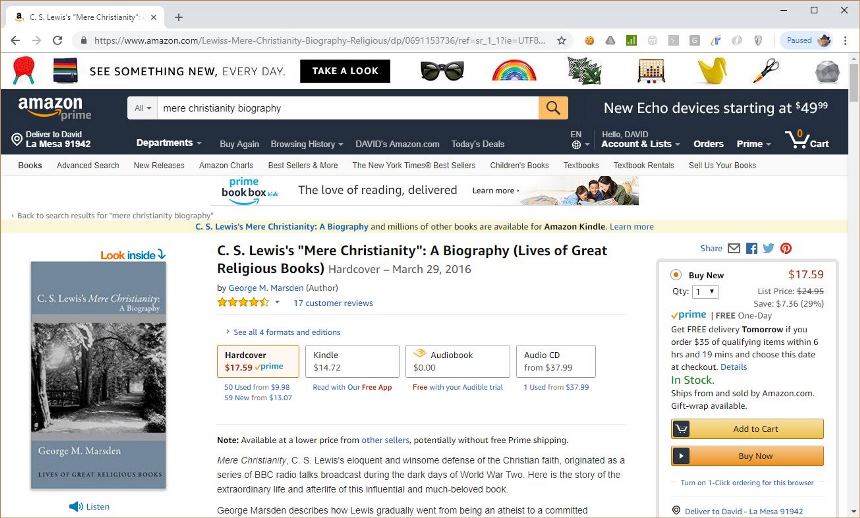
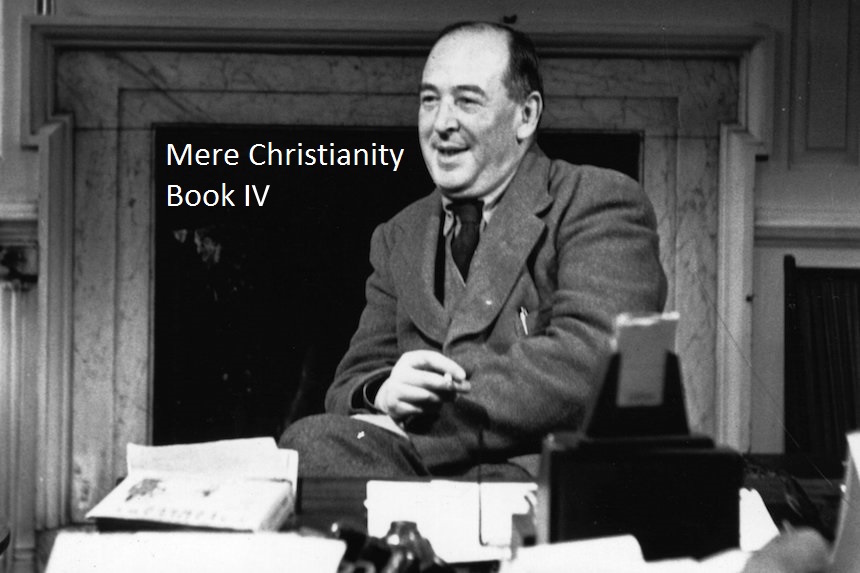
George Marsden recounts the genesis of what is probably Lewis’ most famous Christian apologetics book, Mere Christianity. He traces how Lewis’ talks to the RAF transitioned into radio addresses on the BBC and these were converted into three separate books which were ultimately collected together under the single title “Mere Christianity”.
It was interesting to hear the criticisms which were offered at the time against both Lewis and his arguments by skeptics, as well as the reception of his work over time among different Christian denominations.
If you like learning about C.S. Lewis, but want to read something a little different from the usual popular biographies, I’d thoroughly recommend this book!
Since it is the 500th anniversary of the Reformation, Nessa and I are devoting the next to episodes to the two key doctrines of the Reformation: “Sola Fide” (Faith Alone) and “Sola Scriptura” (Scripture Alone). Today we’ll begin by looking at the first of these doctrines, Sola Fide.
• Over the next two weeks we’re going to look at “Sola Fide” (Faith Alone) and “Sola Scriptura” (Scripture Alone)
• Luther thought that Sola Fide was the central element of Christianity:
“If the doctrine of justification is lost, the whole of Christian doctrine is lost” – Luther, Lectures On Galatians
• I quoted from the Protestant apologetics site “Got Questions”:
“Sola fide or faith alone is a key point of difference between not only Protestants and Catholics but between biblical Christianity and almost all other religions and teachings. The teaching that we are declared righteous by God (justified) on the basis of our faith alone and not by works is a key doctrine of the Bible and a line that divides most cults from biblical Christianity…
If we abandon the doctrine of justification by faith, we abandon the only way of salvation…
The Bible teaches that those that trust Jesus Christ for justification by faith alone are imputed with His righteousness, while those who try to establish their own righteousness or mix faith with works will receive the punishment due to all who fall short of God’s perfect standard” – GotQuestions.org (Emphasis added)
• A key text for Luther in relation to his doctrine of Sola Fide was:
“For we maintain that a person is justified by faith apart from the works of the law” – Romans 3:28
However, when he translated it, he added an additional word:
“For we maintain that a person is justified by faith ALONE apart from the works of the law” – Romans 3:28
To justify this change, Luther responded thus:
“If your papist wishes to make a great fuss about the word sola [alone], say this to him: ‘Dr. Martin Luther will have it so, and he says that a papist and a donkey are the same thing.'” – An Open Letter on Translating by Martin Luther
(The term “papist” here refers to Catholics)
• Luther was a master at insults. So much so, that today you can generate an insult from the Luther Insult Generator.
• When Paul talks about “works”, he is talking about the works of the Mosaic Law. In fact, he spends a lot of time in his letters comparing the Old Covenant with Moses to the New Covenant with Jesus.
• There only verse of the Bible which speaks of “faith alone” is the following passage from the Epistle of James:
“You see that a man is justified by works and not by faith alone” – James 2:24
Luther referred to this epistle as an “epistle of straw” and he moved it to the appendix of his translation of the Bible:
“We should throw the Epistle of James out of this school, for it doesn’t amount to much. It contains not a syllable about Christ. Not once does it mention Christ, except at the beginning. I maintain that some Jew wrote it who probably heard about Christian people but never encountered any.” – Luther’s works, vol. 54: Table Talk
• Nessa asked about what a Catholic should do if he “has a beef” with the Catholic Church. I suggested that it would probably depend upon the kind of issue at hand:
1. Doctrinal Issue
If you disagree with Catholic doctrine, first of all make sure that what you’re rejecting actually is the Catholic teaching on the matter and not some distortion of it. Once you have done this, find yourself a knowledgable Catholic to explain the basis of the doctrine.
2. Issues of Scandal
Reform yourself first! Be an example for others to imitate, imitating St. Francis and St. Dominic.
• I discussed my approach when discussing the Epistle of James. I ask a series of questions:
1. Can a dead faith save you? No? So you’re saying that you need a faith that’s alive?
2. Can a barren faith save you? No? So you’re saying that you need a fruitful faith?
3. Can an incomplete faith save you? No? So you’re saying that you need a complete faith?
• This then leads to another round of questions:
1. How is faith given life?
2. How is a barren faith made fruitful?
3. What is the difference between a complete faith and an incomplete faith?
The answer, according to the Epistle of James, is “Works”. In his letter, James teaches that faith must be living, fruitful and complete:
1. Living Faith “In the same way, faith by itself, if it is not accompanied by action, is dead”
– James 2:17
2. Fruitful Faith “Do you want to be shown, you foolish fellow, that faith apart from works is barren?”
– James 2:20
3. Complete Faith “[Abraham’s] faith was made complete by what he did”
– James 2:22
• On the subject of faith and works, I quote CS Lewis who said:
“Christians have often disputed as to whether what leads the Christian home is good actions, or Faith in Christ…it does seem to me like asking which blade in a pair of scissors is most necessary”
– Mere Christianity
• The Catholic Church does not teach a works-based righteousness. She condemned this heresy (“Pelagianism”) in the Fifth Century!
• I quote Lewis a second time when he’s explaining how the divine life should be nurtured and protected:
“Your natural life is derived from your parents; that does not mean it will stay there if you do nothing about it. You can lose it by neglect, or you can drive it away by committing suicide. You have to feed it and look after it: but always remember you are not making it, you are only keeping up a life you got from someone else. In the same way a Christian can lose the Christ-life which has been put into him, and he has to make efforts to keep it. But even the best Christian that ever lived is not acting on his own steam – he is only nourishing or protecting a life he could never have acquired by his own efforts”
– Mere Christianity
• The pithiest summary of salvation really comes from St. Paul’s epistle to the Galatians:
“The only thing that counts is faith expressing itself through love” – Galatians 5:6
• Pope Emeritus Benedict articulated this in one of
Being “just” simply means being with Christ and in Christ. And this suffices. Further observances are no longer necessary. For this reason Luther’s phrase: “faith alone” is true, if it is not opposed to faith in charity, in love. Faith is looking at Christ, entrusting oneself to Christ, being united to Christ, conformed to Christ, to his life. And the form, the life of Christ, is love; hence to believe is to conform to Christ and to enter into his love. So it is that in the Letter to the Galatians in which he primarily developed his teaching on justification St Paul speaks of faith that works through love – Pope Benedict XVI, Wednesday Audience, 19th November 2008
At last we come to the final chapter of “Mere Christianity” completing my notes for the book.
1. Christ came to transform
“…Christ’s work…is not mere improvement but Transformation. The nearest parallel to it in the world of nature is to be found in the remarkable transformations we can make in insects by applying certain rays to them. Some people think this is how Evolution worked”
(a) We are used to transformation through evolution
“…Everyone now knows about Evolution (though, of course, some educated people disbelieve it): everyone has been told that man has evolved from lower types of life. Consequently, people often wonder ‘What is the next step? When is the thing beyond man going to appear?'”
(b) People have constantly been incorrectly predicting the next step
“…I cannot help thinking that the Next Step will be really new; it will go off in a direction you could never have dreamed of. It would hardly be worth calling a New Step unless it did. I should expect not merely difference but a new kind of difference. I should expect not merely change but a new method of producing the change…. And finally, I should not be surprised if, when the thing happened, very few people noticed that it was happening”
(c) The Next Step is here
“Now, if you care to talk in these terms, the Christian view is precisely that the Next Step has already appeared. And it is really new. It is not a change from brainy men to brainier men: it is a change that goes off in a totally different direction – a change from being creatures of God to being sons of God. The first instance appeared in Palestine two thousand years ago”
This step has some differences in relation to the past…
“And in fact this New Step differs from all previous ones not only in coming from outside nature but in several other ways as well”
Picking back up my notes for C.S. Lewis’ “Mere Christianity”…
1. If Christianity is true, why are all Christians not obviously nicer than all non-Christians?
(a) Part of this question is very reasonable
“If conversion to Christianity makes no improvement in a man’s outward actions… I think we must suspect that his ‘conversion’ was largely imaginary…”
(i) Jesus told us to judge by results
“Fine feelings, new insights, greater interest in ‘religion’ mean nothing unless they make our actual behaviour better; just as in an illness ‘feeling better’ is not much good if the thermometer shows that your temperature is still going up… Christ told us to judge by results”
(ii) When we fail to live up to our calling, we make Christianity harder to believe for others
“When we Christians behave badly, or fail to behave well, we are making Christianity unbelievable to the outside world… Our careless lives set the outer world talking; and we give them grounds for talking in a way that throws doubt on the truth of Christianity itself”
(b) Part of this question is very unreasonable
But there is another way of demanding results in which the outer world may be quite illogical…. they should see the whole world neatly divided into two camps -Christian and non-Christian – and that all the people in the first camp at any given moment should be obviously nicer than all the people in the second.
There are several flaws with this kind of thinking…
Picking back up my notes for C.S. Lewis’ “Mere Christianity”…
1. “Be ye perfect” does not mean that God isn’t going to help us until we get our act together
“Some people seem to think this means ‘Unless you are perfect, I will not help you’; and as we cannot be perfect…our position is hopeless. But I do not think He did mean that. I think He meant ‘The only help I will give is help to become perfect. You may want something less: but I will give you nothing less'”
(a) Jack wouldn’t go to his mother with a toothache because he knew he’d get something else in addition to the relief from immediate pain…
(i) He’d wait until the pain got really bad
“When I was a child I often had toothache, and I knew that if I went to my mother she would give me something which would deaden the pain for that night and let me get to sleep. But I did not go to my mother – at least, not till the pain became very bad…”
(ii) …because he knew he’d also get a trip to the dentist…
“I did not doubt she would give me the aspirin; but I knew she would also do something else. I knew she would take me to the dentist next morning. I could not get what I wanted out of her without getting something more, which I did not want…”
(iii) …and the dentist wouldn’t restrict himself just to that tooth…
And I knew those dentists; I knew they started fiddling about with all sorts of other teeth which had not yet begun to ache… if you gave them an inch they took an ell”
(b) God is like a dentist
“Our Lord is like the dentists. If you give Him an inch, He will take an ell. Dozens of people go to Him to be cured of some one particular sin which they are ashamed of (like masturbation or physical cowardice) or which is obviously spoiling daily life (like bad temper or drunkenness). Well, He will cure it all right: but He will not stop there. That may be all you asked; but if once you call Him in, He will give you the full treatment”
Picking back up my notes for C.S. Lewis’ “Mere Christianity”…
1. Becoming a “son of God” is the entire point of Christianity
What I want to make clear is that this is not one among many jobs a Christian has to do; and it is not a sort of special exercise for the top class. It is the whole of Christianity. Christianity offers nothing else at all.
2. Becoming a “son of God” is not the same thing as “being good”
And I should like to point out how it differs from ordinary ideas of “morality” and “being good.”
(a) A person typically begins by recognizing the demands of the Moral Law upon his desires
We take as starting point our ordinary self with its various desires and interests. We then admit that something else call it “morality”… has claims on this self: claims which interfere with its own desires… Some of the things the ordinary self wanted to do turn out to be what we call “wrong”: well, we must give them up. Other things…turn out to be what we call “right”: well, we shall have to do them.
(b) We secretly hope that once we have met these demands, the natural self will be free to do what it wants
But we are hoping all the time that when all the demands have been met, the poor natural self will still have some chance, and some time, to get on with its own life and do what it likes.
(c) However, this will not work
…if you are really going to try to meet all the demands made on the natural self, it will not have enough left over to live on. The more you obey your conscience, the more your conscience will demand of you. And your natural self, which is thus being starved and hampered and worried at every turn, will get angrier and angrier.
Picking back up my notes for C.S. Lewis’ “Mere Christianity”…
1. This chapter is about how people pretend and their pretense leads to reality
(a) Beauty and the Beast
(b) A man wearing a beautiful mask for a year and his face becomes conformed to the attractive shape of the mask
2. We “pretend” as soon as we say the first two words of the Lord’s Prayer
“…Do you now see what those words mean? They mean quite frankly, that you are putting yourself in the place of a son of God. To put it bluntly, you are dressing up as Christ. If you like, you are pretending”
(a) When you pretend, you realize what a poor imitation you really make
“…the moment you realise what the words mean, you realise that you are not a son of God. You are not being like The Son of God, whose will and interests are at one with those of the Father: you are a bundle of self-centred fears, hopes, greeds, jealousies, and self-conceit, all doomed to death”
(b) This seems like cheek, but this is what God has commanded us to do
“…this dressing up as Christ is a piece of outrageous cheek. But the odd thing is that He has ordered us to do it.
He has done so because there are two kinds of pretending:
(i) The bad kind
“…where the pretence is there instead of the real thing; as when a man pretends he is going to help you instead of really helping you:
(ii) The good kind
“…where the pretence leads up to the real thing”
This explains some of our experience:
(A) Pretending to be friendly
“When you are not feeling particularly friendly but know you ought to be, the best thing you can do, very often, is to put on a friendly manner and behave as if you were a nicer person than you actually are. And in a few minutes, as we have all noticed, you will be really feeling friendlier than you were. Very often the only way to get a quality in reality is to start behaving as if you had it already”
(B) Children’s Games
“They are always pretending to be grown-ups-playing soldiers, playing shop. But all the time, they are hardening their muscles and sharpening their wits, so that the pretence of being grown-up helps them to grow up in earnest.”