What’s the difference between Sunni and Shiite?

Those of you who know me will know that I’ve spent the last few weeks with my head in a lot of books about Islam. You can expect some blog posts on various aspects of Islam in a couple of weeks.

However, today I would just like to share a short video concerning one issue within Islam which confused me for the longest time. We hear them mentioned quite a bit on TV, but what is the difference between Sunni and Shiite Muslims? Dr. Shabir Ally answers…

“They did not kill him”

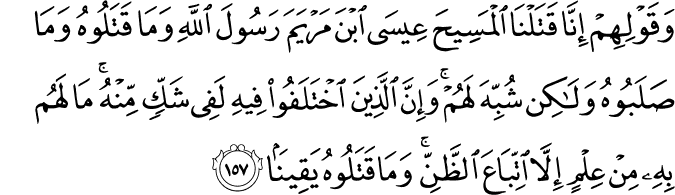
One of the major points of divergence between Islam and Christianity is that, in addition to denying Jesus’ divinity, Islam asserts that Jesus did not die on the cross. We find this assertion in Surah 4 of the Qur’an:

Just in case you don’t read Arabic(!), here is the English translation:

[They said] “Indeed, we have killed the Messiah, Jesus, the son of Mary, the messenger of Allah”… [But] they did not kill him, nor did they crucify him; but [another] was made to resemble him to them… Rather, Allah raised him to Himself – Surah 4:157-158, Sahih International

Read more

No compulsion in religion

A Tunisian man was recently martyred for converting from Islam to Christianity. As hard as it is to believe, video of his death was broadcast on Egyptian TV:

The footage shows a young man being held down by masked men with a knife to his throat. One man chants a number of Muslim prayers in Arabic, mostly condemning Christianity. The man holding the knife to the Christian convert’s throat begins to cut, slowly severing the head amid cries of “Allahu Akbar” (“god is great”). – GodReports

Allah says: “Let there be no compulsion in religion…”
– The Qu’ran, Surah al-Baqarah: 256

May he rest in peace. Please pray for that man and for all those in the area under persecution.

Then [Jesus] called the crowd to him along with his disciples and said: “Whoever wants to be my disciple must deny themselves and take up their cross and follow me. For whoever wants to save their life will lose it, but whoever loses their life for me and for the gospel will save it. What good is it for someone to gain the whole world, yet forfeit their soul? – Mark 8:34-36

Nostra Aetate

In the concluding post for the “Introduction to Islam” series I quoted the Second Vatican Council document “Nostra Aetate” since it provides Church teaching regarding non-Christian religions in general, and Islam in particular.

In the JP2 Group we will be working through this Council document, once we have concluded our current series.

In preparation for this study I have put together a formatted PDF of this document. I also recorded the text onto MP3, which I thought I would also post here:

Nostra Aetate (Download)

Introduction to Islam (Part 5 of 5): The Catholic Response

Today I would like to conclude my introductory series to Islam. This series wasn’t intended to be an apologetic response to Islam, just an accurate and objective description of Islamic belief and practice. It is my hope that this will lead to a better understanding of Islam by Christians.

Over the course of this series we have looked at the origins of Islam, Muhammad, the teaching of the Qur’an, as well as the faith and obligations of Muslim life.  I would now like to conclude by looking at what the Catholic Church had to say about Islam at the Second Vatican Council.

The Catholic Church sets forth its binding teaching regarding Islam in the “Declaration on the Relation of the Church with Non-Christian Religions” (also known as “Nostra Aetate”, literally “In our time”):

#1 In our time, when day by day mankind is being drawn closer together, and the ties between different peoples are becoming stronger, the Church examines more closely her relationship to non-Christian religions. In her task of promoting unity and love among men, indeed among nations, she considers above all in this declaration what men have in common and what draws them to fellowship.

One is the community of all peoples, one their origin, for God made the whole human race to live over the face of the earth. One also is their final goal, God…

The church says that she sees it her task to “promote unity and love”. This unity and love is fostered by considering what unites humankind and, in this “big picture” vision of the world, we are reminded that every single person comes from God and every single one will, some day, return to Him.

#2 … The Church, therefore, exhorts her sons, that through dialogue and collaboration with the followers of other religions, carried out with prudence and love and in witness to the Christian faith and life, they recognize, preserve and promote the good things, spiritual and moral, as well as the socio-cultural values found among these men.

Read more
1 6 7 8 9