Randomly Changing Perspective

One of the first things which struck me about the Qur’an the first time I read it was how it can suddenly and jarringly jump to a completely different scene, and even change who is speaking. For example, the following verse is clearly Allah speaking…

That is Paradise, which We will grant to whoever is devout among Our servantsQuran 19.63

…and then suddenly and without warning we now shift to the angels speaking as a group…

We only descend by the command of your Lord. To Him belongs whatever is before us, and whatever is behind us, and everything in between. And your Lord is never forgetful…Quran 19.64

The Torah and Injil are for mankind!

I’ve often been told that the Torah and the Injil were only for the Jews. However, two problems:

  1. The Qur’an never explicitly tells the Jews to follow the Injil, only the Christians
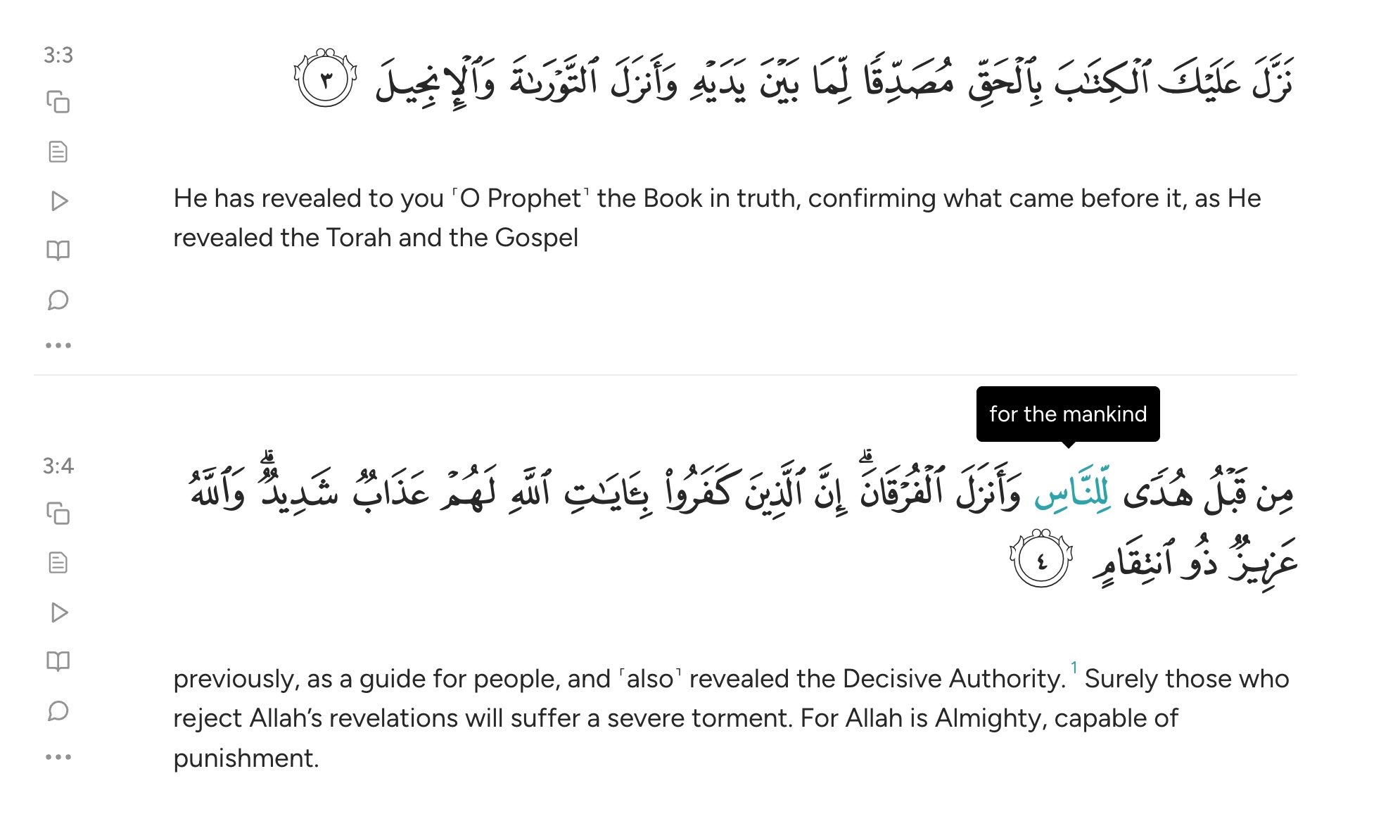
  2. The Qur’an actually describes both as “guidance for mankind”, even if the translations often try to obscure this:

The Pickthall translation doesn’t hide it:

He hath revealed unto thee (Muhammad) the Scripture with truth, confirming that which was (revealed) before it, even as He revealed the Torah and the Gospel. Aforetime, for a guidance to mankind; and hath revealed the Criterion (of right and wrong). Lo! those who disbelieve the revelations of Allah, theirs will be a heavy doom. Allah is Mighty, Able to Requite (the wrong). – Qur’an 3:3

My response to John Fontain

John Fontain recently debated David Wood on the Islamic Dilemma, which points out that the Qu’ran both affirms the Torah and Gospel while contradicting them.

John has a rather different strategy from other Muslim apologists by positing that there was an Islamic Torah and Islamic Gospel present at the time of Muhammad. He claims these are the documents the Qur’an refers to and confirms.

At one point in the debate, John asked David Wood for proof that the documents in the Hejaz were today’s Torah and four-fold Gospel, rather than John’s hypothetical documents. Obviously it’s much easier to do this at leisure and when one isn’t in the hot seat, here’s the answer I would have given…

John, there are lots of things I can’t prove. For example, I can’t prove that there isn’t a small teapot orbiting the sun… but that doesn’t mean I should expect one to be there! 

While it is technically possible that unique documents might have been present in Mecca and Medina, I can say for certain that there is no proof of such documents existing prior to the coming of Muhammad. Consider the timeline for a moment. It means that, for six hundred years in the case of the Gospel and for a couple of thousand years in the case of the Torah, there is no evidence of such documents existing. We have no manuscripts of these Islamic works and no fragments either. Not only that, nobody references them, neither the People of the Book nor their enemies. Don’t you not find that strange? If the Qur’an is true and Allah promised to make the true believers of Jesus uppermost from the days of his ministry until the Day of Resurrection, how is possible that Isa’s message, Apostles, and Scripture left no trace in history


In Early Christianity there was no military power to crush dissenters and there was no central political power such as Caliph Uthman to enforce textual uniformity.  Documents were shared by Christians throughout the world in an uncontrolled fashion, yet we find nothing like an Islamic Gospel or Islamic Torah. We also know about the disputes and heresies in Early Christianity (Docetism, Marcionism, Nestoriamism, Modalism etc), yet we find nothing that looks like Islam. 

Despite this absence of evidence, you John could provide us with the much-needed evidence to substantiate your extraordinary claim that there was an Islamic Torah and an Islamic Gospel present in the Hejaz… just show it to us! If these scriptures were in the possession of the Muslims, they would have preserved them, right? Surely it would have been in their interest to preserve them! Firstly, these were the words of Allah! Secondly, these works would have provided additional information about the earlier prophets. Thirdly, these documents would have contained the detailed prophecies about the coming of Muhammad. And finally, they would substantiate the Qur’an’s argument for its divine origin by showing how the Qur’an truly does confirm the earlier scriptures!

But there’s a problem, isn’t there? You can’t show us these documents because you don’t have them! There is an additional unfortunate consequence to this… If your theory is true, it is Muhammad-believing Muslims who last had custody of the uncorrupted earlier scriptures, yet they seem to have inexplicably my lost them! So, even if you can explain how these documents survived in secret for thousands of years and then mysteriously turned up in the 7th Century Hejaz, you also have to explain why the Muslims failed to preserve them and also why we don’t find any early Islamic scholars lamenting the fact that is was Muhammad’s immediate followers who lost the best possible evidence to confirm the claims of Islam. 

I would suggest that it’s more logical to conclude that your theory is incorrect and your Islamic Torah and Gospel never existed. 

How is “muhaimin” translated?

Those who attempt to say that the Qur’an teaches the corruption of the earlier scriptures, often appeal to Qur’an 5:48, but this argument turns on the translation of the word “muhaimin”. I therefore surveyed all the Qur’anic English translations I could find…

The Translations

And to you We have revealed the Book containing the truth, confirming the earlier revelations, and preserving them (from change and corruption)
– Ahmad Ali

We have sent down to you the Book with the truth, confirming what was before it of the Book and as a guardian over it.
– Ali Qarai

And O dear Prophet (Mohammed – peace and blessings be upon him) We have sent down the true Book upon you, confirming the Books preceding it, and a protector and witness over them
– Amhad Khan

And We have sent down to thee the Book with the truth, confirming the Book that was before it, and assuring it
– Arberry

And We revealed to you the Book in [the] truth, confirming what (was) before his hands of the Book and a guardian over it
– Corpus

And We have sent down the Book unto thee with truth; and confirming that which hath preceded it of the Book, and a guardian thereof
– Daryabadi

And We have sent down to you (O Muhammad SAW) the Book (this Quran) in truth, confirming the Scripture that came before it and Mohayminan (trustworthy in highness and a witness) over it (old Scriptures)
– Hilali & Khan

Then We revealed the Book to you (O Muhammad!) with Truth, confirming whatever of the Book was revealed before, and protecting and guarding over it.
– Maududi

We have revealed the Book to you (Muhammad) in all Truth. It confirms the (original) Bible and has the authority to preserve or abrogate what the Bible contains. 
– Muhammad Sarwar

And We have revealed to you the Book with the truth, verifying what is before it of the Book and a guardian over it
– Muhammad Shakir

And unto thee have We revealed the Scripture with the truth, confirming whatever Scripture was before it, and a watcher over it.
– Pickthall

And to you We have revealed the Book with the truth confirming the Book that was revealed before it, and a guardian over it.
– Qaribullah

And We have revealed to you, [O Muhammad], the Book in truth, confirming that which preceded it of the Scripture and as a criterion over it
– Sahih International

And We revealed to you the Book, with truth, confirming the Scripture that preceded it, and superseding it
– Talal Itani

We have sent down the Book to you with the truth, fulfilling [the predictions] revealed in the previous scriptures and determining what is true therein
– Wahihuddin Khan

To thee We sent the Scripture in truth, confirming the scripture that came before it, and guarding it in safety
– Yusuf Ali

The Analysis

As you can see, the most consistent translation of the word relates to the Qur’an’s protection of the earlier Scriptures: “…preserving them… a guardian over it… a protected and witness over them… assuring it… a guardian over it… a guardian thereof… trustworthy in highness and a witness… protecting and guarding over it… a guardian over ita watcher over ita guardian over itguarding it in safety

This clear consensus makes the polemical nature of the remaining four all the more obvious, offering a “translation” which goes far beyond the the Arabic text:

  • a criterion over it”
    – Sahih International
  • confirming the Scripture that preceded it, and superseding it
    – Talal Itani
  • “has the authority to preserve or abrogate what the Bible contains”
    – Muhammad Sarwar
  • fulfilling [the predictions] revealed in the previous scriptures and determining what is true therein…”
    – Wahihuddin Khan

The bias of Sahih International’s translation is particularly blatant, translating it as “criterion”, pretending that the Arabic text says “furqan” rather “muhaimin”. Even among this group, Talal Itani seems to suggest that the earlier scriptures are uncorrupted, but just subordinate to the Qur’an.

Early Commentators

It’s instructive to look at how earlier Qur’anic commenators explained the word:

  • “Witness” (Al-Suddi, Qadadah, Ibn Abbas, Mujahid)
  • “Entrusted/Faithful” (Ibn Abbas, Qadadah, Mujahid, Ikrimah, Al-Hasan, Saeed bin Jubayr and others)
  • “Confirmer” (Ibn Zayd, Al-Hasan, Al-Hussein and others)
  • “Preserver” (Al-Khalil, and noted by Al-Tabari and Al-Qortobi)
  • “Judge” (Ibn Abbas, Saeed bin al-Musayyab, Al-Dahhak)
  • “Guardian” (Al-Khalil)

A Qur’anic Contradiction in a single verse

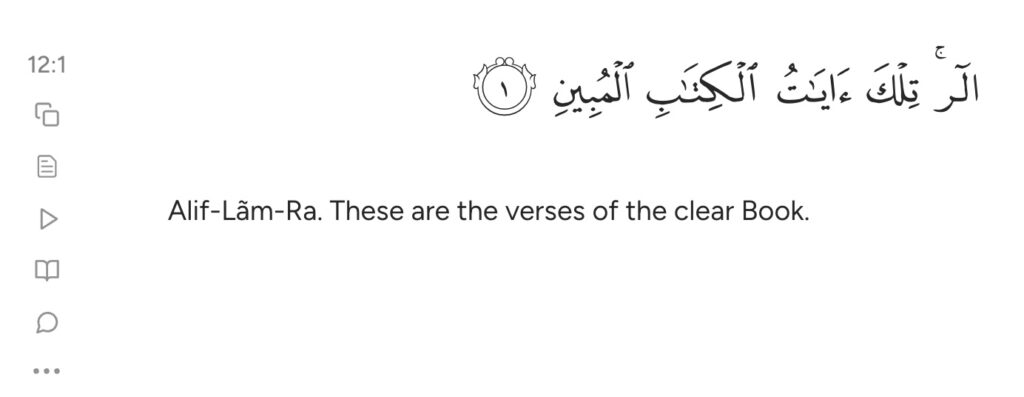
The Qur’an claims that if it were not from God, there would be many contradictions in it. However, there is one Qur’anic verse which presents an inherent contradiction! In chapter 12, verse 1, the Qur’an says the following:

If the Qur’an is a “clear Book”, what does “Alif-Lam-Ra” mean? The “clear Book” doesn’t tell you, doesn’t even give you a hint! Not only that, if you explore the issue, you find there isn’t even anything close to a consensus among Islamic exegetes.

Scientific Claims in the Qur’an and Hadith

The sun sets in muddy spring (18:86)

Semen comes from between backbone & ribs (86:6-7)

Stars are missiles to shoot devils (67:5)

If a fly lands in your drink, one wing has the cure (Bukhari 3320)

A baby’s sex decided by who climaxes first (Bukhari 3329)

1. **Expanding Universe**: The Quran’s vague mention of the heavens being “built with power” or “expanded” (e.g., Quran 51:47) is not a unique or precise prediction of the Big Bang or cosmic expansion, which were discovered through modern astronomy, not religious texts.

2. **Iron’s Origin**: While science confirms iron was formed in stars, this was known to ancient civilizations (e.g., Egyptians and Mesopotamians) through meteorites, predating the Quran. The Quran’s claim (Quran 57:25) doesn’t provide new scientific insight.

3. **Embryology**: The Quran’s descriptions of human development (e.g., Quran 22:5, 23:12-14) are often interpreted post-hoc to match modern embryology. However, they lack detail and accuracy—e.g., describing stages like “alaqa” (clot) doesn’t align with scientific understanding and reflects 7th-century knowledge.

4. **Fingerprints**: The Quran (e.g., Quran 75:4) mentions preserving individual traits but doesn’t specifically predict the uniqueness of fingerprints, a concept developed scientifically in the 19th century by figures like Sir Francis Galton. These “scientific miracles” are often retrofitted interpretations, not precise predictions, and rely on ambiguous language that can be reinterpreted to fit new discoveries. Many pre-Islamic cultures and texts also had similar observations, undermining the claim of divine origin.

Prepubescent Marriage in Islam

  • Qur’an 33:49 states that a waiting period (“Iddah”) is needed if a marriage was consummated. This is to make sure that the woman isn’t pregnant.
  • Qur’an 65:4 outlines three different categories of women regarding the Iddah:
    • Pregnant women whose waiting period ends with the delivery of the child
    • Those who don’t have periods any more have a waiting period of 3 months
    • Those who have never menstruated have to wait 3 months
  • Ibn Kathir’s commentary (14th Century) confirms who this last group is:
    • The same for the young, who have not reached the years of menstruation. Their `Iddah is three months like those in menopause.”
  • Al-Jalalayn (16th Century) says the same:
    • …and [also for] those who have not yet menstruated, because of their young age, their period shall [also] be three months 
  • Sahih al-Bukhari 5133 and Sunan an-Nasa’i 3378 (among others) confirm that Muhammad married Aisha when she was six and consummated the marriage when she was nine when she was still playing with dolls.
1 2 3 9