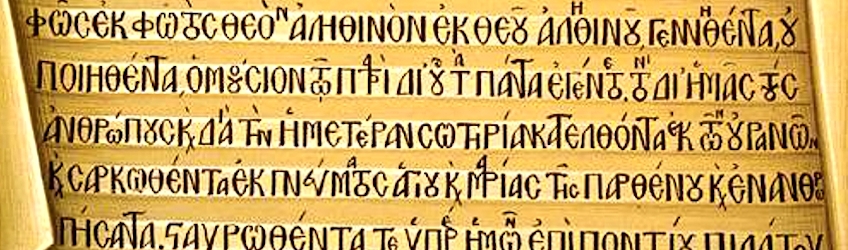
Changing the Creed

I could tell I was tired this morning… During the Divine Liturgy I went into autopilot as we sung the Creed, which unfortunately meant that I sang loudly “I believe in the Holy Spirit…who proceeds from the Father and the Son. Oops!

In case you are unaware, in Eastern Christianity, the last part of that sentence is not included in the Nicene Creed. This creed was the product of two Ecumenical Councils, Nicaea and Constantinople, so technically we should call it the Nicene-Constantinoplean Creed.

The argument surrounding the clause “and the Son” is known as the “Filioque Controversy”, since “Filioque” is the Latin word which was added to the Creed in the West. This controversy dates back to the Great Schism of 1054. The history surrounding it is a little complicated, but the long and the short of it is that one of the reasons much of the Eastern Church broke communion with Rome was due to the addition of this word to the Creed in the West.
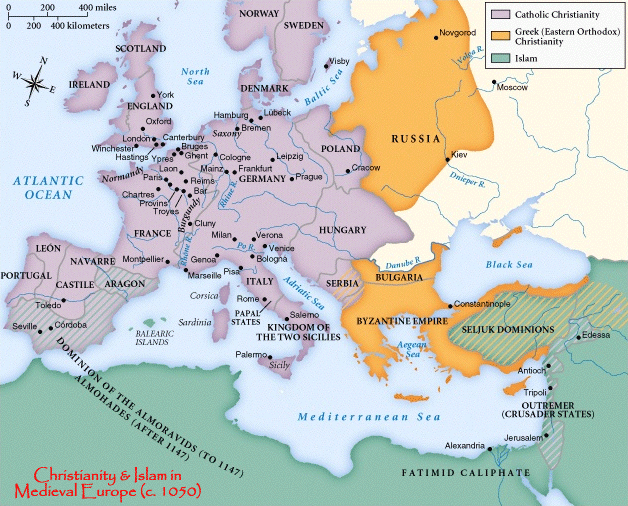
Schism

However, my purpose in this post isn’t so much to speak about the Filioque, but to talk about another slip up I made today when I sang “God from God, Light from Light, true God from true God…”

More changes?!

Back when I lived in San Diego, I often attended the San Diego Orthodox Young Adults Group. Once when I was hanging out with them, one of my Eastern Orthodox friends asked me why the Catholic Church made so many changes to the Creed. What did he mean? There were changes in addition to the Filioque?! That was news to me! However, he then pointed out that in the West we say:

I believe in one Lord Jesus Christ,
the Only Begotten Son of God,
born of the Father before all ages.
God from God, Light from Light,
true God from true God,

In the East, however, the phrase in bold, “God from God”, does not appear!

Creedal Variations

I spent a little bit of time digging into this issue and I was rather surprised to find out that there were actually quite a few creedal variations in the ancient Church. In fact, you could go as far as to say that all the ancient versions differ at least to some degree from the official text given at Nicaea and Constantinople.

For example, the Councils used the first person plural throughout: We believe… We confess… We await…”. However, the Byzantine Churches changed it to the first person singularI believe… confess… await”. Historically, the Latin Church did the same, although until relatively recently, English-speaking Catholics would say “We”. However, following the liturgical reforms of 2011 and retranslation of the Roman Missal to represent more faithfully the Latin text, all Catholics now say “I” instead.

Another textual variation in the Latin text is the one mentioned by my Eastern Orthodox friend. It is true that, in addition to the Filioque clause, the Latin liturgical text has another difference. In the Latin, it reads Deum de Deo, Lumen de Lumine, Deum verum de Deo vero”, which translates asGod from God, Light from Light, true God from true God”. It turns out that the clause, “God from God”, although not found in the Creed from Constantinople, is actually found in the earlier creed from Nicaea. For some reason, this was retained in the Latin. The Armenian text includes this and other variations as well.

Conclusions?

So what should we conclude? I’m not really sure, but I think we can acknowledge two things. The first is simply that there is more variation in the “Nicene Creed” than we commonly think, and the second is that I need to make sure I have a nice cup of tea before I attempt to sing any complex theology in the mornings.

UPDATE: Michael Lofton just recorded a livestream with even more details on this subject:

Open hearts and sweaty palms

Today I would like to discuss briefly a liturgical question of our time: should the congregation hold hands during the Our Father? In 1963, the Beatles sang “I wanna hold your hand”. Well, that’s all fine and good, but there’s a time and place for everything…

A couple of weeks ago a friend of mine sent me a link to an article which argues why the congregation should not hold hands during the Our Father. Broadly speaking, I agree with the arguments made in the article. However, when people bring up this subject, I often take a different tack to the explanation presented in the article…

Read more

The Sabbatical Plan

SabbaticalA week ago I began my sabbatical. Following my spiritual director’s suggestion, I spent that first week away on retreat. I spent my time at a monastery, dedicating the next two months of discernment to the Lord.



The monastery I visited was a Benedictine monastery in Oregon. Having grown up around Benedictine monks, I felt very much at home. It was wonderful having the rhythm of my day guided by the monastic office, even if the (very loud) bell rang for Vigils at 5:30am each day!

It was really nice to have some time away and get a complete change of scenery. I got plenty of rest and spent most of my time reading and writing. It was so good to quiet the noise inside and to have an opportunity collect my thoughts.

I got back Sunday evening and yesterday I spent planning, working out the day-to-day routine of the months ahead…

The Plan

In the mornings I’ll be going to Matins and Divine Liturgy and then I’ll repair to a coffee shop to work on the book for a couple of hours. I’ll try and go to a different coffee shop each day and I’m planning on keeping track of them on this map:

I’ll then come home and cook lunch. I do love cooking but normally I’m too rushed/lazy/impatient to do it. Therefore, during this sabbatical, I’m going to endeavor to expand my usual repertoire of dishes by following a recipe each day.

The afternoons will begin with an hour of exploring new technologies which will then be followed by a long walk through one of Seattle’s many beautiful parks. I’ll listen to a lecture on my iPod, but I’ll always spend the last half an hour in peaceful silence. When I get back I’ll spend some time reading the mountain of books I’ve assembled.

The evenings will be spent relaxing, working out and the odd Holy Hour.

This Week…

This week, during my walks I will be listening to John – The Sacramental Gospel from St. Paul’s Center for Biblical Theology. The meals I will cook will include Spicy Salmon with Bok Choy, Chicken CurrySalmon With Creamy Cucumber-Fennel SaladPasta With Turkey and Broccoli and Southwestern Beef Chili With Corn.

Top Five Ways to be a Rockstar Godparent

Over the last few years I’ve had the honour of sponsoring several people for Baptism and Confirmation. Over my time as a godparent, I’ve asked other sponsors what they do to live out this special vocation.

infant_baptism-600x398

In today’s post I’ve assembled all the advice I’ve heard from other godparents and sponsors and come up with the top five ways to godparent like a rockstar…
Read more

Book Announcement!

Today I’d like to share with you something I’m going to be working on during my sabbatical. For the longest time, my bucket list has contained an entry which reads “Write a book and get it published”. I think it’s finally time to cross off that entry…

Typwriter

The Need and the Vision

I’ve been involved with different Bible Study groups, both in the USA and back in England, for about ten years. During this time, I’ve searched for a book to help guide me in leading these different groups. Unfortunately, that book doesn’t appear to exist! In the Protestant world, I’ve found books which help with basic Biblical exegesis and personal reading, but nothing substantial on leading a group study. In the Catholic world, there are even slimmer pickings. In light of this, over the next couple of months I’m going to be writing the book that I wish I had read a decade ago!

This book is going to lead the reader through the entire process of running a Bible Study, from beginning to end. My goal is to make this book extremely practical, coving all the nitty-gritty details of setting up and running a group. It will guide the reader through a typical Bible Study meeting, providing lots of handy hints as to how to nurture the discussion and avoid common pitfalls. In the appendices I hope to have all kinds of usual material, including a modified version of my commentary on Philippians. It is my hope that, even with no prior experience, once somebody has this book in his hands he will have everything he needs to start a successful Bible Study in his parish.

You’re Involved too!

As a reader of Restless Pilgrim, this involves you! I will be blogging about the book over the coming months and asking for your feedback. This begins today! I’m currently trying to come up with a working title for this book. Please help me choose it by voting below:

I’d also like to choose a tag line or subtitle for the book:

I’m really excited about this and I’d love to hear your thoughts! What would you look for in a book like this? Is there a particular issue related to Bible study groups which you’d particularly like to see addressed?

Quick Apology: The authority to forgive sins…

ForgivenessOne of my favourite things about having a blog is that, every now and then, I’ll get an email out of the blue from someone I don’t know. I love getting emails from people I’ve never met. There’s something quite wonderful in having an interaction with someone from across the continent or even the world, all because of something you’ve written!

Very often when I get emails they contain questions of an apologetics nature. I’m trying to get better at converting these email exchanges into posts. So, in light of that, I would like to share a response I gave to an email I received a few weeks ago. The gentleman asked the following question:

While discussing Christ’s establishment of the Sacrament of Reconciliation, I brought up John 20:21-23.  My Protestant friends said that this is Jesus’ way of warning everyone not to hold a grudge against someone by retaining their sin. I know what Jesus was doing here, but I lack the bomb-proof Catholic response to this interpretation; can you help?

I’m not sure if my response qualifies as “bomb-proof”, but here was my reply…

Read more

The Baggage of Sola Scriptura

wpf087e6e3_06Today we have a guest post from Tom Massoth, the father-in-law of my friend John, who will also soon be a guest poster here at Restless Pilgrim.
Tom and his wife of 39 years, Michele, reside in Yorba Linda, CA where they raised their two daughters Lisa and Jennifer. Now blessed with four perfect grandchildren, this retired Boeing engineer dedicates his time to God, family and friends, and various time-gobbling hobbies such as cycling. He is also a a Certified Flight Instructor in both airplanes and gliders. 

Tom has a love of Scripture and is a student of Church history and the early development of Christian doctrines. His particular interest lies in presenting the fullness of the Catholic faith in simple and easy-to-understand terms to Catholics and non-Catholics alike. He prays for a more unified Christian faith in the world and sees open honest dialog as the key to spreading the Good News.

Here is what Tom has to say on the subject of Sola Scriptura…

Following apologetic debates on various internet blogs is usually interesting, sometimes entertaining and often very frustrating. The exchanges start with the initial blog entry that posits a position favored by the author, which invariably includes historical evidence, perhaps quotations from the writings of Church fathers and of course verses from Holy Scripture that are offered as proof of point in question.

The comment boxes then fill in reaction using the same general modus operandi: “Great Point!” leads the pack. “Ridiculous Point!” soon follows. Still another says “Ref. Romans X: Y-Z and you’ll see the real truth and proof of your foolish conclusions!” Another commenter counters with “Hey, this is so easy, just read 1 Cor A: B, which of course refers to Psalm ##, which was foreseen by Jeremiah L: MN-OP.” the beat goes on, and the beat goes on.

The most frustrating scenario, however, is a case when people holding opposing views on a particular topic offer the exact same Bible verse as proof to support their position! We then have two differing viewpoints, both claiming the inspired Word of God as proof of their positions. We know that the Bible cannot contradict itself; so where do we go from here?

Now, I’m not a member of clergy, nor a trained theologian or Bible scholar, but it doesn’t take an expert to see that something is terribly wrong with the way we are attempting to discover and embrace God’s revealed truth. Jumping from proof text to proof text, trying to understand the position, arguments and supporting evidence, it soon becomes apparent that the Bible per se is no longer at the core of the controversies. It was people themselves that had somehow replaced the single truth of God’s Word.

A battle cry of the Protestant Reformation was the idea of Sola Scriptura, i.e. that the Bible and the Bible alone stands as the sole revelation of God’s truth to mankind. I fully accept the Bible as the inspired Word of God, so at a certain level I agree with the spirit of Sola Scripture. That said, for any premise like Sola Scriptura, we must not only understand the basic concept, we must also peel back the layers to see what other conclusions necessarily come along as an implied attachment.

To that end, I would like to discuss a thought experiment that began with a definition of Sola Scriptura, which continued through some intermediate observations and ended with a most unexpected conclusion…

Consequences

Read more

1 78 79 80 81 82 172