Mere Christianity – Book III – Chapter 1 (“The Three Parts of Morality”)

Book-3

Picking back up my notes for C.S. Lewis’ “Mere Christianity”…

Notes & Quotes

1. Many people think of morality as something which interferes, particularly with our enjoyment.

(a) However, morality is there for our own good.

“…moral rules are directions for running the human machine. Every moral rule is there to prevent a breakdown, or a strain, or a friction, in the running of that machine”

(b) What might initially seem right to us will cause problems.

“When you are being taught how to use any machine, the instructor keeps on saying, ‘No, don’t do it like that,’ because, of course, there are all sorts of things that look all right and seem to you the natural way of treating the machine, but do not really work”

2. Some people prefer to talk about “ideals” and “idealism” rather than “rules” and “obedience”.

(a) However, it is misleading to call moral perfection an ideal because it implies that it’s a private taste and therefore not binding on all

“When a man says that a certain woman…is ‘his ideal’ he does not mean…that everyone else ought to have the same ideal. In such matters we are entitled to have different tastes and, therefore, different ideals”

(b) It could lead to pride…

“It might lead you to become a prig and to think you were rather a special person who deserved to be congratulated on his ‘idealism'”

(c) …and this is as foolish as being congratulated in trying to not make a mistake in your arithmetic

“…you might just as well expect to be congratulated because, whenever you do a sum, you try to get it quite right. To be sure, perfect arithmetic is ‘an ideal’; you will certainly make some mistakes in some calculations. But there is nothing very fine about trying to be quite accurate at each step in each sum.

It would be idiotic not to try; for every mistake is going to cause you trouble later on. In the same way every moral failure is going to cause trouble, probably to others and certainly to yourself. By talking about rules and obedience instead of “ideals” and ‘idealism’ we help to remind ourselves of these facts”

3. Morality can be expressed in the metaphor of a fleet of ships

(a) The ships must have internal integrity and external integrity in relation to one another

“The voyage will be a success only, in the first place, if the ships do not collide and get in one another’s way; and, secondly, if each ship is seaworthy and has her engines in good order

…you cannot have either of these two things without the other. If the ships keep on having collisions they will not remain seaworthy very long. On the other hand, if their steering gears are out of order they will not be able to avoid collisions”

(c) Additionally, the final destination is fundamentally important

“…however well the fleet sailed, its voyage would be a failure if it were meant to reach New York and actually arrived at Calcutta”

4. An alternative metaphor is that of a musical band

“…think of humanity as a band playing a tune. To get a good result, you need two things. Each player’s individual instrument must be in tune and also each must come in at the right moment so as to combine with all the others.

…The instruments might be all in tune and might all come in at the right moment, but even so the performance would not be a success if they had been engaged to provide dance music and actually played nothing but Dead Marches”

5. We may therefore conclude that morality concerns three things:

(a) Exterior: Social relations with other humans

(b) Interior: The harmonising of the interior life

(c) Teleological: In relation to the purpose of man and his creator

6. When speaking about morality, modernity tends to ignore the last two

“When people say in the newspapers that we are striving for Christian moral standards, they usually mean that we are striving for kindness and fair play between nations, and classes, and individuals; that is, they are thinking only of the first thing”

(a) It is quite natural to focus on the first one because its effects are obvious and there is general agreement

“…the results of bad morality in that sphere are so obvious and press on us every day: war and poverty and graft and lies and shoddy work. And also, as long as you stick to the first thing, there is very little disagreement about morality”

(b) However, we can’t stop there…

“Unless we go on to the second thing-the tidying up inside each human being-we are only deceiving ourselves.

What is the good of telling the ships how to steer so as to avoid collisions if, in fact, they are such crazy old tubs that they cannot be steered at all? What is the good of drawing up, on paper, rules for social behaviour, if we know that, in fact, our greed, cowardice, ill temper, and self-conceit are going to prevent us from keeping them?”

(c) We must consider the individual’s morality (the “second thing”) because we rely upon it

“…nothing but the courage and unselfishness of individuals is ever going to make any system work properly

It is easy enough to remove the particular kinds of graft or bullying that go on under the present system: but as long as men are twisters or bullies they will find some new way of carrying on the old game under the new system. You cannot make men good by law: and without good men you cannot have a good society. That is why we must go on to think of the second thing: of morality inside the individual”

(d) We must also consider our purpose (the “third thing”)…

“…religion involves a series of statements about facts, which must be either true or false. If they are true, one set of conclusions will follow about the right sailing of the human fleet: if they are false, quite a different set”

(i) …because the answer to this question may reveal responsibilities 

“…If somebody else made me, for his own purposes, then I shall have a lot of duties which I should not have if I simply belonged to myself”

(ii) …and because it makes a difference whether we live forever

“…there are a good many things which would not be worth bothering about if I were going to live only seventy years, but which I had better bother about very seriously if I am going to live for ever”

(A) Moral Trajectory

“Perhaps my bad temper or my jealousy are gradually getting worse – so gradually that the increase in seventy years will not be very noticeable. But it might be absolute hell in a million years: in fact, if Christianity is true, Hell is the precisely correct technical term for what it would be”

(B) The individual and society

“If individuals live only seventy years, then a state, or a nation, or a civilisation, which may last for a thousand years, is more important than an individual. But if Christianity is true, then the individual is not only more important but incomparably more important, for he is everlasting and the life of a state or a civilisation, compared with his, is only a moment”

7. Jack is going to assume the Christian point of view moving forward

“For the rest of this book I am going to assume the Christian point of view, and look at the whole picture as it will be if Christianity is true”

Discussion Questions

1. How do many people view morality? How does Jack present it?

2. Why should we not be surprised when we find that morality “interferes”?

3. What is the problem with talking about morals as “ideals”?

4. What are the two metaphors Jack uses to explain the different components of morality?

5. What are these three parts of morality? Around which parts are there consensus?

6. What can we not just stop at inter-personal morality? Why does interior morality matter? What are the consequences for society?

7. Why does it matter if we live forever?

C.S. Lewis Doodle

Restless Heart: 6 – “Is there life before marriage?” (Part II)

Bridget

Nessa is back and we’re picking back up our discussion “Is there life before marriage?”. In today’s episode we talk about discernment, virtue and service.

Episode 6: Is there life before marriage? (Download)


— Show Notes —

* If you would like to listen to my original talk I gave on this subject to the Goretti Group, it is available here. The YouTube video is also available here.

* During our discussion, Nessa shared a quotation from Catholic Teen Posts on Instagram:

Purity is not the elimination of sexual attraction, but the ordering of sexual attraction demanded by love.

– Catholic Teen Posts

* …and the the quotation I offered from Ravi Zacharias was as follows:

“Chivalry in love has nothing to do with the sweetness of the appearance. It has everything to do with the tenderness of a heart determined to serve”

– Ravi Zacharias

Please subscribe to this podcast using iTunes and Google Play and if you have any feedback or would like to pose a question for an upcoming episode, you can send us a message from the website or tweet us at @davidandnessa.

Restless Heart: 5 – “Intercommunion”

Communion

Unfortunately, this episode I’m flying solo! Nessa wasn’t able to make it so I thought it best to record on my own, rather than let another week pass without a new episode. In today’s episode I tackle the delicate subject of “Intercommunion” and explain why, under normal circumstances, the Eucharist is not given to non-Catholic Christians.

Episode 5: Intercommunion (Download)


— Notes —

* This episode was based on a two-part series I wrote a few years ago.

* I quote from two Early Church Fathers in this episode. The first is St. Justin Martyr:

“This food we call [the Eucharist], and no one is allowed to partake but he who believes that our doctrines are true, who has been washed with the washing for the remission of sins and rebirth, and who is living as Christ has enjoined… “

“…We do not receive these as common bread and drink. For Jesus Christ our Saviour, made flesh by the Word of God, had both flesh and blood for our salvation. Likewise, we have been taught that the food blessed by the prayer of his word…is the flesh and blood of Jesus who was made flesh.”

– Justin Martyr, First Apology, Chapter 66 (~ AD 150)

* The second Father I quote is St. Ignatius of Antioch:

“They abstain from the Eucharist and from prayer, because they do not confess the Eucharist is the flesh of our Saviour Jesus Christ, which suffered for our sins, and which the Father, in His loving-kindness, raised from the dead”

– Ignatius of Antioch, Letter to the Smyrnaeans, Chapter 7 (~AD 97)

* I also quote from a portion of one of St. Paul’s letters:

“Whoever, therefore, eats the bread or drinks the cup of the Lord in an unworthy manner will be guilty of profaning the body and blood of the Lord. Let a man examine himself, and so eat of the bread and drink of the cup. For any one who eats and drinks without discerning the body eats and drinks judgment upon himself. That is why many of you are weak and ill, and some have died”

– 1 Corinthians 11:29–30

* The Spiritual Communion prayer I quote is as follows:

“My Jesus, I believe that You are present in the Most Holy Sacrament. I love You above all things, and I desire to receive You into my soul. Since I cannot at this moment receive You sacramentally, come at least spiritually into my heart. I embrace You as if You were already there and unite myself wholly to You. Never permit me to be separated from You. Amen”

Please subscribe to this podcast using iTunes and Google Play and if you have any feedback or would like to pose a question for an upcoming episode, you can send us a message from the website or tweet us at @davidandnessa.

“Is there life before marriage?”…the video

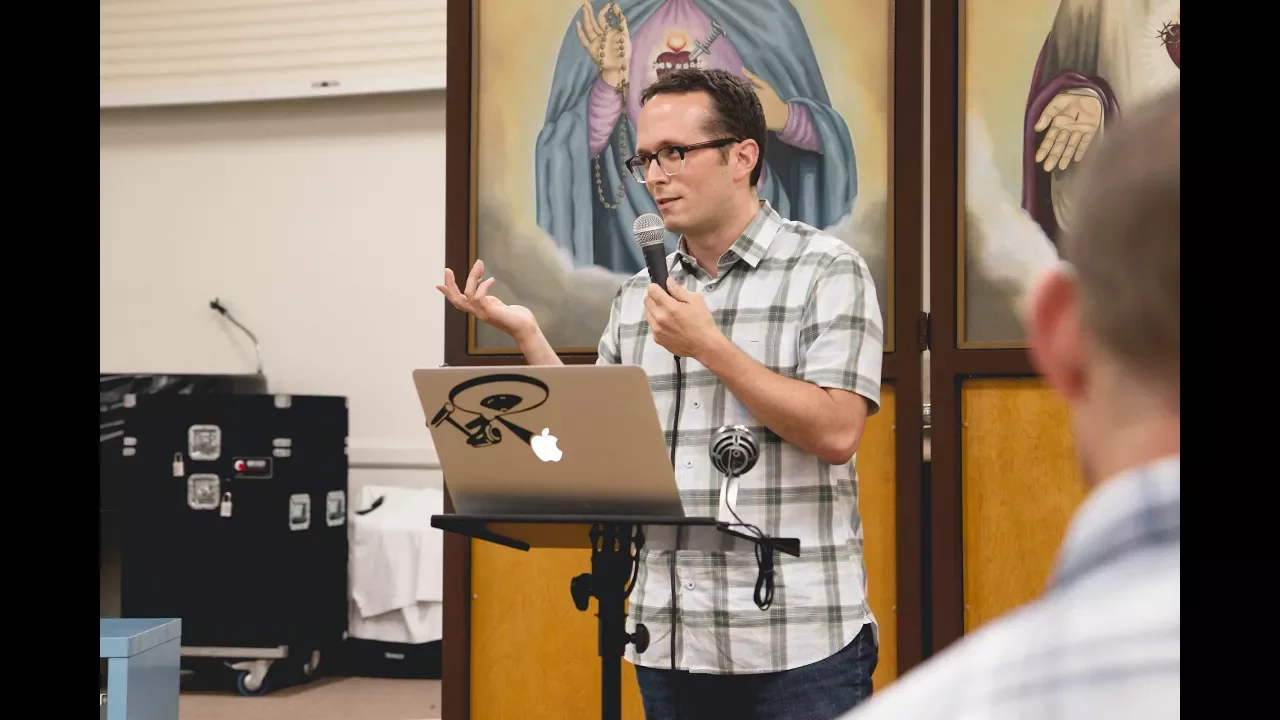
A few weeks ago I gave my presentation on “Is there life before marriage?” to the Goretti Group. The audio for that evening is available here, but I just saw that the video has been posted on the Goretti Group’s YouTube Channel:
If you would like the audio version of this presentation, you can download it from the feed on iTunes and Google Play.

You also might be interested to hear the discussion of some of the ideas raised in this talk between myself and Nessa on recent episodes of The Restless Heart podcast (Episode 4 and Episode 6). The podcast itself is available on iTunes and Google Play.

Restless Heart: 4 – “Is there life before marriage?” (Part I)

Bridget

This past week, I gave at talk to the Goretti Group entitled “Is there life before marriage?” In today’s episode, Nessa and talk about some of the issues I raised in that talk. Do some people derive their self-worth from their Facebook “Relationship Status”? What are some common misunderstandings concerning marriage? We then look at the subject friendships, the first area which I suggest deserves careful investment during your single years.

Episode 4: Is there life before marriage? (Download)


— Show Notes —

* If you would like to listen to my original talk I gave to the Goretti Group, it is available here.

* The Bible passage I quote at the end of the episode is this section from Sirach:

Let your acquaintances be many, but one in a thousand your confidant.
When you gain a friend, first test him, and be not too ready to trust him.
For one sort is a friend when it suits him, but he will not be with you in time of distress.

A faithful friend is a sturdy shelter; he who finds one finds a treasure.
A faithful friend is beyond price, no sum can balance his worth.
A faithful friend is a life-saving remedy, such as he who fears God finds;
For he who fears God behaves accordingly, and his friend will be like himself.

– Sirach 6:6-17

Please subscribe to this podcast using iTunes and Google Play and if you have any feedback or would like to pose a question for an upcoming episode, you can send us a message from the website or tweet us at @davidandnessa.

Mere Christianity – Book II (Summary)

Book 2You can look at my more detailed notes, but this is an overview of the content of Book II of “Mere Christianity”…

Chapter 1 – “Rival Conceptions of God”

Quotations

Truth in other religions

If you are Christian you do not have to believe that all the other religions are simply wrong all through. If you are an atheist you do have to believe that the main point in all the religions of the whole world is simply one huge mistake. If you are a Christian, you are free to think that all those religions, even the queerest ones, contain at least some hint of the truth…[However,] as in arithmetic – there is only one right answer to a sum…but some of the wrong answers are much nearer being right than others

Pantheism

…these people think that long before you got anywhere near the divine point of view the distinction [between good and evil] would have disappeared altogether…

Pantheists usually believe that God, so to speak, animates the universe as you animate your body: that the universe almost is God, so that if it did not exist He would not exist either, and anything you find in the universe is a part of God…

If you do not take the distinction between good an bad very seriously, then it is easy to say that anything you find in this world is a part of God

Non-Pantheists

…[these people believe in] a God who takes sides, who loves love and hates hatred, who wants us to behave in one way and not in another…

…God invented and made the universe – like a man making a picture or composing a tune. A painter is not a picture, and he does not die if his picture is destroyed

…if you think some things really bad, and God really good, then you cannot talk like that. You must believe that God is separate from the world and that some of the things we see in it are contrary to His will…a great many things have gone wrong with the world that God made and that God insists, and insists very loudly, on putting them right again

Evil and God

My argument against God was that the universe seemed so cruel and unjust. But how had I got this idea of just and unjust? A man does not call a line crooked unless he has some idea of a straight line…I could have given up my idea of justice by saying it was nothing but a private idea of my own. But if I did that then my argument against God collapsed too – for the argument depended on saying that the world was really unjust, not simply that it did not happen to please my fancies

Questions

1. Why does Jack say that when he became a Christian he adopted the more “liberal” view?

2. Is it possible to affirm the truth of other religions while still holding to the absolute truth claims of Christianity?

3. Can you think of any religion completely devoid of ALL truth?

4. Into what two central conceptions of God does Jack say people hold? Do you think we could divide it up in a different way?

5. In what way do these conceptions of God and our attitudes towards the Moral Law and the Universe relate to each other?

6. Why does the very question of asking about evil in the world presuppose the existence of God?

Read more

1 22 23 24 25 26 137