Baptism Matters: Part 1 (Scripture)

Over the last six months, many of my non-Catholic Christian friends have given birth to their first child. This was brought about, presumably, through the combination of an extremely poor TV lineup last summer and an abundance of free time on their part.

With this wonderful addition to their family, several of these new parents are now facing a dilemma: should they baptize their newborn child? 

You see, in many cases, one spouse comes from a denomination where infant baptism isn’t performed (Baptists, Seventh Day Adventists, non-denominationals) and the other has come from a denomination where it is standard practice (Catholic, Orthodox, Lutheran, Anglican, Methodist). The parents typically make the choice to either baptize their child or to have some kind of dedication ceremony.

This is an important issue to me. I was once a member of Protestant congregation where they did infant baptisms, but they also carried out child dedications, depending upon the wishes of the parents.  This inconsistency was an important catalyst in my study of the ancient Christian faith and my eventual reversion to the Catholic Church.
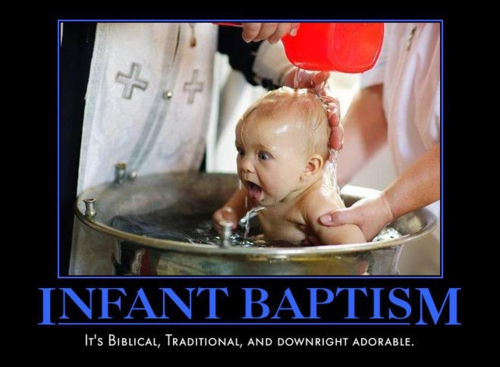
infant-baptism

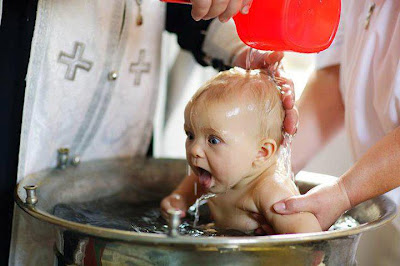
So, in the next few posts I would like to present the basic case in favour of infant baptism…
Read more

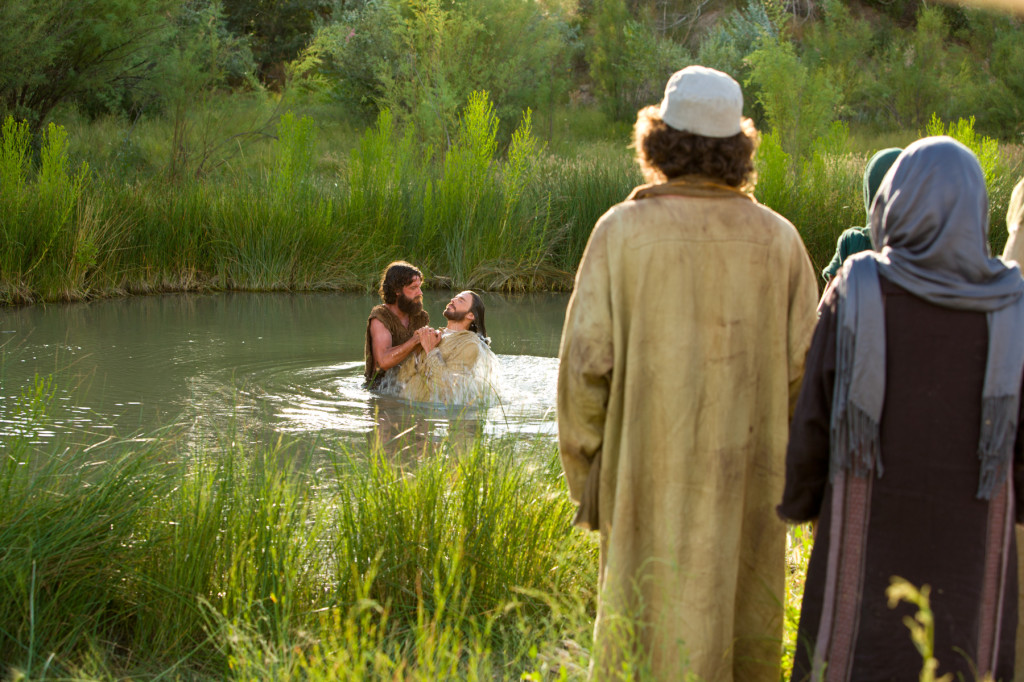
What my legs tell you about Jesus’ Baptism

As I’ve mentioned, I’m currently part of a Bible study in which we are working through St. Matthew’s Gospel. A couple of weeks ago we read Matthew’s account of Jesus’ baptism…

Baptism

This event is something of a head scratcher. I mean, who was it that had been coming to John for baptism? Sinners! So why did Jesus, the sinless Son of God, come to be baptized? What business had he there? In our perplexity, we are in good company since John the Baptist thought it kinda barmy too:

Then Jesus came from Galilee to the Jordan to John, to be baptized by him. John would have prevented him, saying, “I need to be baptized by you, and do you come to me? – Matthew 3:13-14

So why did Jesus come to be baptized? During our discussion in the Bible Study I pointed at my legs and asked “What do these tell you?”

Read more

Sunday Lectionary: Bread from Heaven

I’ve been on vacation this week so my notes are late and not quite as polished as they are normally.

Eighteenth Sunday in Ordinary Time: 2nd August, 2012

Our Readings this week focus again on the subject of sacred food.

In the First Reading, we read how the Israelites were fed with manna in the desert. The manna is also the subject of this week’s Psalm, as psalmist proclaims “The Lord gave them bread from heaven”. These are also the words quoted by the crowd who come to Jesus after “The Feeding of the Multitude”. The crowd comes expecting another free meal, but rather than filling their stomachs, Jesus directs them towards deeper spiritual realities, declaring Himself to be “the bread of life” and that “whoever comes…will never hunger, and whoever believes…will never thirst”.

Our understanding of the Second Reading may be illuminated by considering the rite of Baptism in the early centuries of the Church. In preparation for the Sacrament, someone wishing to be baptised would receive a period of instruction. Afterwards, he would then arrive at the Baptismal pool and shed himself of his clothes, symbolically demonstrating that he wished to put away the old self of [the] former way of life, corrupted through deceitful desires”. He would then descend into the baptismal pool where he would be washed in the name of the Father, Son and Holy Spirit,renewed in the spirit of [his] mind”. He would then ascend and be clothed in a white garment to show that he had put on the new self, created in God’s way in righteousness and holiness of truth”. After having been washed in the waters of regeneration, this newly-born Christian would be admitted to the liturgy of the Eucharist where he would finally receive the bread of life.

We too have been washed in the waters of baptism, we too have been admitted to the altar.  Let us live our lives this week in the “holiness of truth” . We do not receive simply the “bread of angels”, but something even greater, “the bread of life”  Himself.

When, through the hand of the priest, you receive the Body of Christ, think not of the priest which you see, but of the Priest you do not see. The priest is the dispenser of this food, not the author. The Son of man gives Himself to us, that we may abide in Him, and He in us – Alcuin

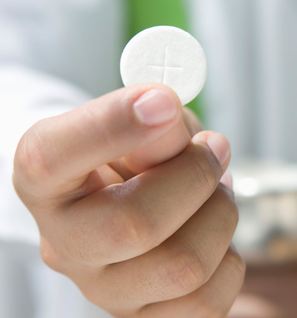
Eucharist

Read more

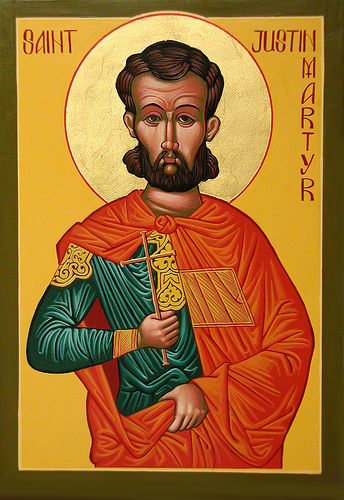
Justin Martyr’s Worship

Justin MartyrFor the next three weeks in the JP2 Group we’re going to be looking at the worship in the Early Church.

The following text is an extract from the writing of Justin Martyr (c AD 100 – 165). The document is known as his First Apology, which was written to the Emperor Antionius Pius around AD 150-155. Various English translations were used in the rendering of this extract.

We will be studying this text as a group tomorrow.  At the weekend I’ll do another post about this text, together with a little bit of commentary…

Chapter 65: Baptism & Eucharist

After we have washed someone who has been convinced and has accepted our teaching, we bring him to the place where those who are called “brethren” are assembled. Together, then, we offer hearty prayers: for ourselves, for the illuminated person, and for all others in every place. We pray that we may be counted worthy, now that we have learned the truth, by our works be found good citizens and keepers of the commandments, so that we may be saved with an everlasting salvation.

Having ended the prayers, we greet one another with a kiss. Then bread and a cup of wine mixed with water are brought to the president of the brethren. Taking them, he gives praise and glory to the Father of the universe, through the name of the Son and of the Holy Spirit, and he offers thanks at considerable length for our being counted worthy to receive these things.

And when he has concluded the prayers and thanksgivings, all the people present express their assent by saying “Amen”, the Hebrew for “so be it”. And when the president has given thanks, and all the people have expressed their assent, those who are called “deacons” give to each person present a portion of the bread and the wine mixed with water, over which the thanksgiving was pronounced. To those who are absent, they carry away a portion.

Read more

1 2 3 4