Tuesday Adventures

Yesterday at midday I got a text from Carrie, the Young Adult Coordinator for the Diocese. The speaker for that night’s “Faith On Fire” was ill and she needed a replacement speaker. This is how I came to find myself a few hours later standing in front of forty or so 18-25 year olds giving the talk “Social Media and Faith-“How to use it without being used by it”

Fortunately, I wasn’t the only one speaking that night. After speaking for about half an hour, Timmerie Millington got up and shared with us how Social Media has played an important part in her Pro-Life work.

Throughout the night I rather shamelessly plugged my blog, so if you’re visiting here for the first time because of that, welcome! While you’re here, you should also go check out Timmerie’s Blog:


Church Councils

Two weeks ago in our Acts of the Apostles Bible study we covered Acts 15 where we heard about the Council of Jerusalem in AD 52.
In our discussion we also spoke about Ecumenical Councils, when the bishops of the world are gathered together to settle issues facing the Church. I said I would put something up here listing those councils. Here they are…

AD 325: Nicea
Issue: The Divinity of Christ

AD 381: Constantinople
Issue: The Divinity of Holy Spirit

AD 431: Ephesus
Issue: Mary as “Theotokos” (“God Bearer”)

AD 46I: Chalcedon
Issue: The two natures in Christ

AD 476:  The Fall of Rome

AD 553: Constantinople II
Issue: Condemned a variety of writings.

AD 680: Constantinople III
Issue: The two wills in Christ

AD 787: Nicea II
Issue: The veneration of images

AD 869: Constantinople IV

AD 1054 Eastern Schism. The East has never held another council. 

AD 1123, 1139, 1179, 1215: Lateran I, II, III and IV

AD 1245 & 1274: Lyons I & II

AD 1311: Vienne

AD 1414: Constance 
Western Schism

AD 1453 Fall of Constantinople

AD 1512: Lateran V

AD 1545: Trent
Issue: Dealt with Luther’s teachings and made Church reforms

AD 1869: Vatican I

AD 1963: Vatican II

Epicurians and Stoics

Yesterday, during our Acts of the Apostles Bible study, we read the section in Acts 17 where St. Luke talks about St. Paul’s interaction with some philosophers in Athens:

“While Paul was waiting for them in Athens, he was greatly distressed to see that the city was full of idols. So he reasoned in the synagogue with both Jews and God-fearing Greeks, as well as in the marketplace day by day with those who happened to be there. A group of Epicurean and Stoic philosophers began to debate with him” – Acts 17:16-18

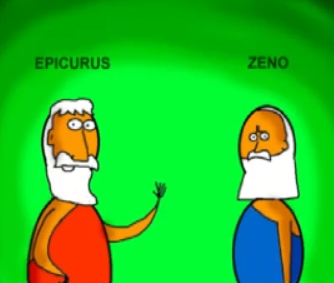
Who were these “Epicurean and Stoic philosophers”? What did they believe? All will be answered in the video below:

So, the Epicureans were founded by Epicurus. They believed that things are “good” and “bad” based upon whether they give pleasure or pain. The Epicureans were negative hedonists, attempting to eliminate desires since Epicurus regarded it as a kind of pain. His followers didn’t fear death because once you’re dead no harm can come to you.

Zeno was the founder of the Stoics. They determined “good” and “bad” based upon whether something was seen as virtue or vice. Pleasure was seen as a vice and was therefore to be avoided. Unrealistic expectations were seen as the source of grief in life.

1 478 479 480 481 482 586