A Little thought: Dangers of being literalistic…

For the last few weeks, for one reason or another, I haven’t been able to attend the Divine Liturgy at my parish, meaning that I’ve had to go to a Roman Mass instead. The Readings for the last couple of weeks in the Roman Lectionary have been rather interesting. Over the next couple of days I wanted to share a few extremely brief thoughts…

The First Reading on 27th July caught my attention. We heard of Solomon’s encounter with the Lord, and God’s gift to him of divine wisdom. At the end of the passage, God says to Solomon the following:

“I give you a heart so wise and understanding that there has never been anyone like you up to now, and after you there will come no one to equal you.” – 1 Kings 3:12

It struck me that this is a perfect example as to why we have to be careful when we interpret the Bible. If we were to take this passage literalistically*, we would have to conclude that Solomon is absolutely, categorically, the wisest man ever. However, from the Christian point of view, that’s not true, is it? What about Jesus? Wasn’t Jesus wiser than Solomon?

“Well, obviously, Jesus is the exception!” some might say. Now, that’s true, but it does at least demonstrate the point that words like “never” and phrases like “no one” aren’t always quite as absolute as they may first appear.
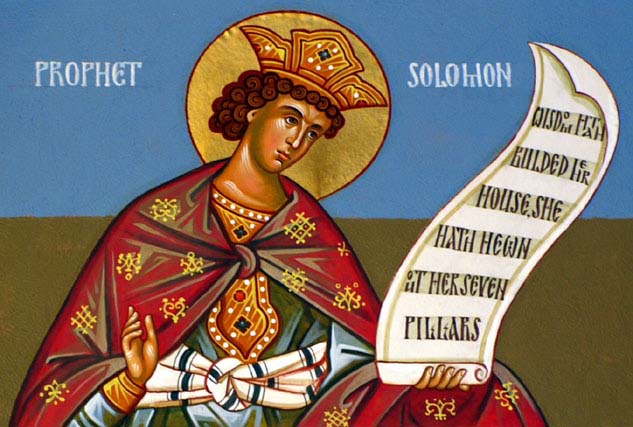
Prophet-Solomon1

* This is in contrast to interpreting a passage literally, which is where we look to the meaning intended by the Author. The phrase “It’s raining cats and dogs”, when literally interpreted, means that it’s raining heavily. To interpret “It’s raining cats and dogs” literalistically means that family pets are falling form the sky.

Music Monday: Sancte Deus (Nimrod)

We’re back to classical music for this week: “Sancte Deus” performed by All Angels. If you attend the Byzantine liturgy or pray the Chaplet of Divine Mercy, the lyrics should sound familiar…
Sancte Deus
(Holy God)

Sancte Fortis
(Holy and mighty)

Sancte et Immortalis, miserere nobis
(Holy and immortal one, have mercy on us)

Peter and the Fathers

The new pastor at my parish has taken to regularly including quotations from the Early Church Fathers. Here are the quotations on the feast of St. Peter and Paul:

Accept our counsel and you will have nothing to regret. If anyone disobeys the things which have been said by [Jesus] though us, let them know that they will involve themselves in no small danger. We, however, shall be innocent of this sin and will pray with entreaty and supplication that the Creator of all may keep unharmed the number of his elect
– St. Clement of Rome, Letter to the Corinthians 58:2, 59 (AD 95)

The Lord says to Peter “I say to you that you are Peter and upon this rock I will build my Church” On him he builds the Church and to him he gives the command to feed the sheep (John 21:17), and although he assigns a like power to all the apostles, yet he founded a single chair [cathedra], and he established by his own authority a source and an intrinsic reason for that unity. Indeed the others were also that which Peter was [i.e. apostles], but primacy is given to Peter, whereby it is made clear that there is but one Church and one chair. So too all [the apostles] are shepherds, and the flock is shown to be one, fed by all the apostles in single-minded accord. If someone does not hold fast to this unity of Peter, can he imagine that he still holds the faith? If he should desert the chair of Peter upon whom the Church was built, can he still be confident that he is in the Church?
– St. Cyrpian of Carthage, The Unity of the Catholic Church (AD 252)

For the Father gave to Peter the revelation of the Son; but the Son gave him to sow that of the Father and that of Himself in every part of the world; and to a mortal man He entrusted the authority over all things in heaven, giving him the keys, who extended the Church to every part of the world, and declared it to be stronger than heaven
– St. John Chrysostom, Homily LIV on Matthew 16:2,3

Fathers

Fall down seven times stand up eight

Fall Down Seven, Get Up EightI have a confession.

At the beginning of the year I announced that one of my New Year Resolutions was to read the Bible from cover-to-cover in a year. It was all going so well… I had managed to get through the hard bits: the genealogies of Genesis, the battles of Exodus and even the liturgical rubrics of Leviticus. In fact, at the halfway point of this year I was even a little ahead of schedule in my daily reading.

Ah, but then things went awry… I had a couple of tough, busy weeks and it all went to pot. I got out of the habit of reading my Bible each day. The habit was broken and before I knew it, two months had passed and I hadn’t done any of my set reading.

As of yesterday, I was miles behind on my assigned schedule and hadn’t done any devotional reading in ages. Today that changed. Today I set aside some time. I read my Bible for about half an hour. It was long overdue. It was a small beginning, but at least it was a start.

This struggle to re-establish the habit of daily Scripture reading got me to thinking about a similar struggle in the Spiritual life…

Failures

Times of failure are so hard. It’s always tempting to think “Well, I’ve screwed this up. There’s no point trying again”. If you’re working towards a goal, failures and setbacks can be so demoralizing. There is the temptation to give up, particularly when the final goal seems so far off.

If you’ve ever tried dieting and ended up binging one evening, you’ll know the temptation just to throw in the towel. Starting again just seems too hard and helpless. I’ve heard people express something similar in reference to Confession, choosing to forgo Confession entirely rather than repeatedly confessing some habitual sin.

Rocky

Read more

1 356 357 358 359 360 586