One of the first things which struck me about the Qur’an the first time I read it was how it can suddenly and jarringly jump to a completely different scene,
I’ve often been told that the Torah and the Injil were only for the Jews. However, two problems: The Pickthall translation doesn’t hide it: He hath revealed unto thee (Muhammad)
John Fontain recently debated David Wood on the Islamic Dilemma, which points out that the Qu’ran both affirms the Torah and Gospel while contradicting them. John has a rather different
Those who attempt to say that the Qur’an teaches the corruption of the earlier scriptures, often appeal to Qur’an 5:48, but this argument turns on the translation of the word
I’m reading through the Qu’ran one last time this year and wanted to follow along with a Tafsir. I discovered Quran Garden which was just the sort of thing I
The Qur’an claims that if it were not from God, there would be many contradictions in it. However, there is one Qur’anic verse which presents an inherent contradiction! In chapter
The sun sets in muddy spring (18:86) Semen comes from between backbone & ribs (86:6-7) Stars are missiles to shoot devils (67:5) If a fly lands in your drink, one
The Qur’an speaks about Allah helping the followers of Jesus and keeping them “uppermost”, but this presents a dilemma since, historically, this has to refer to Trinitarian Christians… which is
Today’s song is one which I discovered through the Catholic Playlist Show and I’ve had it on pretty much constantly this entire weekend. The tune is catchy, but it was the lyrics which caught the heart of this Restless Pilgrim! The song is “Walk by faith” by John Finch:
There are days I still long for purpose
to see the plans that you have willed for me.
Though sometimes I am walking through the valley,
I’m certain you are always right beside me
Even when I can’t see, I can’t see…
And you have gone before me, before me…
And I will walk by faith, I will walk by faith
The future is a mystery, a mystery…
Forever will you lead me, lead me…
And I will walk by faith, I will walk by faith
Lord, I’m looking for a perfect answer
to all the questions my heart begs of you
And if you give me more than I can handle,
I will pray for strength to make it through
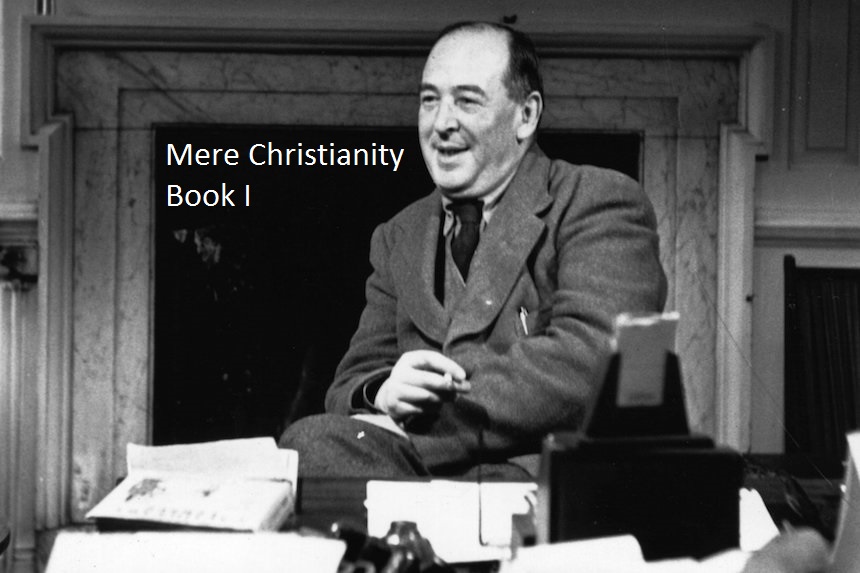
You can look at my more detailed notes, but this is an overview of the content of Book I of “Mere Christianity”…
Preface
Quotations
Mere Christianity
…I have thought that the best…service I could do for my unbelieving neighbours was to explain and defend the belief that has been common to nearly all Christians at all times…So far as I can judge…the book…did at least succeed in presenting an agreed, or common, or central, or ‘mere’ Christianity…it may possibly be of some help in silencing the view that, if we omit the disputed points, we shall have left only a vague and bloodless [Highest Common Factor]. The H.C.F. turns out to be something not only positive but pungent”
Omitted Topics
I should be very glad if people would not draw fanciful inferences from my silence on certain disputed matters…There are questions at issue between Christians to which I do not think we have been told the answer…you cannot even conclude, from my silence on disputed points, either that I think them important or that I think them unimportant. For this is itself one of the disputed points…I have a reluctance to say much about temptations to which I myself am not exposed…
The Roman Catholic beliefs on that subject are held not only with the ordinary fervour that attaches to all sincere religious belief, but…with…chivalrous sensibility that a man feels when the honour of his mother or his beloved is at stake…contrariwise…Protestant beliefs on this subject…it seems that the distinction between Creator and creature (however holy) is imperilled.
[Regarding contraception], I am not a woman nor even a married man, nor am I a priest. I did not think it my place to take a firm line about pains, dangers and expenses from which I am protected; having no pastoral office which obliged me to do so.
The name “Christian”
When a word ceases to be a term of description and becomes merely a term of praise, it no longer tells you facts about the object: it only tells you about the speaker’s attitude to that object… A gentleman, once it has been spiritualised and refined out of its old coarse, objective sense, means hardly more than a man whom the speaker likes
The Hall Analogy
It is more like a hall out of which doors open into several rooms…it is in the rooms, not in the hall, that there are fires and chairs and meals. The hall is a place to wait in, a place from which to try the various doors, not a place to live in…you must be asking which door is the true one; not which pleases you best by its paint and panelling…Are these doctrines true: Is holiness here?…be kind to those who have chosen different doors and to those who are still in the hall. If they are wrong they need your prayers all the more; and if they are your enemies, then you are under orders to pray for them. That is one of the rules common to the whole house
Questions
1. Why does Jack say that this book not help someone decide between two different denominations? Why did he write the book in this way?
2. Was it a good idea to leave out controversial topics? Why does he say he does this? Do you think this hampers the book?
3. How would you define “Christian”? How does Jack define it? Do you think this is a sufficient definition?
4. Do you find Jack’s “Hall and rooms” analogy helpful when talking about different denominations? What advice does he give for interacting with Christians of other denominations? What do you disagree with and what advice would you add?
These are my notes from reading through “Mere Christianity” with a local San Diego book club.
Notes & Quotes
1. The Moral Law points to something beyond the material universe
“…in the Moral Law somebody or something from beyond the material universe…[is] getting at us”
2. Some readers might complain that Lewis tricked them
“…that I had been carefully wrapping up to looking like philosophy what turns out to be one more ‘religious jaw’…but if it turns out to be only religion…the world has tried that and you cannot put the clock back”
(a) Sometimes you have to go back to go forward
“…progress means getting nearer to the place where you want to be. And if you have taken a wrong turning, then to go forward does not get you any nearer…it is pretty plain that humanity has been making some big mistake”
(b) We have not yet reached “religion”
“We have not yet got as far as the God of any actual religion… We have only got as far as a Somebody or Something behind the Moral Law…“
(i) We are trying to discover more about this Something behind the Moral Law from the universe. From this, we see the Being is…
(A) An Artist
“…we should have to conclude that He was a great artist (for the universe is a very beautiful place)…”
(B) Dangerous
“…but also that He is quite merciless and no friend to man (for the universe is a very dangerous and terrifying place)”
(ii) We are also trying to discover more about this Being from the Moral Law itself.
(A) The Being cares about Right and Wrong
“…the Being behind the universe is intensely interested in right conduct…”
(B) We cannot yet call this being forgiving
“The Moral Law does not give us any grounds for thinking that God is ‘good’ in the sense of being indulgent, or soft, or sympathetic. There is nothing indulgent about the Moral Law. It is as hard as nails… if there does exist an absolute goodness it must hate most of what we do”
(C) He’s not a tame lion
“God is the only comfort, He is also the supreme terror: the thing we most need and thing we most want to hide from”
(c) Christianity doesn’t make sense until you understand the questions it attempts to answer
“Christianity tells people to repent and promises them forgiveness. It there has nothing…to say to people who do not know they have done anything to repent of and who do not feel that they need any forgiveness…. When you know you are sick, you will listen to the doctor”
Discussion Questions
1. Given what you’ve learned in Book I, what can you say to friends and family to make the case for Christianity? What illusions can keep us from recognizing the truth of this book?
2. Why does a God behind the Moral Law both attract and terrify us?
3. How does the Moral Law make sense within the context Christianity specifically?
These are my notes from the penultimate chapter of Book 1 of “Mere Christianity”:
1. What is this universe and how did it come to be here? There are two (or three) main views on the subject (neither of which are new):
(a) The Materialist view
“…matter and space just happen to exist…[which] by some sort of fluke produced creates like ourselves who are able to think”
(b) The Religious View
“…which is behind the universe is more like a mind…conscious, and has purposes, and prefers one thing to another…”
2. Science can’t tell you which view is correct
“…why anything comes to be…and whether there is anything behind the things science observes – something of a different kind – this is not a scientific question”
3. We know more about mankind than the universe because we don’t simply observe mankind
“We do not merely observe men, we are men…we have, so to speak, inside information”
4. Since we are man, we know that we are under a moral law
“…men find themselves under a moral law, which they did not make, and cannot quite forget even when they try, and which they know they ought to obey”
5. If there a controlling power outside the universe it could not be inside the universe
“…no more than the architect of a house could actually be a wall… The only way in which we could expect it to show itself would be inside ourselves as an influence or a command trying to get us to behave in a certain way”
6. This doesn’t take us all the way to the Christian God
“All I have got to is a Something which is directly the universe, and which appears in me as a law urging me to do right… I think we have to assume it is more like a mind than it is like anything else we know – because…the only other thing we know is matter and you can hardly imagine a bit of matter giving instructions”
7. There was actually a third possible worldview regarding the universe, Life-Force philosophy
“…the small variations by which life on this planet ‘evolved’…were not due to chance but to the ‘striving’ or ‘purposiveness’ of a Life-Force”
(a) When we hear someone say this, we should ask whether this “life-force” has a mind:
(i) If yes, then it is really a god
(ii) If no, then how can something without a mind ‘strive’ and have ‘purposes’?
(b) This worldview is attractive
“…it gives one much of the emotional comfort of believing in God and none of the less pleasant consequences…[the life-force] will never interfere with you like that troublesome God we learned about when we were children. The Life-Force is a sort of tame God… All the thrills of religion and none of the cost.”
Discussion Questions
1. Lewis offers two fundamental views of the universe. What are they and how do they differ from each other?
2. Why can’t science help us decide which view is correct? Would this discount proofs for God such as the Kalaam Argument?
3. What extra information does Lewis say we have which can help us to point us to an answer?
These are my notes for Chapter 3 of “Mere Christianity”. Here, Jack tries to penetrate the Law of Human Nature more deeply and explains why its presence and our disobedience to it is odd…
1. The fact that there is a Law of Human Nature and that we don’t always obey it is odd
(a) Some people questioned why he called it “odd”
(i) They said that it’s not odd, it only shows that humans are imperfect
(ii) …but Jack points out that the idea of something being imperfect is important
“…the very idea of something being imperfect, of its not being what it ought to be, has certain consequences”
(b) He asks whether, when you say that stones obey the Law of Gravity whether or not it’s the same thing as just saying what stones do.
“The laws of nature, as applied to stones or trees, may only mean ‘what Nature, in fact, does'”
(c) However, the Law of Human Nature tells us something different and this is odd, it is prescriptive, not descriptive…
“…the Law of Human Nature tells you what human beings ought to do and do not. In other words, when you are dealing with humans, something else comes in above and beyond the actual facts. You have the facts (how men do behave) and you have something else (how they ought to behave)”
2. Some will try to explain away the oddness…
(a) …by saying that when someone doesn’t act rightly he is simply being inconvenient to you
“…we might try to make out that when you say a man ought not to act as he does, you only mean the same as when you say that a stone is the wrong shape [for your rockery]; namely, that what he is doing happens to be inconvenient to you”
(i) However, we can have two identical inconveniences yet blame one while we might not blame another.
“A man occupying the corner seat in the train because he got there first, and a man who slipped into it while my back was turned and removed my bag, are both equally inconvenient”
(ii) We can be angry even if we are not inconvenienced
“I am angry with a man who tries to trip me up even if he does not succeed”
(iii) We call some behaviour “bad” even if it is convenient to us!
“In war, each side may find a traitor on the other side very useful. But though they puse him and pay him they regard him as human vermin“
(iv) Our own “good” behaviour often is inconvenient!
“It means things like…doing school work honestly when it would be easy to cheat…staying in dangerous places when you would rather go somewhere safer, keeping promises you would rather not keep…”
(b) …by saying that “good” behaviour might not benefit us immediately, but benefits humanity as a whole
“…decent conduct does not mean what pays each particular person at a particular moment…it means what pays the human race as a whole”
(i) It is true that safety and happiness is dependent upon societal cooperation
“…[we] see that you cannot have any real safety or happiness except in a society where every one plays fair, and it is because they see this that they try to behave decently”
(ii) However, it misses the point and results in circular reasoning:
Q. Why should we be unselfish? A. For the good of society.
Q. Why should I care about society except where it affects me personally?
A. Because you ought to be unselfish
“If a man asked what was the point of playing football, it would not be much good saying ‘in order to score goals’, for trying to score goals is the game itself, not the reason for the game, and you would really only be saying that football is football – which is true, but not worth saying”
3. From all this we conclude that the Law of Human Nature is real and speaks to another kind of reality
“…the Law of Human Nature…[is] a thing that is really there, not made up by ourselves. And yet it is not a fact …in the same way as our actual behaviour is a fact. It begins to look as if we shall have to admit that there is more than one kind of reality…yet quite definitely real – a real law, which none of us made, but which we find pressing on us”
Discussion Questions
1. Since the Law of Nature is prescriptive, what does this tell us about the world?

 Today’s song is one which I discovered through the Catholic Playlist Show and I’ve had it on pretty much constantly this entire weekend. The tune is catchy, but it was the lyrics which caught the heart of this Restless Pilgrim! The song is “Walk by faith” by John Finch: