One of the first things which struck me about the Qur’an the first time I read it was how it can suddenly and jarringly jump to a completely different scene,
I’ve often been told that the Torah and the Injil were only for the Jews. However, two problems: The Pickthall translation doesn’t hide it: He hath revealed unto thee (Muhammad)
John Fontain recently debated David Wood on the Islamic Dilemma, which points out that the Qu’ran both affirms the Torah and Gospel while contradicting them. John has a rather different
Those who attempt to say that the Qur’an teaches the corruption of the earlier scriptures, often appeal to Qur’an 5:48, but this argument turns on the translation of the word
I’m reading through the Qu’ran one last time this year and wanted to follow along with a Tafsir. I discovered Quran Garden which was just the sort of thing I
The Qur’an claims that if it were not from God, there would be many contradictions in it. However, there is one Qur’anic verse which presents an inherent contradiction! In chapter
The sun sets in muddy spring (18:86) Semen comes from between backbone & ribs (86:6-7) Stars are missiles to shoot devils (67:5) If a fly lands in your drink, one
The Qur’an speaks about Allah helping the followers of Jesus and keeping them “uppermost”, but this presents a dilemma since, historically, this has to refer to Trinitarian Christians… which is
Our penultimate chapter of Book I of “Mere Christianity” is Chapter 4 and is entitled “What lies behind the Law”. In this episode, Jack digs into the consequences of the Moral Law and, in particular, what we can know about the universe in which we live.
Unfortunately, there were some small issues in this episode with my microphone, a bit of a crackle, but hopefully I’ll have it sorted out by the next time Matt and I record agin.
If you enjoy this episode, you can subscribe using iTunes or Google Play. As always, if you have any objections, comments or questions, please send us an email through my website or tweet us @pintswithjack.
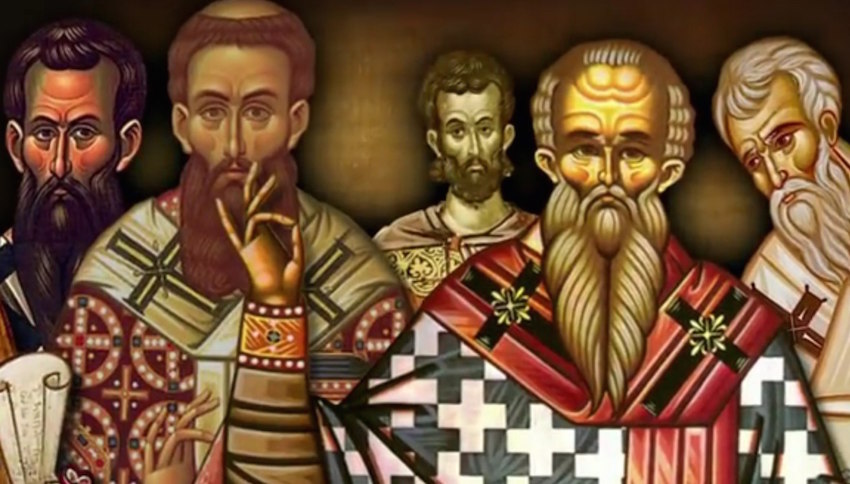
In this week’s episode, we return to the Early Church and discuss the successors to the Apostles, known as the Early Church Fathers. Somehow Nessa manages to talk about relationships… :-/
* I mentioned my article I’ve written called “Before 300” where I outline 21 documented beliefs of Christians prior to the rise of the Emperor Constantine:
Part #1: The Church
1. The Church is Catholic
2. The Church has a three-fold structure of leadership
3. There is unity through episcopal authority and schism is evil
4. Sacred Tradition is authoritative
5. Worship is liturgical
6. There is Apostolic Succession
7. Peter has Primacy
Part #2: Salvation & Sacraments
1. The Eucharist is a Sacrifice
2. Jesus is truly present in the Eucharist
3. The Eucharist is taken to the sick
4. Infants are to be baptized
5. Baptism actually washes away sin
6. Priests forgive sins
7. Works are involved in salvation
Part #3: The Saints and Our Lady
1. Prayers are said for the dead
2. There is purgation after death
3. Relics are venerated and Saints are celebrated
4. Mary is the New Eve
5. Mary was a perpetual virgin
6. Mary is the Mother of God
7. Prayers are made and songs are sung to Mary
1. Antiquity Did this person live sometime between the time of Christ and the end of the 8th Century? This span of time is called the “Patristic Era” (“Patristic” simply means relating to the Early Church Fathers).
2. Sanctity Did this person live a life of outstanding holiness? Is this person a canonized Saint?
3. Orthodoxy
Did this person hold heretical views? Tertullian and Origen are two early Christians who are typically disqualified here due to some of their erroneous beliefs. We therefore instead give them the title of “Early Ecclesiastical Writers”.
4. Church Recognition and Approval Has the Church and Christians throughout history generally referred to this person as a Father of the Church?
* There were about one hundred Early Church Fathers.
* The Early Church Fathers of the 1st and 2nd Centuries are usually called the “Apostolic Fathers” since they were born during the era of the Apostles.
* We then briefly spoke about three Apostolic Fathers:
1. St. Clement of Rome
* A successor to St. Peter as Bishop of Rome
* He wrote a letter to the Church at Corinth (AD ~96) in response to the ejection of their clergy
* In the letter he gives many Old Testament examples of those who flaunted God-given authority and who suffered the consequences
* In a particularly beautiful passage reminiscent of 1 Corinthians 13, Clement exhorts the Corinthians to love. I had a small rant about 1 Corinthians 13, pointing out that Paul is speaking of “agape” love rather than “eros” love.
2. St. Ignatius of Antioch
* A successor to St. Peter as Bishop of Antioch
* Taken to Rome in chains (AD ~107) to be thrown to wild animals
* Wrote seven letters, one to St. Polycarp (see below), several to nearby Churches and one to the Church in Rome
* In his letter to the Roman Church he begs them to not interfere with his coming martyrdom: “I beseech of you not to show an unseasonable goodwill towards me. Suffer me to become food for the wild beasts, through whose instrumentality it will be granted me to attain to God. I am the wheat of God, and am ground by the teeth of the wild beasts, that I may be found the pure bread of God”
* In the account of his martyrdom, the Governor tells Polycarp to say “Caesar is Lord”, but Polycarp knew that “Christ/Jesus is Lord”. He was told to “revile Christ”, but he responded: “Eighty-six years have I served Him, and He never did me any wrong: how then dare I blaspheme my King and my Saviour?”
* Prior to being burned alive, Polycarp gives a prayer which sounds an awful lot like a Eucharistic Prayer.
* As he was burned, people reported the smell of baking bread.
* Some Jews claimed that the Christians might start worshipping Polycarp after his death. The author of the Martyrdom account says the following: “They did not realize that we could never abandon Christ, He who suffered for our salvation – the blameless one for sinners! – or worship any other. Him we worship as being the Son of God, the martyrs we love as being disciples and imitators of the Lord; and deservedly so, because of their unsurpassable devotion to their King and Teacher. May it be our good fortune, too, to be their companions and fellow disciples!”
* After his death, the Christians gathered Polycarp’s relics and and interred them in a fitting place: “There the Lord will permit us, as far as possible, to assemble in rapturous joy and celebrate his martyrdom – his birthday – both in order to commemorate the heroes that have gone before, and to train the heroes yet to come…”
* In last week’s episode, we spoke about another Early Church Father, St. Basil of Caesarea.
* If you would like to read what the different Fathers wrote about the Sunday Gospel, you can look it up using the Catena Aurea (“Golden Chain”), a collection of patristic commentary which was assembled by St. Thomas Aquinas. You can also get it on your mobile!
I first noticed the comment. The phrase “Birth control is good for business” pretty much translates into “Sterilize your workforce and their family won’t get in the way of their productivity”. However, then I noticed the graphic used in the tweet. It looked so familiar… they didn’t, did they? I clicked on the link…
Yup, Planned Parenthood had used a graphic of an NFP chart! Apparently they do know what is! Maybe they could consider this a better way to plan parenthood?
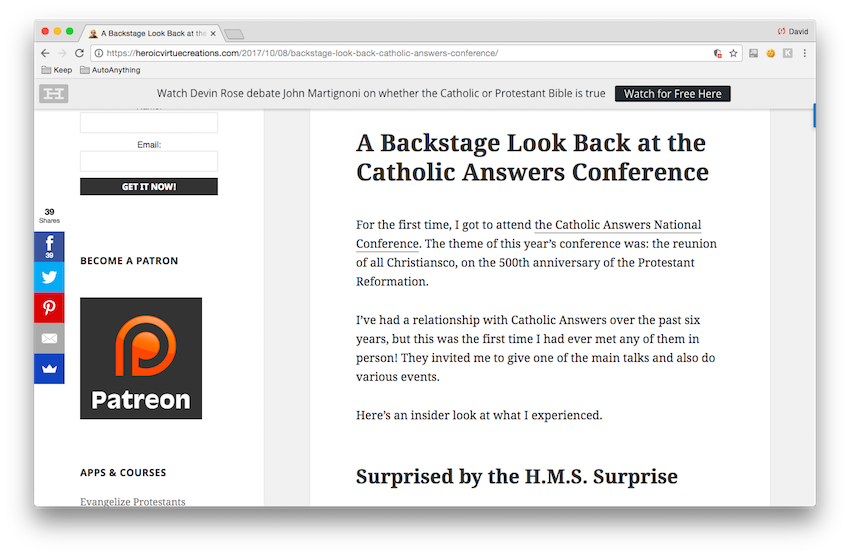
Last month was the Catholic Answers Conference here in San Diego. It was a weekend full of great talks from guest speakers and the Catholic Answers apologists.
However, the real highlight for me was meeting in the flesh two guys with whom I have corresponded for some time, but never actually met in the flesh. These two Catholic Titans were Devin Rose and Douglas Beaumont, both of whom should be familiar to regular readers of this blog as I share their articles often. As a bonus, I also got to meet Matt Nelson!
If you’d like to get a better sense of what it was like at the conference, Devin authored a piece on his conference-going experience:
The great thing about saints is that they will not lose their faith because of bad liturgical music. They can suffer bad preaching, small budgets, poor management, and every single one of the many fools we have in this hospital for sinners. They’ll still be in the pews on Sunday, quietly winning the world for Christ, slowly transforming the Church, recruiting more saints and often fixing other problems in the process.
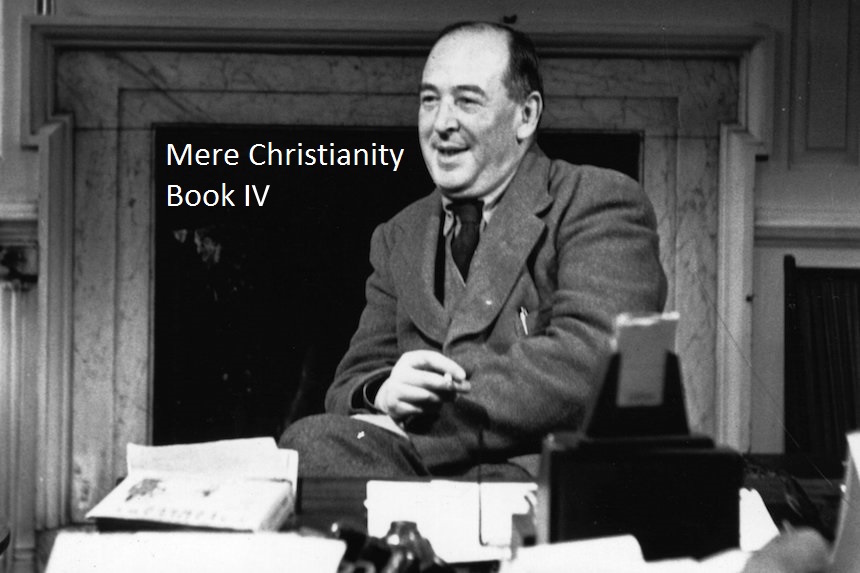
Picking back up my notes for C.S. Lewis’ “Mere Christianity”…
1. “Be ye perfect” does not mean that God isn’t going to help us until we get our act together
“Some people seem to think this means ‘Unless you are perfect, I will not help you’; and as we cannot be perfect…our position is hopeless. But I do not think He did mean that. I think He meant ‘The only help I will give is help to become perfect. You may want something less: but I will give you nothing less'”
(a) Jack wouldn’t go to his mother with a toothache because he knew he’d get something else in addition to the relief from immediate pain…
(i) He’d wait until the pain got really bad
“When I was a child I often had toothache, and I knew that if I went to my mother she would give me something which would deaden the pain for that night and let me get to sleep. But I did not go to my mother – at least, not till the pain became very bad…”
(ii) …because he knew he’d also get a trip to the dentist…
“I did not doubt she would give me the aspirin; but I knew she would also do something else. I knew she would take me to the dentist next morning. I could not get what I wanted out of her without getting something more, which I did not want…”
(iii) …and the dentist wouldn’t restrict himself just to that tooth…
And I knew those dentists; I knew they started fiddling about with all sorts of other teeth which had not yet begun to ache… if you gave them an inch they took an ell”
(b) God is like a dentist
“Our Lord is like the dentists. If you give Him an inch, He will take an ell. Dozens of people go to Him to be cured of some one particular sin which they are ashamed of (like masturbation or physical cowardice) or which is obviously spoiling daily life (like bad temper or drunkenness). Well, He will cure it all right: but He will not stop there. That may be all you asked; but if once you call Him in, He will give you the full treatment”
This week we have another song from PJ Anderson, “Rise”….
Everyday is a struggle to believe, still we rise
It’s time to put distance between truth and all the lies
We are not just rising to give in to the fall
Your love has come to bring new life to us all
We rise, we rise, from the darkness we will rise x2
We will fight for justice in our world and our lives
We will challenge cultures that do not value life
We will stand united for our Hope makes us one
Your truth is amour and this battle will be won
We will rise with you, live our lives for your
We will rise with you, give our lives to you x2







 This week we have another song from PJ Anderson, “Rise”….