Wise Words on Wednesday: Plan of Action

“No plan of action ever survives contact with the enemy”
– Helmuth von Moltke the Elder
"We are travellers…not yet in our native land" – St. Augustine

“No plan of action ever survives contact with the enemy”
– Helmuth von Moltke the Elder
 Well this is a little different!


Summary
The Dwarf struggles against joy. It “was not the meeting [the ghost] had pictured; he would not accept it”. He tugs at the chain and the Tragedian acts offended, saying, “It is fortunate that you give yourself no concern about my fate. Otherwise you might be sorry afterwards to think that you had driven me back to Hell”. The Lady replies “Dear, no one sends you back. Here is all joy. Everything bids you stay”. Saying this does no good – the Tragedian says he still has some self-respect and the dwarf starts to shrink.
When the Lady tells the Dwarf to not “let it talk like that“, the “Tragedian caught her words greedily as a dog catches a bone”, complaining that she always had to be “sheltered”. The Lady explains that wasn’t what she meant, rather that she wanted him to “stop acting… He is killing you. Let go of that chain. Even now”.
Sarah tells Frank to stop “using…other people’s pity, in the wrong way…”. She explains that “Pity was meant to be a spur that drives joy to help misery. But it…can be used for a kind of blackmailing… [to] hold joy up to ransom”. This is something he did ever since he was a child. She asks him “Did you think joy was created to live always under that threat? Always defenceless against those who would rather be miserable than have their self-will crossed?” She explains that “you can no longer communicate your wretchedness… Our light can swallow up your darkness: but your darkness cannot now infect our light”.
The Dwarf and the chain having disappeared, for the first time the Lady addresses the Tragedian, asking who he is and where Frank has gone. She invites him to stay, but the Tragedian vanishes. The lady returns to her retenue who begin to sing a song: “The Happy Trinity is her home: nothing can trouble her joy…”
After departing, Lewis asks his teacher: “Is it really tolerable that she should be untouched by his misery, even his self-made misery?”. MacDonald asks him if he would prefer it if “he still had the power of tormenting her”. He talks about “The demand of the loveless and the self-imprisoned… to blackmail the universe: that till they consent to be happy (on their own terms) no one else shall taste joy… that Hell should be able to veto Heaven… Either the day must come when joy prevails and all the makers of misery are no longer able to infect it: or else for ever… the makers of misery can destroy in others the happiness they reject for themselves”.
Lewis says he finds it horrible to say that pity must someday die. His teacher distinguishes between the action which will last forever and passion of pity which will come to the end. He says that the passion of pity “draws men to concede what should not be conceded” whereas the action “changes darkness into light and evil into good”. However, “we will not call blue yellow to please those who insist on still having jaundice”.
Lewis once again asks why the Spirits don’t go down into Hell to rescue the damned. Going down on his knees and using a blade of grass as a pointer, MacDonald points to a tiny crack, saying, “…through a crack no bigger than that ye certainly came…”. The idea that the infinitely empty Grey Town is down in a little crack blows his mind, but Lewis now realizes that the Lady couldn’t even fit into Hell. MacDonald concurs that “Hell could not open its mouth wide enough”. Referring to Jesus, MacDonald says that “Only the Greatest of all can make Himself small enough to enter Hell…” Lewis asks if He ever will descend again, but MacDonald explains that time doesn’t work that way, but assures Lewis that “There is no spirit in prison to Whom He did not preach”.
Lewis asks MacDonald about his Universalist beliefs, but MacDonald says “it’s ill talking of such questions…because all answers deceive. If ye put the question from within Time…the choice of ways is before you… But if ye are trying to leap on into eternity… then ye ask what cannot be answered to mortal ears. Time is the very lens through which ye see…something that would otherwise be too big for ye to see at all…[but] every attempt to see the shape of eternity except through the lens of Time destroys your knowledge of Freedom”
Questions
Q1. Why does the ghost resist joy? What does the Tragedian threaten? How does the Lady respond?
Q2. What did the Tragedian hold love hostage? What does MacDonald say about pity?
Q3. How does the Lady respond to the Ghost’s disappearance? Why is Lewis troubled by her reaction?
Q4. What does Lewis find out about Hell from MacDonald? Why couldn’t the lady go there?
Q5. What does MacDonald say about time, freedom and predestination?

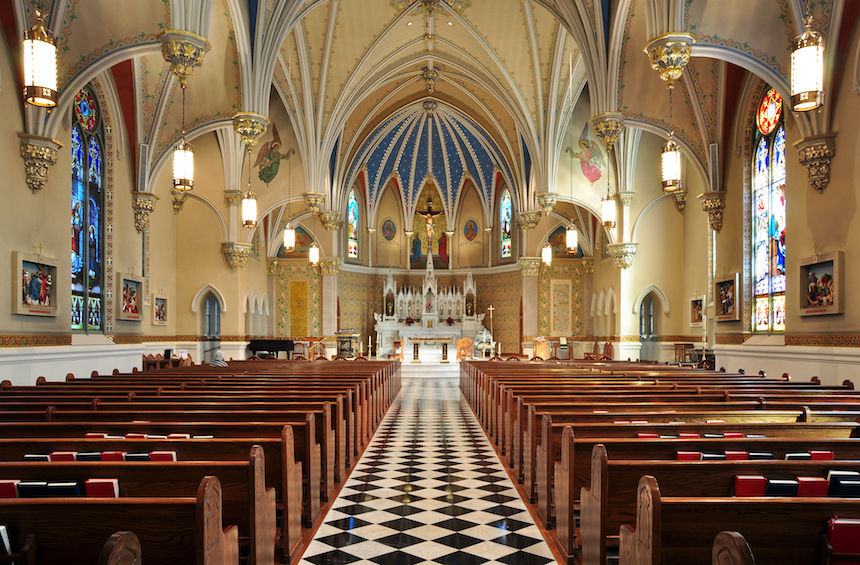
This weekend, a friend of mine will be attending his first Catholic Mass. It got me thinking: What is the best way to prepare someone who will be attending Mass for the first time? What advice might be helpful?
Obviously you’d prepare someone to attend a Catholic Liturgy differently, depending upon the visitor’s religious background. If that person were Eastern Orthodox, he would already have a very good theological grounding to understand the Mass. Depending upon the particular denomination, a Protestant might also understand much, although that’s not guaranteed, particularly if she were from a non-Liturgical tradition. Those of different religions entirely and those with no real exposure to spirituality would likely have a harder time.
As a result of all this, it’s rather hard to write a general, suitable-for-all article for someone going to Mass for the first time. Fortunately, I’ve never let either a difficult challenge or my lack of ability hold me back from trying anything, therefore I’m going to give it a go! So, without further ado, here are my top ten tips for those of you attending Mass for the first time…
1. Turn up in good time
Speaking as someone who has often turned up late for Mass, I can tell you that there are few experiences more awkward than arriving late to church. So, if you don’t want to feel stressed, do yourself a favour and turn up a little early, perhaps fifteen minutes beforehand. Doing this will give you a chance to find a seat, settle in, admire the art, and take in your new surroundings, which may well be very unfamiliar.
Use the remaining time to calm your soul. After all, Catholics claim that, in the Mass, Heaven comes to earth, so it would be good to take a few minutes to quiet yourself and prepare for what you are about to experience.
Not sure where to sit? I’d suggest somewhere in the front third, so you can clearly see everything going on, but you’ve also got some folks in front of you so you can see what they do.
Oh, and don’t forget to turn off your phone as you enter the Church. You don’t want it to be your phone blaring Beyoncé’s “All the single ladies” during a quiet moment of prayer!
2. You won’t understand everything (but that’s okay)
At Mass, we Catholics do things and say things which are likely to seem rather alien to you. Don’t worry, it’ll all become less strange over time. The Mass is based on 2,000 years of Christian theology and practice, and this itself rests on the even older foundation of Judaism.
Things at the Mass are sometimes initially hard to understand because it is so rich and it has so many layers of meaning. For example, consider incense… Incense is used at Mass for a host of reasons. It is symbolic of our prayers rising to God, but it also harkens back to the incense which was offered in the Jerusalem Temple in Ancient Israel.
I can promise you that if you keep coming back each week and start digging into the roots of the Mass, it’ll all start to make sense and you’ll come to discover the profound richness which can be found there.
3. There’s a script
When you visit, you’ll soon notice that there’s a “script” for Mass. The priest and the people have prescribed parts. The priest will say something (e.g. “The Lord be with you!”) and then all the people will respond in unison (e.g. “And with your spirit”). These exchanges and prayers have been prayed by the Church for over 2,000 years and are worthy of a lifetime of meditation. Everything will probably be entirely in English, but there may be a few small parts sung in Latin or Greek.
If you’re at a Mass during the week, the service will likely be slightly simplified, with minimal music and with some of the optional parts dropped.
Read more

For the last couple of months, I have been helping beta test a website which is being launched by a friend of mine. Normally, I’m the one writing the code, so it was a lot of fun having an opportunity to find the bugs in someone else’s work!
Although I’ve known people to find their spouse on CatholicMatch.com, I also know of a lot of people who have found the whole online dating experience frustrating. If this is you, you might like to try CatholicChemistry…
 Click on the link above and sign up with the promo code “JMJ”, you’ll get a 6-month subscription for free. If you’re not sure how to start the conversation and get a date, you might like to try some of my favourite Catholic pick-up lines. You can thank me in your wedding toast… 😉
Summary
The branches of trees down one aisle of the forest dance with light and Lewis thinks there must be another river nearby. It turns out the light is coming from people in a procession. Lewis tells us that “If I could remember their singing and write down the notes, no man who read that score would ever grow sick or old”. Behind them came a beautiful lady in whose honour all this was being done.
Lewis whispers to MacDonald, “Is it? … is it?”. His teacher responds that it’s actually a lady from Golders Green named Sarah Smith, who is “one of the great ones” in this country. MacDonald identifies some of the people in the procession as angels, and others as “her sons and daughters” who were any child she met on earth. She is also surrounded by animals: cats, dogs, birds and horses. MacDonald explains that “Every beast and bird that came near her had its place in her love. In her they became themselves. And now the abundance of life she has in Christ from the Father flows over into them.”
The Lady moves towards “two phantoms: a great tall Ghost, horribly thin and shaky”, whom Lewis dubs “The Tragedian”, who is being led on a chain by another Ghost who is “no bigger than an organ-grinder’s monkey”. When they meet, despite the Tragedian being the one who speaks, the Lady addresses only the Dwarf Ghost. She kisses him and asks for his forgiveness “For all I ever did wrong and for all I did not do right since the first day we met”. The Dwarf shakes the chain and the Tragedian responds, saying he accepts her apology.
The Tragedian says that he’s been thinking only about her “all these years…breaking your heart about me”. In a small, bleating voice, the Dwarf Ghost asks if she missed him. When the Lady tells him that he’ll understand it soon enough, the Dwarf and Tragedian speak in unison to each other, saying that she didn’t answer the question. It is at this point that Lewis “realised then that they were one person, or rather that both were the remains of what had once been a person”, Sarah’s husband, Frank. The Dwarf and the Tragedian tell each other that “it would be rather fine and magnanimous not to press the point” but they aren’t sure if she’d notice, recalling a time when they let her have the last stamp and she didn’t “see how unselfish we’d been”.
The Dwarf and the Tragedian are shocked to find out that the Lady has been happy in Heaven without him. The Tragedian asks here if she even knows the meaning of the word “Love”! The Lady responds: “How should I not?.. I am in love. In love, do you understand? Yes, now I love truly”. Rather than being comforted by this, the Tragedian asks if this means she didn’t love him on earth. The Lady says she did but “only in a poor sort of way… mostly the craving to be loved… I needed you”. The Tragedian is horrified at the idea that she no longer needs him, even though she says that “We shall have no need for one another now: we can begin to love truly”.
The Tragedian, becoming even more melodramatic, laments “Would to God I had seen her lying dead at my feet before I heard those words”. The Lady tries to snap him out of it by saying to the Dwarf “Frank! … Look at me… What are you doing with that great, ugly doll? Let go of the chain. Send it away. It is you I want. Don’t you see what nonsense it’s talking?”. Her message seems to get through and he starts to smile and grow a little bigger.
Questions
Q1. How would you describe the procession? What is Lewis’ suspicion regarding the identity of the lady?
Q2. Who are the ghosts in this chapter? Why are there two ghosts, one of them on a chain? Why are the ghosts shocked to find that the lady has been happy in Heaven?
Q3. How does the lady describe her love for her husband on earth? How is it different now in Heaven?
Q4. How does the lady try to snap Frank out of the melodrama? Why might this work?