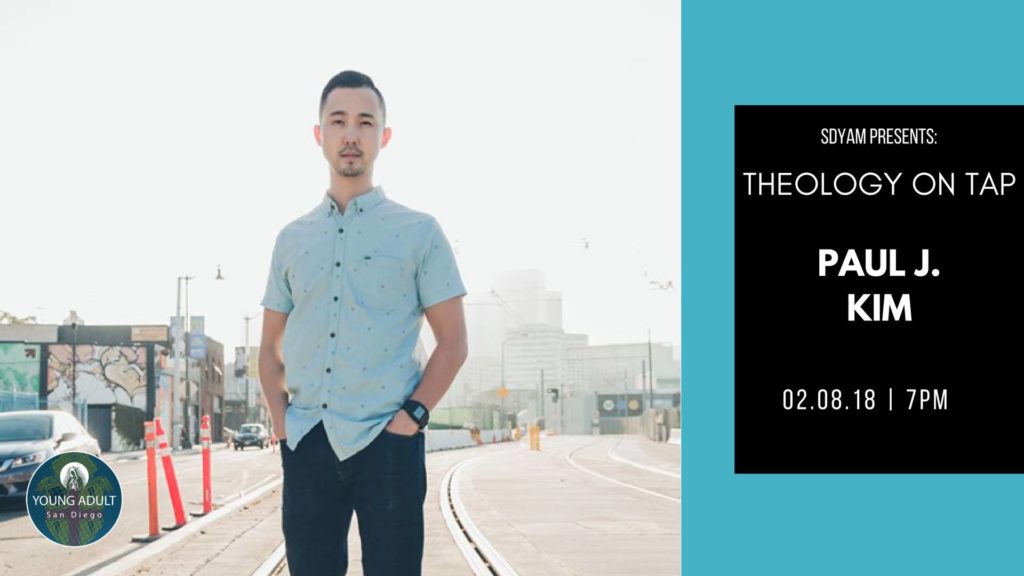
Tonight’s “Theology On Tap” was hosted by Paul Kim. Paul came to speak to use about “Adulting the Catholic Way”. Paul is a husband and father of two, as well as a well-known Catholic speaker, beatboxer and avid Instagram picture-taker!
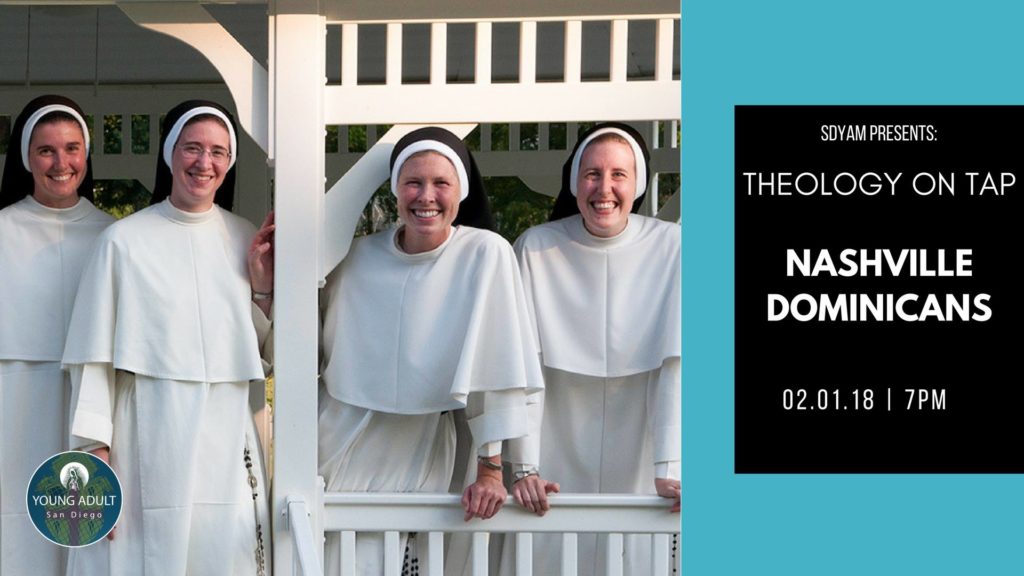
On the 1st February, a new Theology On Tap series was kicked off at St. Michael’s Catholic Church in Paradise Hills. Sister Peter Marie and Sister Elizabeth Marie from the Nashville Dominicans gave a talk on “Joyful Discernment”. They were accompanied by some of their Dominican brothers, Fr. Stephen Maria Lopez and Fr. James Moore, who joined them for the Q&A session.
• How long have you been a teacher? What has been your favourite subject to teach?
• What is “sanctifying grace”?
• I felt called to a ministry and that’s now complete. I’m not currently feeling called to anything in particular. Should I wait or should I actively be looking?
• Have you ever experienced synchronicities in your life which you felt were of God?
• Is it selfish to ask God for clarity in your vocation?
• Is it free will if God already knows what I’m going to choose?
As noted in recent episodes of “The Eagle and Child”, my co-host Matt has a pretty dire knowledge of movies. For example, he has only recently been introduced to the Star Wars and Indiana Jones franchises. This Christmas was his first time watching It’s a wonderful life (or “Winter Wonderland” as he insisted on calling it…). Put simply, Matt has had some major flaws in his education…
Since one of the great Spiritual Works of Mercy is “Instructing the ignorant”, I could hardly call myself a good Christian if I didn’t attempt to remedy these serious deficiencies. So, with that, these are my “must-see” movies. The basic rule of thumb I’ve used is: would I judge someone if I found out they hadn’t seen these movies?
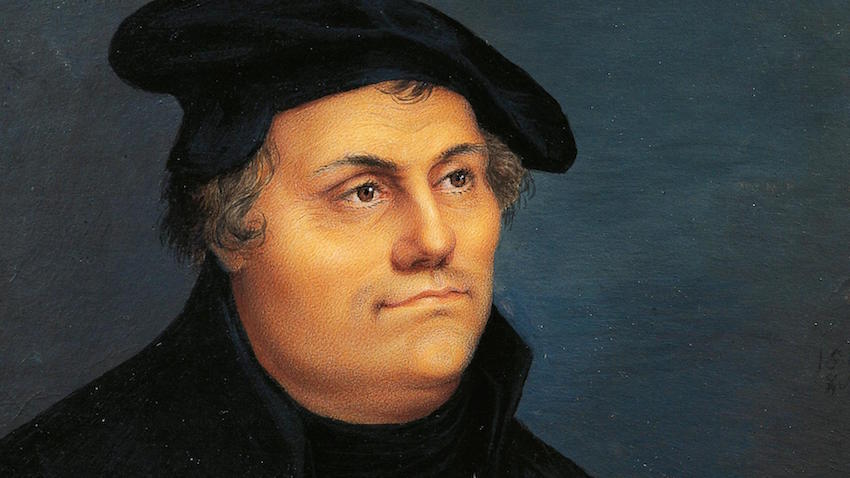
Since it is the 500th anniversary of the Reformation, Nessa and I are devoting the next to episodes to the two key doctrines of the Reformation: “Sola Fide” (Faith Alone) and “Sola Scriptura” (Scripture Alone). Today we’ll begin by looking at the first of these doctrines, Sola Fide.
• Over the next two weeks we’re going to look at “Sola Fide” (Faith Alone) and “Sola Scriptura” (Scripture Alone)
• Luther thought that Sola Fide was the central element of Christianity:
“If the doctrine of justification is lost, the whole of Christian doctrine is lost” – Luther, Lectures On Galatians
• I quoted from the Protestant apologetics site “Got Questions”:
“Sola fide or faith alone is a key point of difference between not only Protestants and Catholics but between biblical Christianity and almost all other religions and teachings. The teaching that we are declared righteous by God (justified) on the basis of our faith alone and not by works is a key doctrine of the Bible and a line that divides most cults from biblical Christianity…
If we abandon the doctrine of justification by faith, we abandon the only way of salvation…
The Bible teaches that those that trust Jesus Christ for justification by faith alone are imputed with His righteousness, while those who try to establish their own righteousness or mix faith with works will receive the punishment due to all who fall short of God’s perfect standard” – GotQuestions.org (Emphasis added)
• A key text for Luther in relation to his doctrine of Sola Fide was:
“For we maintain that a person is justified by faith apart from the works of the law” – Romans 3:28
However, when he translated it, he added an additional word:
“For we maintain that a person is justified by faith ALONE apart from the works of the law” – Romans 3:28
To justify this change, Luther responded thus:
“If your papist wishes to make a great fuss about the word sola [alone], say this to him: ‘Dr. Martin Luther will have it so, and he says that a papist and a donkey are the same thing.'” – An Open Letter on Translating by Martin Luther
(The term “papist” here refers to Catholics)
• Luther was a master at insults. So much so, that today you can generate an insult from the Luther Insult Generator.
• When Paul talks about “works”, he is talking about the works of the Mosaic Law. In fact, he spends a lot of time in his letters comparing the Old Covenant with Moses to the New Covenant with Jesus.
• There only verse of the Bible which speaks of “faith alone” is the following passage from the Epistle of James:
“You see that a man is justified by works and not by faith alone” – James 2:24
Luther referred to this epistle as an “epistle of straw” and he moved it to the appendix of his translation of the Bible:
“We should throw the Epistle of James out of this school, for it doesn’t amount to much. It contains not a syllable about Christ. Not once does it mention Christ, except at the beginning. I maintain that some Jew wrote it who probably heard about Christian people but never encountered any.” – Luther’s works, vol. 54: Table Talk
• Nessa asked about what a Catholic should do if he “has a beef” with the Catholic Church. I suggested that it would probably depend upon the kind of issue at hand:
1. Doctrinal Issue
If you disagree with Catholic doctrine, first of all make sure that what you’re rejecting actually is the Catholic teaching on the matter and not some distortion of it. Once you have done this, find yourself a knowledgable Catholic to explain the basis of the doctrine.
2. Issues of Scandal
Reform yourself first! Be an example for others to imitate, imitating St. Francis and St. Dominic.
• I discussed my approach when discussing the Epistle of James. I ask a series of questions:
1. Can a dead faith save you? No? So you’re saying that you need a faith that’s alive?
2. Can a barren faith save you? No? So you’re saying that you need a fruitful faith?
3. Can an incomplete faith save you? No? So you’re saying that you need a complete faith?
• This then leads to another round of questions:
1. How is faith given life?
2. How is a barren faith made fruitful?
3. What is the difference between a complete faith and an incomplete faith?
The answer, according to the Epistle of James, is “Works”. In his letter, James teaches that faith must be living, fruitful and complete:
1. Living Faith “In the same way, faith by itself, if it is not accompanied by action, is dead”
– James 2:17
2. Fruitful Faith “Do you want to be shown, you foolish fellow, that faith apart from works is barren?”
– James 2:20
3. Complete Faith “[Abraham’s] faith was made complete by what he did”
– James 2:22
• On the subject of faith and works, I quote CS Lewis who said:
“Christians have often disputed as to whether what leads the Christian home is good actions, or Faith in Christ…it does seem to me like asking which blade in a pair of scissors is most necessary”
– Mere Christianity
• The Catholic Church does not teach a works-based righteousness. She condemned this heresy (“Pelagianism”) in the Fifth Century!
• I quote Lewis a second time when he’s explaining how the divine life should be nurtured and protected:
“Your natural life is derived from your parents; that does not mean it will stay there if you do nothing about it. You can lose it by neglect, or you can drive it away by committing suicide. You have to feed it and look after it: but always remember you are not making it, you are only keeping up a life you got from someone else. In the same way a Christian can lose the Christ-life which has been put into him, and he has to make efforts to keep it. But even the best Christian that ever lived is not acting on his own steam – he is only nourishing or protecting a life he could never have acquired by his own efforts”
– Mere Christianity
• The pithiest summary of salvation really comes from St. Paul’s epistle to the Galatians:
“The only thing that counts is faith expressing itself through love” – Galatians 5:6
• Pope Emeritus Benedict articulated this in one of
Being “just” simply means being with Christ and in Christ. And this suffices. Further observances are no longer necessary. For this reason Luther’s phrase: “faith alone” is true, if it is not opposed to faith in charity, in love. Faith is looking at Christ, entrusting oneself to Christ, being united to Christ, conformed to Christ, to his life. And the form, the life of Christ, is love; hence to believe is to conform to Christ and to enter into his love. So it is that in the Letter to the Galatians in which he primarily developed his teaching on justification St Paul speaks of faith that works through love – Pope Benedict XVI, Wednesday Audience, 19th November 2008
* “Memento Mori” is a phrase in Latin which means “Remember Death”
* If you were wondering where Whidbey Island is, it’s here.
* The book I referenced was “Something Other Than God” by Jennifer Fulwiler:
“The Catechism explained that praying for the souls of the dead is a tradition going back to the first Christians and to the Jews before them… The living sent their love for the deceased into the spiritual world, like adding water to a stream that would eventually float their lost friends home“
* Don’t believe me about the ninja boots? Here they are.
* The Psalm I quoted was Psalm 84:6
Blessed are the men whose strength is in [the Lord]… As they go through the Valley of Baca [weeping] they make it a place of springs; the early rain also covers it with pools.
* The poem I quoted at the end was “As Kingfishers Catch Fire” by Gerard Manly Hopkins:
…for Christ plays in ten thousand places, Lovely in limbs, and lovely in eyes not His To the Father through the features of men’s faces.
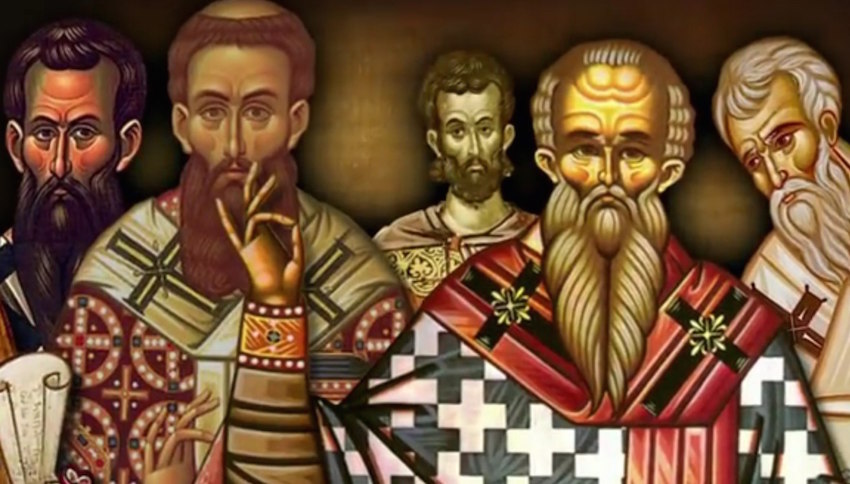
In this week’s episode, we return to the Early Church and discuss the successors to the Apostles, known as the Early Church Fathers. Somehow Nessa manages to talk about relationships… :-/
* I mentioned my article I’ve written called “Before 300” where I outline 21 documented beliefs of Christians prior to the rise of the Emperor Constantine:
Part #1: The Church
1. The Church is Catholic
2. The Church has a three-fold structure of leadership
3. There is unity through episcopal authority and schism is evil
4. Sacred Tradition is authoritative
5. Worship is liturgical
6. There is Apostolic Succession
7. Peter has Primacy
Part #2: Salvation & Sacraments
1. The Eucharist is a Sacrifice
2. Jesus is truly present in the Eucharist
3. The Eucharist is taken to the sick
4. Infants are to be baptized
5. Baptism actually washes away sin
6. Priests forgive sins
7. Works are involved in salvation
Part #3: The Saints and Our Lady
1. Prayers are said for the dead
2. There is purgation after death
3. Relics are venerated and Saints are celebrated
4. Mary is the New Eve
5. Mary was a perpetual virgin
6. Mary is the Mother of God
7. Prayers are made and songs are sung to Mary
1. Antiquity Did this person live sometime between the time of Christ and the end of the 8th Century? This span of time is called the “Patristic Era” (“Patristic” simply means relating to the Early Church Fathers).
2. Sanctity Did this person live a life of outstanding holiness? Is this person a canonized Saint?
3. Orthodoxy
Did this person hold heretical views? Tertullian and Origen are two early Christians who are typically disqualified here due to some of their erroneous beliefs. We therefore instead give them the title of “Early Ecclesiastical Writers”.
4. Church Recognition and Approval Has the Church and Christians throughout history generally referred to this person as a Father of the Church?
* There were about one hundred Early Church Fathers.
* The Early Church Fathers of the 1st and 2nd Centuries are usually called the “Apostolic Fathers” since they were born during the era of the Apostles.
* We then briefly spoke about three Apostolic Fathers:
1. St. Clement of Rome
* A successor to St. Peter as Bishop of Rome
* He wrote a letter to the Church at Corinth (AD ~96) in response to the ejection of their clergy
* In the letter he gives many Old Testament examples of those who flaunted God-given authority and who suffered the consequences
* In a particularly beautiful passage reminiscent of 1 Corinthians 13, Clement exhorts the Corinthians to love. I had a small rant about 1 Corinthians 13, pointing out that Paul is speaking of “agape” love rather than “eros” love.
2. St. Ignatius of Antioch
* A successor to St. Peter as Bishop of Antioch
* Taken to Rome in chains (AD ~107) to be thrown to wild animals
* Wrote seven letters, one to St. Polycarp (see below), several to nearby Churches and one to the Church in Rome
* In his letter to the Roman Church he begs them to not interfere with his coming martyrdom: “I beseech of you not to show an unseasonable goodwill towards me. Suffer me to become food for the wild beasts, through whose instrumentality it will be granted me to attain to God. I am the wheat of God, and am ground by the teeth of the wild beasts, that I may be found the pure bread of God”
* In the account of his martyrdom, the Governor tells Polycarp to say “Caesar is Lord”, but Polycarp knew that “Christ/Jesus is Lord”. He was told to “revile Christ”, but he responded: “Eighty-six years have I served Him, and He never did me any wrong: how then dare I blaspheme my King and my Saviour?”
* Prior to being burned alive, Polycarp gives a prayer which sounds an awful lot like a Eucharistic Prayer.
* As he was burned, people reported the smell of baking bread.
* Some Jews claimed that the Christians might start worshipping Polycarp after his death. The author of the Martyrdom account says the following: “They did not realize that we could never abandon Christ, He who suffered for our salvation – the blameless one for sinners! – or worship any other. Him we worship as being the Son of God, the martyrs we love as being disciples and imitators of the Lord; and deservedly so, because of their unsurpassable devotion to their King and Teacher. May it be our good fortune, too, to be their companions and fellow disciples!”
* After his death, the Christians gathered Polycarp’s relics and and interred them in a fitting place: “There the Lord will permit us, as far as possible, to assemble in rapturous joy and celebrate his martyrdom – his birthday – both in order to commemorate the heroes that have gone before, and to train the heroes yet to come…”
* In last week’s episode, we spoke about another Early Church Father, St. Basil of Caesarea.
* If you would like to read what the different Fathers wrote about the Sunday Gospel, you can look it up using the Catena Aurea (“Golden Chain”), a collection of patristic commentary which was assembled by St. Thomas Aquinas. You can also get it on your mobile!
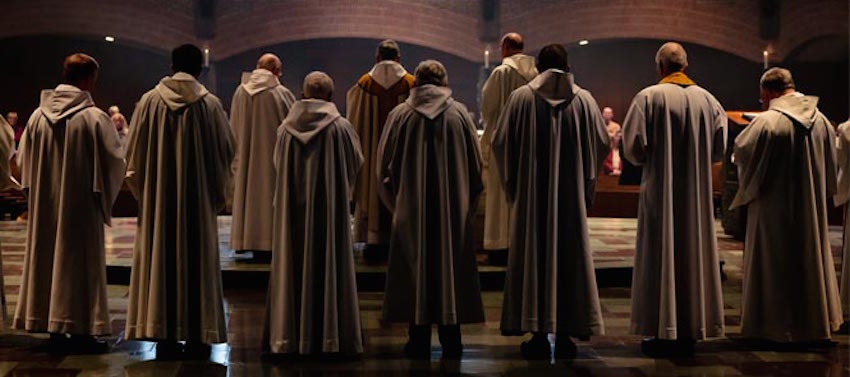
In this week’s episode, Nessa and I talk about one of the most essential of Christian activities, prayer. In particular, we will be talking about the Liturgy of the Hours, which is part of the formal prayer of the Church and prayed by monks and nuns throughout the world
* At the beginning of the show I talked about my trip to Medieval Times. If you like watching jousting, give it a visit!
* Nessa and I briefly spoke about Novenas. My favourite is this one to Pierre Giorgio Frassati. If you’d like to explore more Novenas, check out Devin Rose’s app.
* I shared the Latin phrase “Quidquid latine dictum sit altum videtur” which means “Anything said in Latin sounds profound”.
* The different Hours in the Liturgy of the Hours are: Matins, Lauds, Prime, Terce, Sext, None, Vespers and Compline. The Second Vatican Council reformed this.
* The Liturgy of the Hours grew out of Judaism: “Seven times a day I praise you for your righteous laws” – Psalm 119:164
* Nessa mentioned the different Rites of the Catholic Church. We will do a future episode on this topic in the future, but if you would like to know more, I describe my initial visit to a Byzantine Rite parish here.
* The book used to pray the Liturgy of the Hours is known as a breviary. You can buy the multi-volume set, but I would personally recommend getting The Shorter Christian Prayer Book.
* If you would like help praying the Liturgy of the Hours, I would recommend the website Universalis. For your cell phone, I would recommend the Laudate app, but especially the iBrievery. If you would like to listen to the prayers being prayed, check out the podcast Praystation Portable by SQPN. However, the most important suggestion when starting is to pray it with a friend!
* When prayed in groups, the Liturgy of the Hours has an antiphonal form, a back-and-forth, a call-and-response between the two groups.