One of the news items being discussed by the hosts referred to my country of origin and I thought it would be worth briefly sharing here. The news item in question referred to a study by David Paton and Liam Wright and published in the Journal of Health Economics.
Back in the 1990s, Britain had some of the highest teen pregnancy rates, so the government responded with a rigorous sex education plan costing four hundred and fifty-four million pounds. The plan was implemented, free contraception was handed out… but it it did little to reduce the occurrences of teen pregnancy.
However, in 2008 things changed. Due to the economic downturn, the funding for the sex education initiatives were cut. Some of the schools chose to continue the programmes, while others dropped them due to lack of funding. It might surprise some to find out that in the geographical areas where the programmes no longer functioned, there was a distinct drop in the number of teenage pregnancies and abortions (up to 40%), while it was business-as-usual in the areas where the programmes continued.
Perhaps contraception isn’t the panacea we were promised…
This past Friday, Joe Heschmeyer was on Catholic Answer Live, the audio of which is available here. Joe was talking about one of my favourite subjects, Church History. In particular he was talking about how many of the early controversies in the Church can’t really be explained from within a Protestant framework.
For example, in the Early Church there was a breakaway group in AD 311 called the Donatists. These were rigorists who insisted that the sacraments administered by clergy who had been compromised during persecution were invalid. This was a major issue within the Church of the Early Fourth Century…but it’s an argument that makes no sense within most Protestant frameworks.
If you are interested, the article where he draws out these ideas is available below:
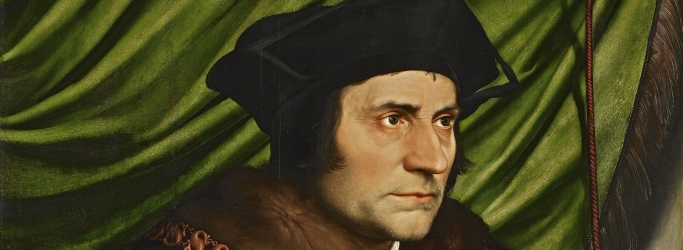
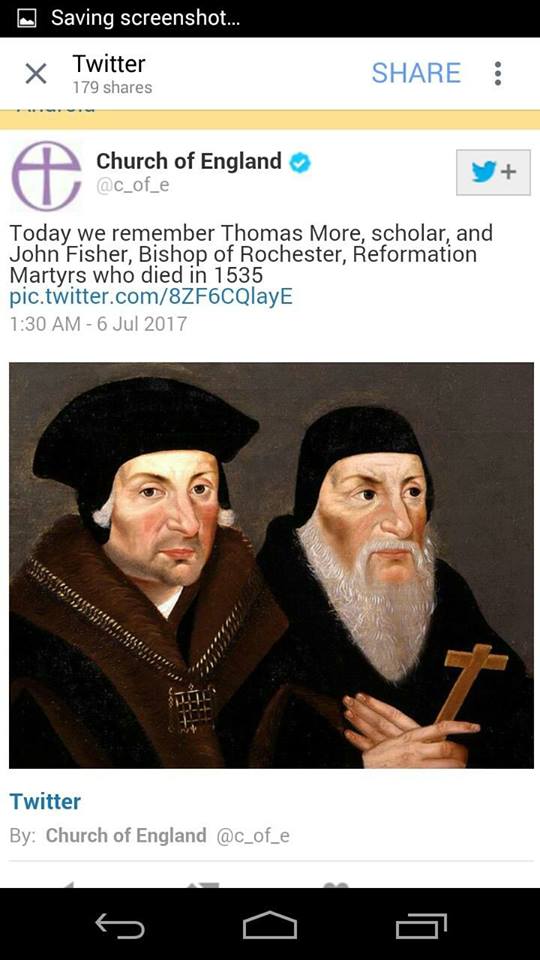
Cardinal Newman famously said that “…to go deep into history is to cease to be Protestant”. I couldn’t help but think of this quotation when a friend of mine sent me a screenshot of the Church of England Twitter account, remembering the “Reformation Martyrs” St. Thomas More and St. John Fisher. While I can appreciate the ecumenical good-will which no doubt motivated the tweet, the history of these two men renders this tweet exceptionally odd.
Both Sir Thomas More and Bishop John Fisher were Catholics who were executed by King Henry VIII. They were killed because they opposed the King’s divorce of Catherine of Aragon, his marriage to Anne Boleyn and the break from Rome which this remarriage necessitated. It is therefore more than a little strange for the Church of England to hold in high regard two men who shed their blood in opposing the creation of their own institution!
On a personal note, when I lived in London, the gym which I attended was very close to the location of their execution on Tower Hill, so I would quite often pray the Divine Office on that martyrdom site.
It has been said that shortly before Bishop Fisher’s execution, he opened St. John’s Gospel and read the following:
“Eternal life is this: to know You, the only true God, and Him Whom You have sent, Jesus Christ. I have given You glory on earth by finishing the work You gave me to do. Do You now, Father, give me glory at Your side”
– John 17:3-5
After closing the book, the good bishop commented “There is enough learning in that to last me the rest of my life”. St. More and St. Fisher, pray for us.
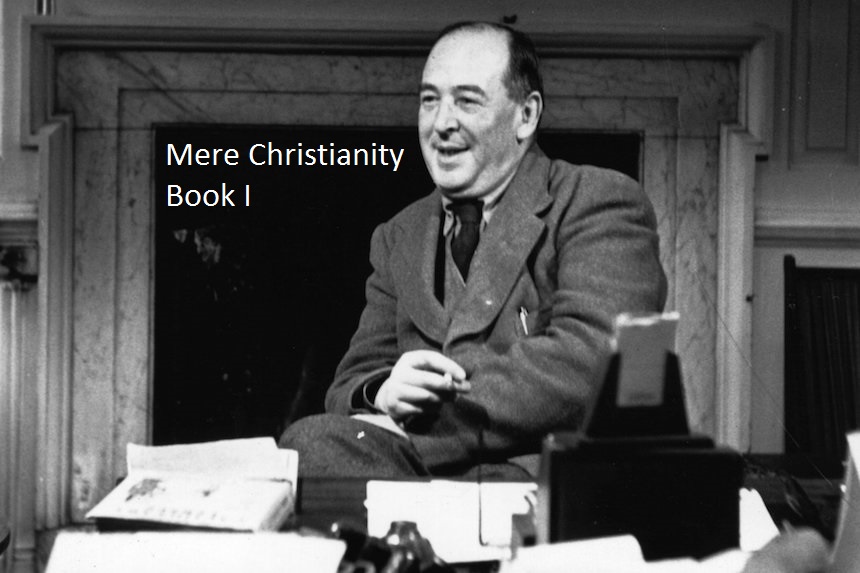
You can look at my more detailed notes, but this is an overview of the content of Book I of “Mere Christianity”…
Preface
Quotations
Mere Christianity
…I have thought that the best…service I could do for my unbelieving neighbours was to explain and defend the belief that has been common to nearly all Christians at all times…So far as I can judge…the book…did at least succeed in presenting an agreed, or common, or central, or ‘mere’ Christianity…it may possibly be of some help in silencing the view that, if we omit the disputed points, we shall have left only a vague and bloodless [Highest Common Factor]. The H.C.F. turns out to be something not only positive but pungent”
Omitted Topics
I should be very glad if people would not draw fanciful inferences from my silence on certain disputed matters…There are questions at issue between Christians to which I do not think we have been told the answer…you cannot even conclude, from my silence on disputed points, either that I think them important or that I think them unimportant. For this is itself one of the disputed points…I have a reluctance to say much about temptations to which I myself am not exposed…
The Roman Catholic beliefs on that subject are held not only with the ordinary fervour that attaches to all sincere religious belief, but…with…chivalrous sensibility that a man feels when the honour of his mother or his beloved is at stake…contrariwise…Protestant beliefs on this subject…it seems that the distinction between Creator and creature (however holy) is imperilled.
[Regarding contraception], I am not a woman nor even a married man, nor am I a priest. I did not think it my place to take a firm line about pains, dangers and expenses from which I am protected; having no pastoral office which obliged me to do so.
The name “Christian”
When a word ceases to be a term of description and becomes merely a term of praise, it no longer tells you facts about the object: it only tells you about the speaker’s attitude to that object… A gentleman, once it has been spiritualised and refined out of its old coarse, objective sense, means hardly more than a man whom the speaker likes
The Hall Analogy
It is more like a hall out of which doors open into several rooms…it is in the rooms, not in the hall, that there are fires and chairs and meals. The hall is a place to wait in, a place from which to try the various doors, not a place to live in…you must be asking which door is the true one; not which pleases you best by its paint and panelling…Are these doctrines true: Is holiness here?…be kind to those who have chosen different doors and to those who are still in the hall. If they are wrong they need your prayers all the more; and if they are your enemies, then you are under orders to pray for them. That is one of the rules common to the whole house
Questions
1. Why does Jack say that this book not help someone decide between two different denominations? Why did he write the book in this way?
2. Was it a good idea to leave out controversial topics? Why does he say he does this? Do you think this hampers the book?
3. How would you define “Christian”? How does Jack define it? Do you think this is a sufficient definition?
4. Do you find Jack’s “Hall and rooms” analogy helpful when talking about different denominations? What advice does he give for interacting with Christians of other denominations? What do you disagree with and what advice would you add?
These are my notes from reading through “Mere Christianity” with a local San Diego book club.
Notes & Quotes
1. The Moral Law points to something beyond the material universe
“…in the Moral Law somebody or something from beyond the material universe…[is] getting at us”
2. Some readers might complain that Lewis tricked them
“…that I had been carefully wrapping up to looking like philosophy what turns out to be one more ‘religious jaw’…but if it turns out to be only religion…the world has tried that and you cannot put the clock back”
(a) Sometimes you have to go back to go forward
“…progress means getting nearer to the place where you want to be. And if you have taken a wrong turning, then to go forward does not get you any nearer…it is pretty plain that humanity has been making some big mistake”
(b) We have not yet reached “religion”
“We have not yet got as far as the God of any actual religion… We have only got as far as a Somebody or Something behind the Moral Law…“
(i) We are trying to discover more about this Something behind the Moral Law from the universe. From this, we see the Being is…
(A) An Artist
“…we should have to conclude that He was a great artist (for the universe is a very beautiful place)…”
(B) Dangerous
“…but also that He is quite merciless and no friend to man (for the universe is a very dangerous and terrifying place)”
(ii) We are also trying to discover more about this Being from the Moral Law itself.
(A) The Being cares about Right and Wrong
“…the Being behind the universe is intensely interested in right conduct…”
(B) We cannot yet call this being forgiving
“The Moral Law does not give us any grounds for thinking that God is ‘good’ in the sense of being indulgent, or soft, or sympathetic. There is nothing indulgent about the Moral Law. It is as hard as nails… if there does exist an absolute goodness it must hate most of what we do”
(C) He’s not a tame lion
“God is the only comfort, He is also the supreme terror: the thing we most need and thing we most want to hide from”
(c) Christianity doesn’t make sense until you understand the questions it attempts to answer
“Christianity tells people to repent and promises them forgiveness. It there has nothing…to say to people who do not know they have done anything to repent of and who do not feel that they need any forgiveness…. When you know you are sick, you will listen to the doctor”
Discussion Questions
1. Given what you’ve learned in Book I, what can you say to friends and family to make the case for Christianity? What illusions can keep us from recognizing the truth of this book?
2. Why does a God behind the Moral Law both attract and terrify us?
3. How does the Moral Law make sense within the context Christianity specifically?
 As I was driving in to work today, I was listening to Episode 26 of Trending with Don and Timmerie.
 Cardinal Newman famously said that
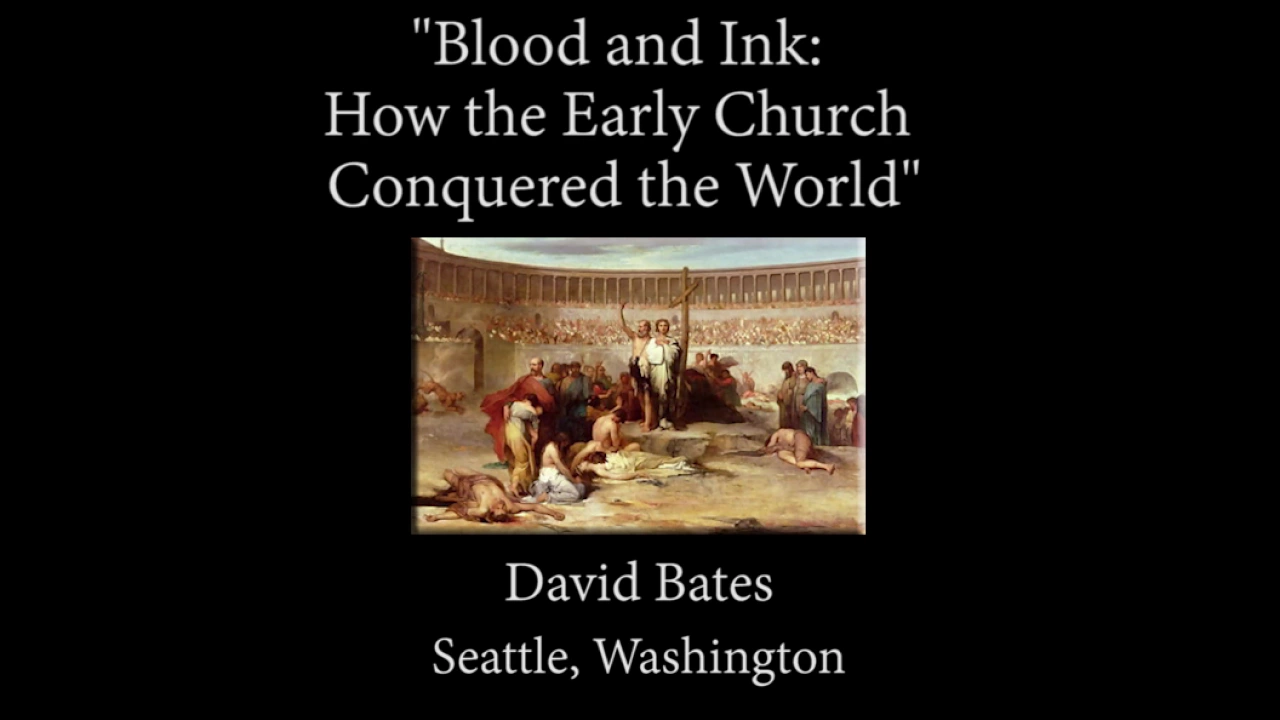 My friend David uploaded the audio of one my talks last year onto YouTube, “Blood & Ink: How the Early Church conquered the World”: