One of the first things which struck me about the Qur’an the first time I read it was how it can suddenly and jarringly jump to a completely different scene, and even change who is speaking. For example, the following verse is clearly Allah speaking…
That is Paradise, which We will grant to whoever is devout among Our servants – Quran 19.63
…and then suddenly and without warning we now shift to the angels speaking as a group…
We only descend by the command of your Lord. To Him belongs whatever is before us, and whatever is behind us, and everything in between. And your Lord is never forgetful… – Quran 19.64
I’ve often been told that the Torah and the Injil were only for the Jews. However, two problems:
The Qur’an never explicitly tells the Jews to follow the Injil, only the Christians
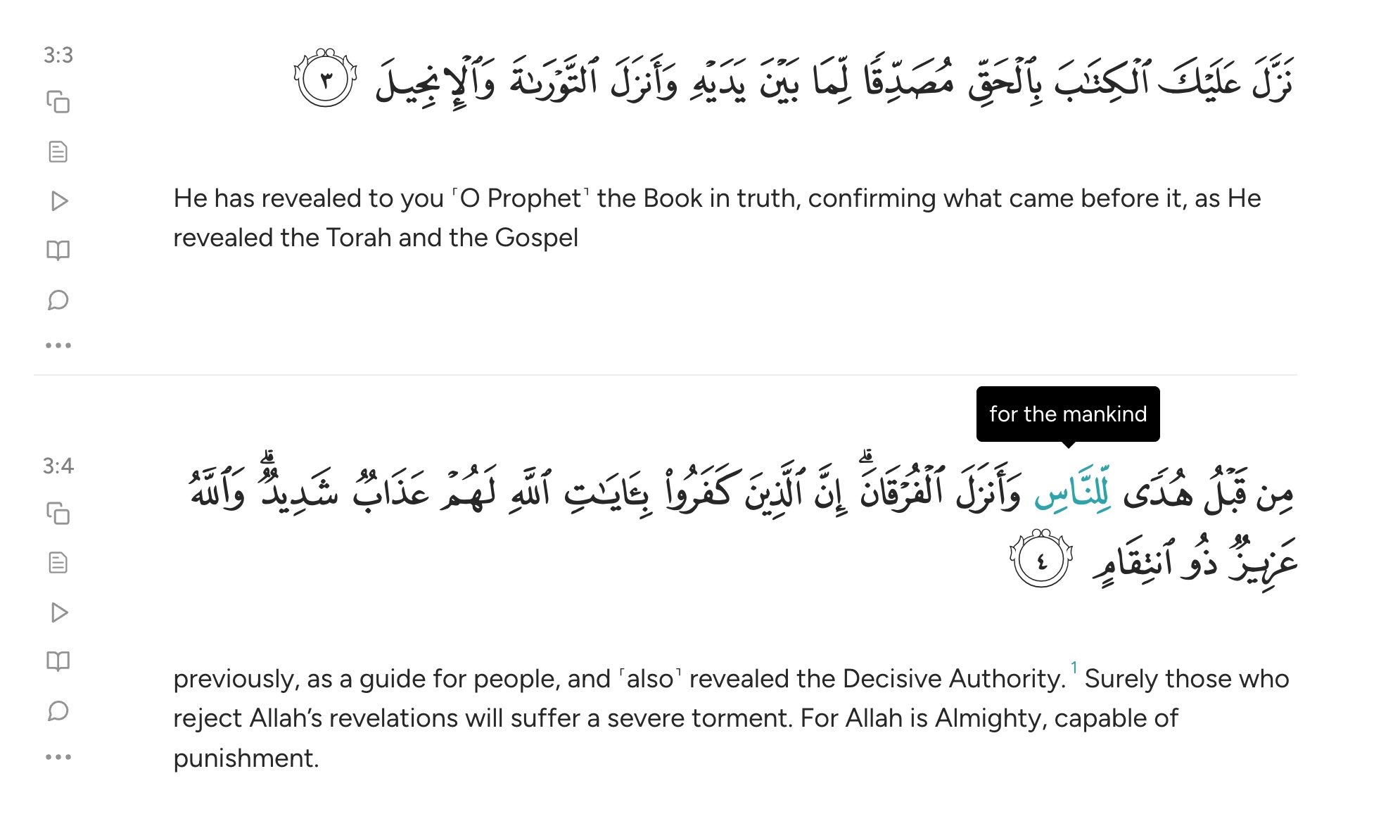
The Qur’an actually describes both as “guidance for mankind”, even if the translations often try to obscure this:
The Pickthall translation doesn’t hide it:
He hath revealed unto thee (Muhammad) the Scripture with truth, confirming that which was (revealed) before it, even as He revealed the Torah and the Gospel. Aforetime, for a guidance to mankind; and hath revealed the Criterion (of right and wrong). Lo! those who disbelieve the revelations of Allah, theirs will be a heavy doom. Allah is Mighty, Able to Requite (the wrong). – Qur’an 3:3
Three times the Qur’an says what someone should do if he doubts the Qur’an… consult those who have knowledge of the earlier scriptures:
“If you ˹O Prophet˺ are in doubt about ˹these stories˺ that We have revealed to you, then ask those who read the Scripture before you. The truth has certainly come to you from your Lord, so do not be one of those who doubt.” – Qur’an 10:94
“We did not send ˹messengers˺ before you ˹O Prophet˺ except mere men inspired by Us. If you ˹polytheists˺ do not know ˹this already˺, then ask those who have knowledge ˹of the Scriptures˺.” – Qur’an 21:7
“If you ˹O Prophet˺ are in doubt about ˹these stories˺ that We have revealed to you, then ask those who read the Scripture before you. The truth has certainly come to you from your Lord, so do not be one of those who doubt…” – Qur’an 16:43
John Fontain recently debated David Wood on the Islamic Dilemma, which points out that the Qu’ran both affirms the Torah and Gospel while contradicting them.
John has a rather different strategy from other Muslim apologists by positing that there was an Islamic Torah and Islamic Gospel present at the time of Muhammad. He claims these are the documents the Qur’an refers to and confirms.
At one point in the debate, John asked David Wood for proof that the documents in the Hejaz were today’s Torah and four-fold Gospel, rather than John’s hypothetical documents. Obviously it’s much easier to do this at leisure and when one isn’t in the hot seat, here’s the answer I would have given…
John, there are lots of things I can’t prove. For example, I can’t prove that there isn’t a small teapot orbiting the sun… but that doesn’t mean I should expect one to be there!
While it is technically possible that unique documents might have been present in Mecca and Medina, I can say for certain that there is no proof of such documents existing prior to the coming of Muhammad. Consider the timeline for a moment. It means that, for six hundred years in the case of the Gospel and for a couple of thousand years in the case of the Torah, there is no evidence of such documents existing. We have no manuscripts of these Islamic works and no fragments either. Not only that, nobody references them, neither the People of the Book nor their enemies. Don’t you not find that strange? If the Qur’an is true and Allah promised to make the true believers of Jesus uppermost from the days of his ministry until the Day of Resurrection, how is possible that Isa’s message, Apostles, and Scripture left no trace in history?
In Early Christianity there was no military power to crush dissenters and there was no central political power such as Caliph Uthman to enforce textual uniformity. Documents were shared by Christians throughout the world in an uncontrolled fashion, yet we find nothing like an Islamic Gospel or Islamic Torah. We also know about the disputes and heresies in Early Christianity (Docetism, Marcionism, Nestoriamism, Modalism etc), yet we find nothing that looks like Islam.
Despite this absence of evidence, you John could provide us with the much-needed evidence to substantiate your extraordinary claim that there was an Islamic Torah and an Islamic Gospel present in the Hejaz… just show it to us! If these scriptures were in the possession of the Muslims, they would have preserved them, right? Surely it would have been in their interest to preserve them! Firstly, these were the words of Allah! Secondly, these works would have provided additional information about the earlier prophets. Thirdly, these documents would have contained the detailed prophecies about the coming of Muhammad. And finally, they would substantiate the Qur’an’s argument for its divine origin by showing how the Qur’an truly does confirm the earlier scriptures!
But there’s a problem, isn’t there? You can’t show us these documents because you don’t have them! There is an additional unfortunate consequence to this… If your theory is true, it is Muhammad-believing Muslims who last had custody of the uncorrupted earlier scriptures, yet they seem to have inexplicably my lost them! So, even if you can explain how these documents survived in secret for thousands of years and then mysteriously turned up in the 7th Century Hejaz, you also have to explain why the Muslims failed to preserve them and also why we don’t find any early Islamic scholars lamenting the fact that is was Muhammad’s immediate followers who lost the best possible evidence to confirm the claims of Islam.
I would suggest that it’s more logical to conclude that your theory is incorrect and your Islamic Torah and Gospel never existed.