One of the first things which struck me about the Qur’an the first time I read it was how it can suddenly and jarringly jump to a completely different scene,
I’ve often been told that the Torah and the Injil were only for the Jews. However, two problems: The Pickthall translation doesn’t hide it: He hath revealed unto thee (Muhammad)
John Fontain recently debated David Wood on the Islamic Dilemma, which points out that the Qu’ran both affirms the Torah and Gospel while contradicting them. John has a rather different
Those who attempt to say that the Qur’an teaches the corruption of the earlier scriptures, often appeal to Qur’an 5:48, but this argument turns on the translation of the word
I’m reading through the Qu’ran one last time this year and wanted to follow along with a Tafsir. I discovered Quran Garden which was just the sort of thing I
The Qur’an claims that if it were not from God, there would be many contradictions in it. However, there is one Qur’anic verse which presents an inherent contradiction! In chapter
The sun sets in muddy spring (18:86) Semen comes from between backbone & ribs (86:6-7) Stars are missiles to shoot devils (67:5) If a fly lands in your drink, one
The Qur’an speaks about Allah helping the followers of Jesus and keeping them “uppermost”, but this presents a dilemma since, historically, this has to refer to Trinitarian Christians… which is
I see Belle Liu posing this challenge a lot recently. She asks her Muslim interlocutor to read Qur’an 17:101 which it says “We surely gave Moses nine clear signs. ˹You, O Prophet, can˺ ask the Children of Israel”. She then asks them to resolve the problem – the Qur’an says that there were nine signs in the Qur’an, yet the Torah read by the Jews says that there were ten.
I have yet to see any substantive response to this challenge. If anyone comes across one (or has a solution) please leave a comment.
As an aside, I do really like the way Belle approaches this kind of evangelism, pointing out the differences in the Torah and then asking why the details are different – scribal errors, political reasons, or an attempt to hide a prophecy of Muhammad. Unfortunately for the Muslim position, there are far too many big differences for them to be scribal errors and many of the differences seem pretty innocuous. This therefore points to the Qur’an’s author just being misremembering a story or pulling from later derivative works like midrash or sermons.
Claim #1: “Years before the advent of Muhammad, the Jews of Medina used to boast about the coming of an unlearned prophet in Arabia… Prophet Muhammad’s attributes and detailed description were in the Torah.”
Claim #2: “But when Prophet Muhammad was sent, just as they had asked, they were the first to reject him… Because the new prophet threatened their governing authority and the clergy’s power… Corrupt clergy distorted the Torah and the Gospel by adding their own words to them while omitting God’s”
If the Jews of Medina in the 7th Century were publicly expecting an unlearned prophet from Arabia then that means Muhammad’s detailed description should have still been in the Torah at the time.
How then would textual corruptions by Jews of Medina manage to change EVERY Torah in the world? In particular, how would it change the Dead Sea Scrolls which were hidden 10 centuries earlier and would remain undiscovered until 1946?
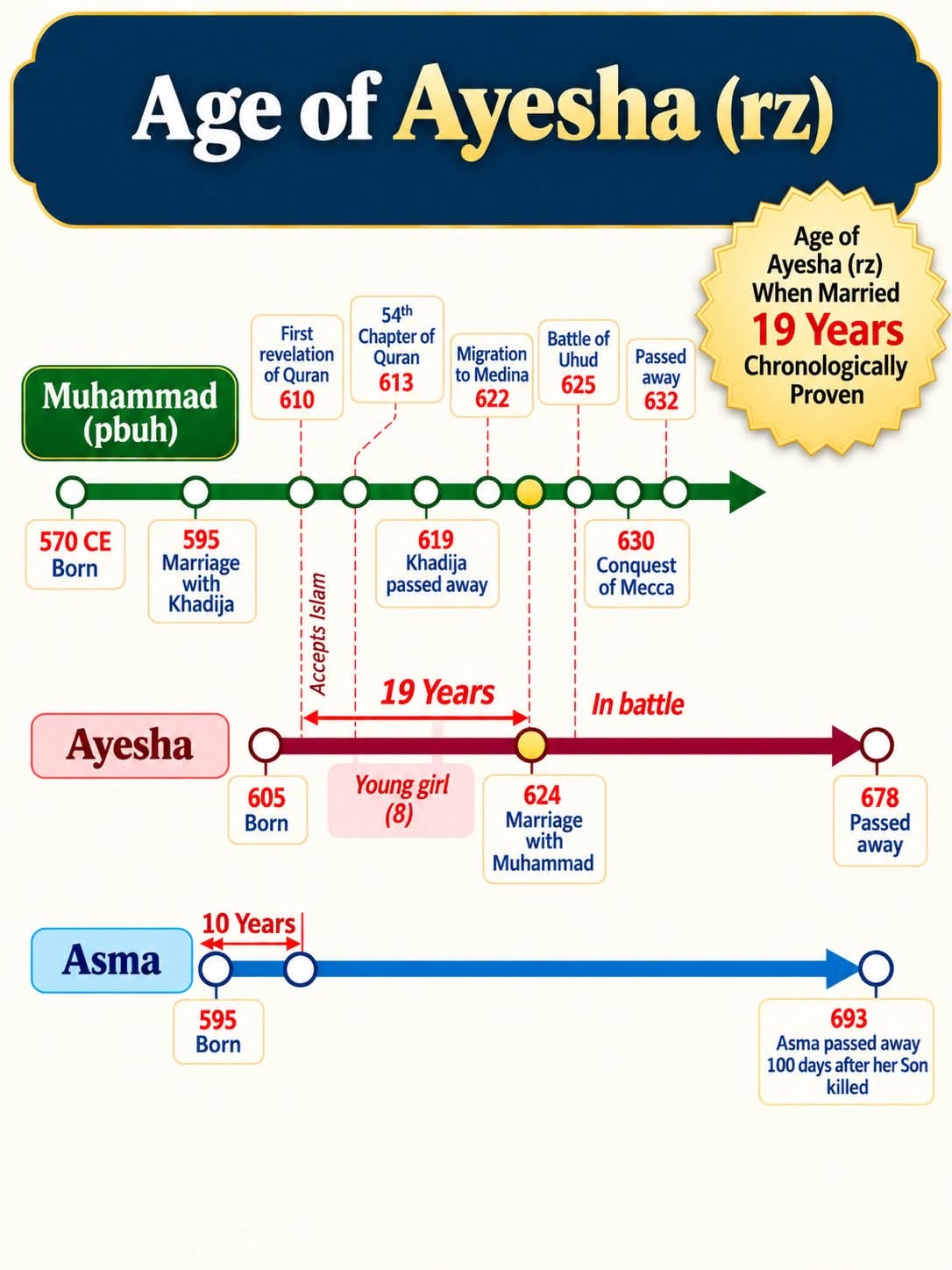
Here’s the argument I’ve sometimes seen made by Muslims that Aisha was not, in fact, nine when Muhammad slept with her.
The Argument
Premise 1: Asma died in 73 AH at the age of 100
Premise 2: Asma was ten years older than Aisha
Conclusion: Therefore, at the Hijrah, Asma would have been roughly 27 years old, making Aisha approximately 17, meaning she would have been 18 or 19 when she began cohabiting with Muhammad which took place shortly afterwards.
The Problem
The problem with this argument is that neither of the premisses trace back to Asma herself. This is contrasted with the sahih hadith which provide chains saying Aisha was nine all the way back to Aisha herself. This is why the classical Sunni position overwhelmingly was that she really was nine and the older-age interpretation is a much more recent minority position.
Premise 1: “Asma died at 100 in 73 AH”
This claim has relatively strong traditional support: she is reported to have died in 73 AH, and a report transmitted through her son Urwah ibn al-Zubayr says that she had reached 100 years, meaning the information ultimately comes from someone who personally knew Asma.
The earliest surviving written source preserving this isnad is Abu Zurah al-Dimashqi, about 208 years after Asma’s death, although the chain does purport to preserve Urwah’s earlier testimony.
The wording “reached 100 years” certainly sounds like a specific age, but it doesn’t tell us whether ʿUrwah meant exactly 100 years or was giving an approximate figure such as “about 100.”
Premise 2: “Asma was ten years older than Aisha”
The important source for this claim is Abd al-Rahman ibn Abi al-Zinad(Person A), who was born around 100 AH, approximately 27 years after Asma is meant to have died so he obviously could not have personally obtained the information from her.
However, Abd al-Rahman’s statement is transmitted by al-Asmai(Person B) and later recorded by Ibn Asakir(Person C) who died in 571 AH, about 498 years after Asma’s death. The Ibn Askair chain of narration (“isnad”) isn’t graded and that its authenticity relative to the Aisha-age traditions is therefore uncertain.
Event
Date
Time since Asma’s death (73 AH)
Asma dies
73 AH
Ibn Abi al-Zinad (Person A) born
~100 AH
~27 years
Ibn Abi al-Zinad (Persona A) dies
174 AH
101 years
al-Asmai dies (Person B)
216 AH
143 years
Ibn Asakir dies (Person C)
571 AH
498 years
There is also an important wrinkle: another transmission preserved by Ibn Abd al-Barr (Person D) who dies in 463 AH has the wording:
“Asma was ten years or so older than Aisha”
This shows the exact ten-year figure isn’t completely uniform in the material reporting on Ibn Abi al-Zinad (Person A).
What are the consequences?
My guess is that a lot of Muslims would prefer to believe Aisha was older because they don’t like the idea of their prophet (and best example for mankind) sleeping with a nine-year-old. This is why they choose the chronology which is less well attested.
Unfortunately, it seems to me that the consequence of adopting this position is that it severely undermined the entire hadith system which makes up a substantial part of what makes Islam what it is. The entire methodology then has to be questioned.
I saw someone post a variant of this on Facebook and thought it was great so copied-and-pasted it here (and made few edits):
1. Revelation and initial transmission (AD 610–632)
Revelations were primarily oral, memorized by companions (huffaz), and written fragmentarily on materials such as palm stalks, bones, leather, and stones by scribes (including Zayd ibn Thabit).
There was no single complete codex existed during Muhammad’s lifetime. The text circulated in oral form with written supports, and some reports indicate it was expected to remain open to further revelation until his death.
2. First compilation under Abu Bakr (AD ~632–634)
After losses of memorizers at the Battle of Yamama, Abu Bakr commissioned Zayd ibn Thabit to collect the revelations from written fragments and verified oral recitations (requiring witnesses for each passage).
This produced the first collected sheets (suhuf), kept by Abu Bakr, then Umar, then Hafsa. It was not yet a fully standardized public codex.
3. Uthmanic standardization (AD ~650)
Due to regional differences in recitation as Islam expanded, Uthman ordered a committee (led by Zayd, with Quraysh scribes) to produce an official version based on Hafsa’s collection, in the Quraysh dialect.
Official copies were sent to major centers (Medina, Kufa, Basra, Damascus, etc.). Non-conforming personal or regional codices were ordered destroyed to prevent division.
This fixed the rasm (consonantal skeleton/undotted skeleton text). It became the dominant archetype. Reports of companion codices (e.g., Ibn Mas’ud, Ubayy ibn Ka’b) indicate differences in surah order, occasional wording, and (in some traditions) inclusion/exclusion of certain short surahs or material later treated as non-Quranic (e.g., qunut prayers). These were largely superseded.
4. Early manuscript evidence of variants (mid-to-late 7th century)
The Birmingham manuscript (radiocarbon dated roughly 568–645 CE) closely matches the later standard text.
The Sana’a palimpsest (lower text, parchment dated primarily to the 7th century, with writing likely mid-to-late 7th century) is the main surviving non-Uthmanic tradition. Its lower (erased) layer shows:
Different surah sequencing (not matching the standard order or exactly the reported companion orders).
Additions, omissions, or substitutions of words/phrases (synonyms, different roots, extra clarifying phrases, or shorter formulations).
Occasional verse-order swaps or missing verses (one notable omission in 9:85 attributed by scholars to scribal parablepsis/eye-skip).
Orthographic differences (e.g., defective spelling of long vowels).
Variants are more numerous than later literary reports of companion differences but rarely alter core meaning. The upper (later) text is essentially standard Uthmanic. This indicates a period of textual fluidity before the Uthmanic rasm fully dominated; non-standard copies became obsolete and were sometimes recycled.
5. Orthographic and scribal evolution (late 7th–10th centuries)
Early rasm lacked dots distinguishing similar consonants (b/t/th/n/y, etc.) and lacked short-vowel marks. Readers relied on oral knowledge.
Diacritical dots (i’jam/nuqat) were introduced or systematized around the late 7th century (traditionally linked to Abu al-Aswad al-Du’ali, d. 688 CE) and refined under Umayyad governors such as al-Hajjaj.
Vowel marks (tashkil/harakat) followed, initially as colored dots, then standardized into the familiar fatha/damma/kasra system (further developed by figures such as al-Khalil).
Additional signs for pauses, elongation, and verse division were added over time. Script styles evolved from early Hijazi to Kufic and later styles. These changes made the text more accessible to non-native Arabic speakers and reduced ambiguity without altering the underlying rasm.
6. Formalization of the qira’at (readings) (8th–10th centuries and later)
Multiple oral reading traditions (tracing to companions and the reported “seven ahruf” modes) continued alongside the fixed rasm.
Regional schools developed in Medina, Mecca, Kufa, Basra, and Damascus.
Ibn Mujahid (d. 936 CE) selected and documented seven canonical readings (later expanded by consensus to ten). Criteria included conformity to the Uthmanic rasm, Arabic grammar, and sound chains of transmission.
Differences among the qira’at (and their narrations, e.g., Hafs ‘an ‘Asim vs. Warsh ‘an Nafi’) are mostly:
Phonetic/pronunciation (vowel length/madd, imalah/inclination of vowels, hamza handling, letter qualities).
Grammatical (active vs. passive verbs, singular vs. plural, case endings).
Occasional lexical (different but related word forms or particles).
Concrete examples between Hafs (dominant today) and Warsh include: māliki vs. maliki (“Owner/Master” vs. “King”) in 1:4; wa-waṣṣā vs. wa-awṣā in 2:132; active/passive or other form shifts in places such as 3:146; slight differences in verse counting/numbering conventions (not missing content). Estimates of places with word-form differences run to several dozen (commonly cited around 50+ for major pairs), with the large majority not changing core meaning. All accepted readings are considered authentic transmissions compatible with the rasm.
7. Medieval to early modern period
Full pointed and vocalized manuscripts became standard. Scholarly literature catalogued and transmitted the qira’at rigorously.
Peripheral or irregular (shadhdh) readings continued to be discussed but were excluded from canonical use.
The text remained manuscript-based for centuries, with high fidelity in copying once the Uthmanic tradition dominated.
8. Printing and modern standardization (19th–20th centuries to present)
The 1924 Cairo edition (al-Azhar/Egyptian government) produced a widely influential standardized printed Quran based on the Hafs ‘an ‘Asim reading, with specific orthography, verse numbering (Kufan system), and symbols. It became the de facto global standard.
Hafs now accounts for the vast majority (~95%) of printed and recited Qurans worldwide. Warsh (and a few others) remain in active use especially in North and West Africa, with corresponding printed editions.
Some modern mushafs make minor orthographic adjustments for contemporary readability while aiming to respect the traditional rasm. Digital and printed dissemination has further fixed one dominant presentation, though the other canonical readings continue.
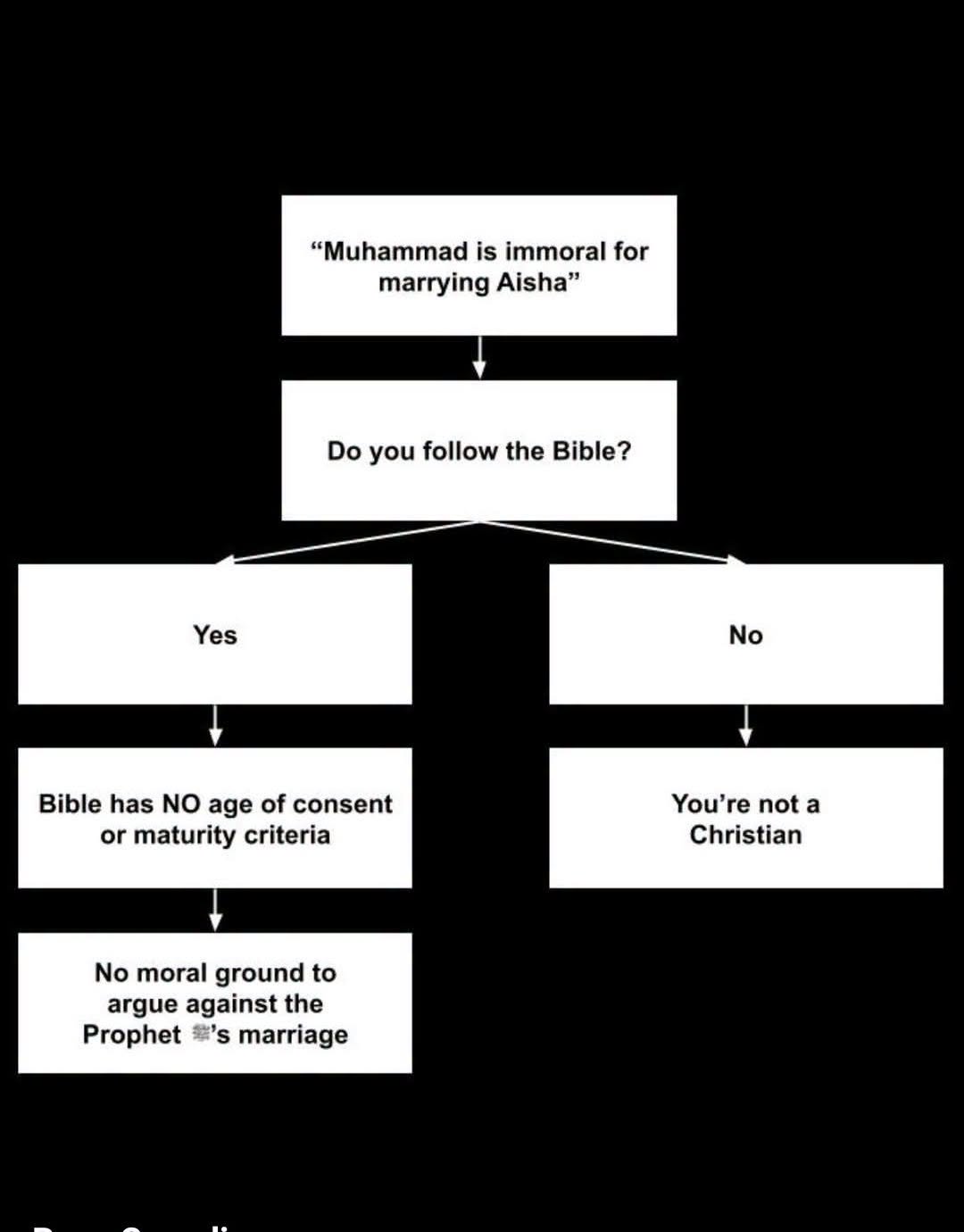
You follow the Bible, therefore you can’t criticize Muhammad.
You don’t follow the Bible, therefore you’re not a Christian.
Those are not the only possibilities. A Christian can follow the Bible and not reach your conclusion, particularly if they don’t hold to Sola Scriptura. For example, they can include natural moral reasoning and historical evidence to evaluate any historical figure.
2. Non Sequitur
Even if the Bible never explicitly states an “age of consent,” it does not follow that every marriage at every age is therefore morally acceptable. That’s like saying: “The Bible never gives a speed limit, therefore reckless driving cannot be immoral.”
3. Argument from Silence
The argument assumes: “Because Scripture doesn’t explicitly prohibit X, Scripture approves X.” but silence is not approval The Bible never mentions heroin, identity theft, or child labor either, yet Christians can still conclude these are wrong by applying biblical principles.
4. Category Error
The Bible is not primarily writing a modern civil law code with every possible regulation. Christian morality applies Christian principles to situations the Bible never explicitly names.
5. False Equivalence
The comparison ignores a major theological difference – Christians do not believe every action recorded in Scripture is morally exemplary. The Bible records David’s adultery, Solomon’s polygamy, Jephthah’s vow, and many other sinful actions without approving them.
By contrast, many Muslims regard Muhammad as the perfect moral example for all generations (Qur’an 33:21). Therefore, questions about Muhammad’s actions carry a different theological significance than merely asking whether something appears in biblical history.
6. The Historical Question Isn’t Addressed
The chart never actually answers the criticism: Was consummating a marriage with Aisha when she was very young morally right?
Soon I should be able to say “I’m in better shape in my forties than at any other time!” This past year I lost 25.5 lbs and finally have my blood pressure consistently in the “Normal” range.
In case you’re interested, here are the things I’ve been doing…
Weight
45 minute workout with my brother-in-law twice a week:
2-3 mile run, core, and weights
Swim 600 meters, interval running, core, and weights
No eating after dinner until breakfast – no pre-bed snack or midnight eating.
Healthy snacks
Waiting until really hungry to eat
Protein for breakfast before having any caffeine
Ground flax seeds
30 push-ups each day
Cold shower
Blood Pressure
7 minutes of exercise after breakfast: wall sits, planks, calf raises, squats, jacks, arm swings, and slow breathing